Roland Michell–Maud Bailey relationship
PossessionRoland Michell and Maud Bailey’s relationship develops through a shared investigation into whether Randolph Henry Ash and Christabel LaMotte corresponded. What begins as Roland’s guarded approach to a scholar with access to LaMotte materials becomes a collaboration shaped by their different scholarly instincts: he wants to discover what happened, while Maud has tended to value LaMotte’s language over the biographical details of her life. Their work connects personal trust to archival access, and turns an academic question into a consequential encounter with the past.
Identity and Initial Encounter
In 1986, Roland is a twenty-nine-year-old scholar with a doctorate on the presentation of historical evidence in Ash’s poems. He works part-time in James Blackadder’s Ash research operation at the British Museum, where his academic prospects and finances are precarious. His approach to Maud is therefore not an established collaboration between secure colleagues: he is seeking help from a researcher whose knowledge and access might advance a discovery he has not yet disclosed openly.
Roland tells Maud that he is researching Ash and has learned that Ash may have corresponded with LaMotte. He offers her his transcript of Crabb Robinson’s account of a breakfast party where Ash first met LaMotte. The account records a discussion of poetry and spiritual manifestations, including Ash’s claim that historical imagination required a kind of poetic belief in the mental universe of a writer’s characters. Maud’s expertise is relevant not only because the transcript names LaMotte, but because the encounter raises questions about how a scholar can infer a life from incomplete records.
Trust, Secrecy, and the Letters
At first Roland does not show Maud the photocopies of Ash’s letters. He has taken the papers and kept them to himself, and he recognizes that revealing them may conflict with Maud’s rigorous sense of justice. Yet his need to learn more about LaMotte leads him to take the risk. He asks about Blanche Glover’s reported prowler; Maud explains that Leonora Stern has tentatively identified him as Thomas Hearst, a young man who played the oboe for the women and later married someone else. She also notes that Blanche may have invented the prowling, underscoring how uncertain the historical record remains.
After reading the letters, Maud sees how much their dates could alter received accounts. She recognizes that a story could be built from them, while also acknowledging that the evidence may not warrant certainty. The discovery, she says, could change LaMotte scholarship and understandings of the Melusina theme; Roland adds that it could also change Ash scholarship, since these letters differ from the correct, distant quality he associates with Ash’s other correspondence. Their exchange establishes a shared intellectual stake without erasing their different areas of expertise.
Maud will not let Roland photocopy Blanche’s journal because its spine cannot withstand the process, but she permits him to copy it by hand and continue searching through the boxes. Her offer is a practical act of trust: she does not grant unrestricted access, but makes further research possible while protecting a fragile source. She also invites him to stay in a guest room. Roland declines because he has a day-return ticket and cannot afford the extra expense, a reminder that their collaboration unfolds amid his insecure circumstances rather than outside them.
From Research to Personal Attention
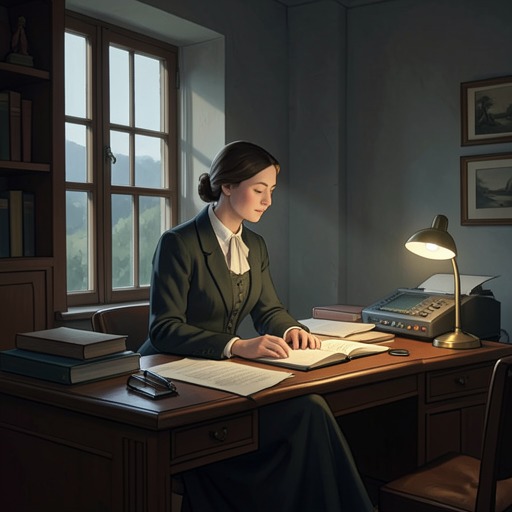
Their shared interest becomes more personal during an evening at Maud’s home. She makes up a proper bed for Roland on the high white divan, with laundered sheets, pillows, a down quilt, and a new toothbrush. The hospitality is concrete and considered, extending the trust already expressed in her willingness to let him work among the papers. Their conversation returns to Ash’s poetry and to the question of what survives education: Roland recalls his mother’s attachment to Ash’s poems, and Maud responds that this is precisely what matters.
Maud admits that she has rarely felt curiosity about LaMotte’s life and has been uneasy about the idea of places and objects LaMotte might have touched; she has cared more about the language and what went on in LaMotte’s mind. Blanche’s account of a prowler had likewise seemed beside the point. Roland’s arrival changes the emphasis: he has stirred Maud’s curiosity about the biographical traces she had set aside. This is not a simple conversion from textual scholarship to biography. Rather, their partnership makes the distinction newly unstable, as the letters’ language, dates, and circumstances begin to demand attention together.
Roland then brings out the envelope of letters he has carried with him. Maud recognizes their importance in the altered terms of their investigation: the documents are not merely evidence to be assessed at a distance, but writing that makes the people behind the archive newly present to the researchers. The scene consolidates the relationship’s movement from cautious professional exchange toward shared discovery, while leaving the risks of Roland’s private possession of the papers unresolved.
Scholarly and Narrative Significance
The relationship takes shape against a larger academic contest. Roland’s part-time position belongs to an Ash project funded in part by a foundation of which Mortimer Cropper is a trustee; Blackadder suspects that Cropper is maneuvering to acquire manuscripts held outside the British Museum. When an intermediary later asks Blackadder to value an unspecified group of roughly fifty long Ash letters, Blackadder connects the inquiry to Roland’s visits to Maud in Lincoln. Their research is therefore entangled with questions of who can access, value, and control literary documents, even before the letters’ full significance is established.
The novel also places their collaboration beside earlier arguments about scholarly judgment and interpretation. Blackadder’s academic formation includes a formative occasion when he recognized Ash’s authorship of several poems but remained silent as Ash was misidentified. Maud and Roland’s work proceeds in the shadow of such failures: documents can be misread, withheld, or made to serve a scholar’s interests, and a plausible narrative is not automatically a proven one. Their alliance depends on investigating those uncertainties together rather than treating the archive as transparent.
That method has an earlier counterpart in Beatrice Nest’s research on Ellen Ash. Although she wished to write a dissertation on Ash’s poem Ask to Embla, Professor Bengtsson steered her toward editing Ellen’s journal, a safer and more manageable project. The episode shows how institutional limits shape what can be studied and how readily women’s writing may be approached through an approved editorial task. Against that background, Maud’s work with Roland does not merely recover a hidden correspondence: it makes the personal, intellectual, and material conditions of historical knowledge part of their shared inquiry.
Their exchanges are also illuminated by the nineteenth-century debate about spiritualism that appears in the records they read. At Crabb Robinson’s breakfast party, Ash demands experimental conviction for spiritual manifestations but says that historical imagination can make a poet so deeply inhabit another mind that he risks having no beliefs of his own. In a letter, Ash rejects planchette communications attributed to Samuel Taylor Coleridge and considers fraud, collective agitation, and weakening religious certainty as possible explanations for spiritualist enthusiasm. Later, his account of a séance describes him exposing the medium Hella Lees’s tricks, while Lees’s own account presents Ash as a skeptical visitor whose presence destabilizes the circle. Such competing documents reinforce the central difficulty shared by Roland and Maud: accounts are shaped by position, belief, and desire, so interpretation requires both imaginative attention and scrutiny.
The relationship’s early development consequently works on two levels. Roland and Maud investigate the historical connection between Ash and LaMotte, while their methods disclose what each has been reluctant to know: Roland must risk sharing what he has withheld, and Maud allows the life behind the writing to become a legitimate object of curiosity. Their collaboration gains force from that mutual adjustment, without making the surviving documents yield more certainty than they contain.