Christabel LaMotte–Blanche Glover relationship
PossessionThe relationship between Christabel LaMotte and Blanche Glover is a creative partnership and shared domestic life that gradually becomes unequal in its knowledge and intimacy. Blanche helps shape Christabel’s artistic world and cherishes a home in which the two women can live freely; when Christabel’s correspondence draws her into experiences she does not disclose, Blanche is left to watch the boundaries of their former closeness harden. Her journal preserves the emotional cost of that change, while also showing how strongly she continues to love and protect Christabel.
A Shared Home and Artistic Partnership
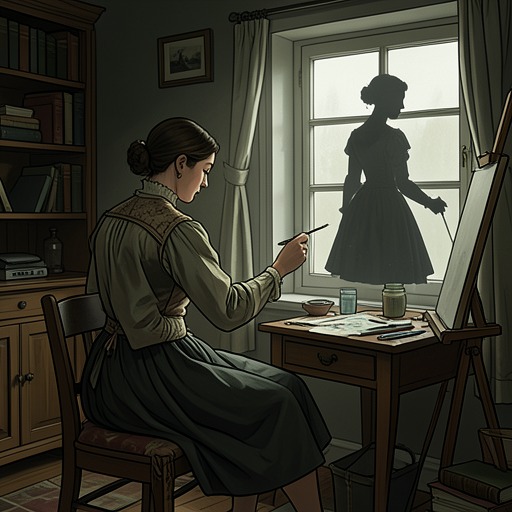
Christabel’s aunt Antoinette’s bequest gave her a modest independence in 1853, allowing her to establish a household in Richmond with Blanche, a young woman she had met at a lecture by Ruskin. Their arrangement offered more than shelter: it gave the two artists room to pursue their work and pleasures without a household authority forbidding or criticizing them. Blanche had artistic ambitions of her own. She painted large oil canvases, none of which survive, and made wood engravings that illustrated Christabel’s books and religious lyrics.
Blanche’s engraving work connected their practices directly. Her images appeared in Christabel’s Tales for Innocents, Tales Told in November, and Orisons, lending a visual form to Christabel’s writing. Blanche is also believed to have encouraged Christabel to undertake The Fairy Melusina, the ambitious retelling of a magical half-woman, half-snake figure. Their partnership thus included artistic influence as well as practical companionship: Blanche helped furnish the work by which Christabel was known, even when critical opinion of the epic was mixed and it later fell from view.
The Richmond Household
Blanche’s journal presents their home as a hard-won refuge. She contrasts its security with the life she might otherwise have expected: a marginal place in someone else’s drawing room or a servant’s garret. In Richmond, the women share meals, walks in the Park, music, and reading aloud from The Faerie Queene. These routines join ordinary domestic pleasures to the intellectual and artistic freedom neither takes for granted. Blanche imagines Richmond as Beulah, a place of peace, while the possibility that a wicked Fairy might envy them gives their happiness the delicate vulnerability of a fairy tale.
That domestic closeness is expressed through repeated, concrete acts of attention. Blanche observes the work of the household, including Liza’s cooking, and records their shared reading and music as part of a life made meaningful by its continuity. She also takes pride in the intimacy of their private conversation and in the small things the women once shared quietly. The household is not merely a setting for the relationship: it is the form their chosen life takes, a protected space in which companionship, creative work, and daily habit reinforce one another.
Correspondence and Growing Exclusion
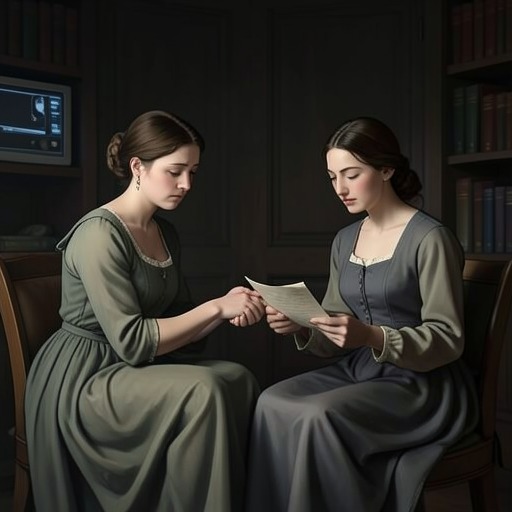
The change begins when Christabel receives a long letter that she smiles over, folds, and puts away without showing Blanche. Blanche does not know its author; she can only register the secrecy and worry that it signals. Later she believes Christabel is preparing a literary letter, while Christabel says she is hurrying to finish The Glass Coffin. Blanche suspects that the correspondence is taking time and attention away from poetry, and fears that its flattery is unnecessary to a woman who already knows her worth. Her concern for Christabel’s writing is inseparable from her concern about losing their former ease.
As letters continue to arrive, Blanche describes herself as excluded from knowledge that had once seemed naturally shared between them. She resents being treated as though she cannot see what is happening, but insists that she will not make claims on Christabel or forget the gratitude she feels for being rescued from the prospect of governess work. Her protest therefore contains opposing loyalties: she wants acknowledgment and frankness, yet fears that asking for either would turn affection into a demand. The correspondence becomes a boundary within the household, separating Christabel’s new experience from the life Blanche believed they shared.
Blanche gives that boundary a threatening, almost supernatural shape. She imagines a prowler circling their retreat, testing the shutters and trying the door; the old protection of mountain-ash berries and a horseshoe over the lintel becomes her imagined defense. Dog Tray reacts to the imagined intruder with raised hackles and snapping jaws. The images translate a private emotional disturbance into an invasion of domestic space: the home remains small and apparently safe, but its locks now suggest how frightening it would be to have its privacy forced.
Love, Anxiety, and the Limits of Reassurance
Blanche fears that an unseen observer has put an eye to a crack in their walls. Christabel laughs at the concern and says the observer cannot see what is essential between them, treating him as harmless and tame. Blanche cannot share that confidence. She asks how much Christabel has been writing; Christabel answers that she is learning a great deal and will have new matter to write about once she has learned it. Blanche’s worry is not only that Christabel writes less, but that the source of Christabel’s new knowledge lies outside the intimacy Blanche can access.
The two women try to preserve their bond through physical and verbal reassurance. Christabel kisses Blanche, calls her dear, and describes her as strong rather than foolish. Blanche responds that everyone is foolish and needs divine strength when weak. Christabel says that she has never felt divine presence so immediately as she does now, an answer that intensifies rather than settles Blanche’s unease. After Blanche goes upstairs to pray, Christabel finds her kneeling, raises her, and promises that they must never quarrel and that she will never give Blanche cause to doubt her. Blanche is sure Christabel means it; she also notices her agitation and tears. Their quiet return to one another is real, but the promise cannot erase the withheld correspondence or restore Blanche’s former certainty.
The Relationship’s Tragic Imbalance
The partnership is defined by a tension between genuine affection and unequal access. Blanche’s devotion appears in her care for Christabel’s work, her preservation of their shared routines in her journal, and her effort not to turn gratitude into a claim. Yet her self-restraint leaves her to interpret changes from outside: folded letters, concealed plans, and Christabel’s new experiences. Christabel’s reassurance is sincere, but Blanche’s account makes clear that sincerity alone cannot make their knowledge equal again.
The narrative gives the relationship a further historical weight through its outcome. Blanche drowns in the Thames in 1861; her death has a distressing effect on Christabel, who eventually returns to her family and lives with her sister Sophie for the rest of her life. After The Fairy Melusina, Christabel appears to write no more poetry and retreats increasingly into voluntary silence. The surviving account therefore places the women’s creative companionship before a lasting rupture: Blanche’s art and influence remain part of Christabel’s literary history, while the private life that once sustained their work ends in loss and withdrawal.