Christabel LaMotte’s post-childbirth frailty
PossessionChristabel LaMotte’s post-childbirth frailty is the bodily and social aftermath of a concealed pregnancy, rendered not as a settled explanation but as a crisis witnessed through uncertainty. When she returns to the home of Sabine de Kercoz and Raoul de Kercoz, she is markedly weakened and refuses to explain where she has been or what became of the child. Her insistence that she can stand and her repeated request that no one ask questions preserve her independence, yet leave her family unable to distinguish deliberate secrecy from distress.
The Unspoken Pregnancy
Before Christabel’s return, her pregnancy has become impossible to overlook and remains impossible to discuss. Sabine records that her cousin is visibly near the end of her pregnancy, while no one in the household dares bring the subject into the open. Raoul wants to tell Christabel that the child is welcome as family, regardless of its origins, and that they will care for it. Yet even he cannot speak: Christabel’s manner seems to prohibit the conversation, and he fears that raising it wrongly could cause her further distress. The practical matter of preparing for a child is displaced by elaborate conversation about subjects such as Morgan le Fay and Plotinus.
This silence is not simply an absence of information; it structures the household’s response. Raoul’s efforts to find a way to help meet a further obstacle when a nun responds brusquely to his account of Christabel’s refusal to speak. Sabine, meanwhile, has already recognized that writing about jealousy and bafflement can give those feelings a troubling solidity rather than dispel them. Her diary becomes an uneasy form of witnessing: she writes because the situation is strange and difficult to understand, even as she distrusts the act of recording it.
Return and Physical Weakness
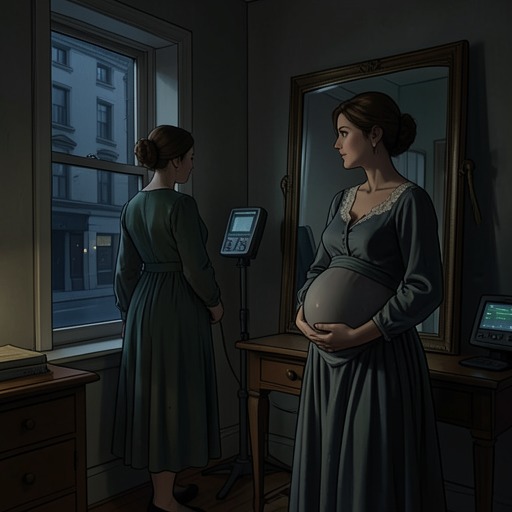
On May 8, while Sabine and Raoul are discussing the circumstances of Christabel’s disappearance, Christabel suddenly appears in the doorway. Her return, after a period during which the family has speculated about how she left, does not bring an account of her absence. She looks thin and weak, her clothes drawn in with a heavy belt, and her hair has been cut short. Sabine’s description makes the change in Christabel’s appearance evidence of a serious physical ordeal, while stopping short of identifying its full cause or course.
Raoul moves to embrace her, but Christabel raises a hand to stop him and says, “I am quite well, thank you. I can stand on my own feet.” With great care, she makes her way to the fire and sits down rather than allowing herself to be carried upstairs. She accepts wine, bread, and milk and eats and drinks eagerly, but this practical acceptance of care does not open a path to conversation. She tells the household not to ask questions, acknowledges that she has relied on their kindness, and says she will not do so for much longer.
The Family’s Uncertainty
Christabel’s condition is therefore visible, while its implications remain withheld. Sabine wonders whether Christabel expects to die in the household or has some plan she has not disclosed; she also wonders whether her cousin is mad or simply secretive. These are Sabine’s questions, not confirmed explanations. Her account shows how Christabel’s request for silence blocks ordinary expressions of concern and turns care into an uncomfortable mixture of pity and frustration.
The unanswered question of the child intensifies that uncertainty. Sabine and Raoul do not know whether the child is alive or dead, or whether it is a boy or a girl. Christabel’s silence prevents them from making even the most basic arrangements or offering reassurance. Gode reports that she has no fever and is not in decline, but is very weak. That observation provides a limited account of her immediate physical state; it does not reveal what happened during the disappearance or establish the child’s whereabouts.
What the Later History Establishes
Christabel’s own later account supplies facts unavailable to Sabine when she watches her return. Christabel explains that after parting from Randolph Henry Ash, she knew pregnancy was a likely consequence, though she lacked certain proof. She had arranged a place to go and enlisted her sister Sophie’s help. Their plan involved concealing the birth: the daughter was born in a convent in Brittany, carried to England, and raised by Sophie as her own. Sophie, Christabel says, loved and cared for the girl.
This later disclosure clarifies why the child was absent when Christabel returned, but it does not make Sabine’s original uncertainty unreal. The narrative first presents a household confronting a visibly weakened woman who will not speak, and only later supplies Christabel’s account of the decisions behind the concealment. The gap between observation and explanation is central to the state: her frailty is evident, while the family’s knowledge remains incomplete.
The concealment also belongs to a broader history of constrained choices. Blanche Glover’s account of their shared ideal describes an effort by independent women to live useful, fully human lives together, without relying on men or outside support. She concludes that their experiment could not be sustained, whether because the world opposed it too fiercely or because they lacked sufficient resources. Christabel’s pregnancy and her reliance on Sophie reveal the practical stakes of that vulnerability, although the available account does not reduce her choices to a single motive.
Kinship and Consequence
The later revelation also changes the meaning of the child’s hidden place in the family. Euan MacIntyre explains that children born outside marriage could not inherit at the time and that Victorian families sometimes placed them within legitimate households to secure their prospects. He observes that Maud Bailey, by then present among those discussing the discovery, is descended from both Randolph Henry Ash and Christabel LaMotte. Thus the child whose existence Sabine could not confirm becomes part of a family history whose consequences reach Maud and the scholarly investigation of her ancestry.
Christabel’s post-childbirth frailty occupies the interval before those facts become knowable. Her return allows her family to see that she is alive and physically weak, but not to learn what happened to her child or how she intends to proceed. The later account answers some of those questions without undoing the defining feature of the scene: care is offered, accepted in limited forms, and held apart from explanation by Christabel’s insistence on silence.