Victorian gender inequality
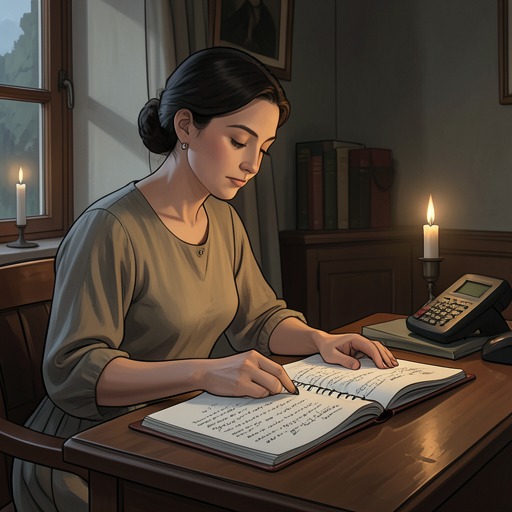
PossessionVictorian gender inequality is more than a historical backdrop in Possession: it determines who may study, earn a living, enter academic spaces, and be recognized as an author. The novel traces its effects across the lives of Christabel LaMotte and Blanche Glover, and links those Victorian constraints to later generations of women scholars and workers. Its central tension is between women’s intellectual and creative capacities and the social arrangements that confine, undervalue, or redirect them.
Education and Intellectual Authority
Christabel’s family history places her within a culture that valued learning but did not guarantee women an independent public life. Her father, Isidore LaMotte, was a serious historian and mythographer, while her mother’s firm religious faith shaped Christabel’s childhood. Christabel lived with her parents until 1853, when money left by her aunt Antoinette de Kercoz enabled her to establish a home in Richmond with Blanche Glover. That modest inheritance mattered: it gave Christabel a degree of independence that her own income and social position might not otherwise have secured.
Christabel’s correspondence with Randolph Henry Ash makes the exclusion of women from literary authority explicit. She describes the condescending praise commonly given to women writers and the assumption that certain subjects lie beyond their knowledge or proper scope. A male poet had judged her poems as merely pretty and acceptable as an occupation until she acquired more consequential responsibilities. Ash’s serious engagement with her language offered a rare alternative to that dismissal, but the correspondence also exposes how exceptional it was for a woman’s intellectual work to be treated as work in its own right.
The problem persisted beyond the Victorian period. Beatrice Nest wanted to write her doctoral dissertation on Ash’s Ask to Embla poems, but Professor Bengtsson steered her toward editing Ellen Ash’s journal, a project he considered modest, manageable, and suitable. The novel does not present this redirection as a question of ability: it shows how institutional expectations could determine which questions a woman was encouraged to ask, and which scholarly work counted as a viable route into academic employment.
Creative Work and Shared Independence
Christabel and Blanche tried to build an alternative to dependence through their shared household. They had met at a lecture by John Ruskin, where the dignity of handicraft and individual work helped shape their ideal of a life organized around useful activity, intellectual freedom, and artistic production. They hoped to combine small incomes from drawing lessons and publications with shared domestic work, making a living without relying on men or conventional marriage. Their project treated household labor not as separate from art, but as part of a deliberate, jointly sustained way of life.
The arrangement enabled substantial creative work. Blanche painted large canvases and made wood engravings for Christabel’s books, while Christabel wrote stories, religious lyrics, and the epic poem The Fairy Melusina. Blanche is believed to have encouraged Christabel to undertake that ambitious retelling of the tale of a magical half-woman, half-snake. Their partnership thus complicates the idea of the solitary author: Christabel’s literary production was supported by another woman’s artistic labor, even though that collaboration could be less visible than the published work it helped make possible.
Blanche’s account of the household’s failure identifies the material limits of their experiment without dismissing its purpose. In her final statement, she lists poverty, her refusal to return to governess work, and the collapse of their ideals as reasons for her decision. She concludes that their attempt to live frugally, creatively, and independently had been defeated either by a hostile world or by their own insufficient resources. Yet she also hopes that the early years of economic independence and the work they leave behind will encourage other women to try again. Her account makes the cost of independence concrete: women could reject service and dependence, but doing so did not provide the money or support needed to make a self-sustaining life secure.
Academic Institutions and Women’s Work
Beatrice’s career shows how gendered limitations can persist even when women enter universities. For years she edited Ellen Ash’s papers, a project first proposed as a safe and useful alternative to research on Ash’s poetry. She eventually published Helpmeets, a book about the daily lives of wives of eminent men, and gained an assistant lectureship. The work gave her a career, but its subject also reflected an institutional pattern: women were directed toward the domestic lives of male writers, rather than toward the authors’ central literary questions.
The barriers were not only implicit. At Prince Albert College, women could not enter the main Senior Common Room until the late 1960s. Their separate room was smaller, while important decisions were made in a pub where women were neither invited nor comfortable. Beatrice recalls that women were grateful to have employment and faced disadvantages associated with both youth and age. Her experience connects formal exclusion from academic spaces with less visible judgments about who belongs, who can influence policy, and whose scholarship is considered worth pursuing.
The novel also makes women’s labor visible outside the university. When Roland Michell’s grant ran out, Val became the principal earner while he completed his doctorate. She worked in temporary jobs across offices, hospitals, shipping firms, and galleries, and typed academic work at home on an IBM golfball typewriter. She called her work menial, a word that captured both its low status and her awareness of how much it sustained. Her income supported Roland’s scholarly progress, while its repetitive noise and the demands of her paid work formed part of their shared domestic reality.
Historical Continuities and Narrative Significance
The contrast between women’s creative ambitions and their social conditions recurs across the novel’s periods. Blanche and Christabel attempt a shared life beyond conventional dependence; Beatrice’s academic choices are narrowed by assumptions about women’s capacities; Val supports a man’s education through work that receives little prestige. Their circumstances differ, but each demonstrates that intellectual achievement depends on material conditions: access to income, institutional space, time, and recognition.
The novel also resists reducing every woman’s experience to a single explanation. When Maud Bailey and Beatrice discuss Ellen Ash’s journal, Beatrice objects to the assumption that whatever has been omitted must concern sexuality. Maud acknowledges that scholarship, including feminist scholarship, can keep sexuality at the center even while questioning other conventions. Their exchange frames interpretation itself as a potential constraint: taking women’s writing seriously means attending to what the evidence says, but also resisting the urge to force every silence into a predetermined account.
Through these linked lives and working conditions, Victorian gender inequality remains consequential in the novel’s contemporary academic world. It shapes the archive—what women could publish, preserve, or be paid to study—as well as the relationships that make creative work possible. The women’s letters, books, household arrangements, teaching, and paid labor are not incidental background to literary history. They reveal the work and limited choices beneath the appearance of individual authorship.