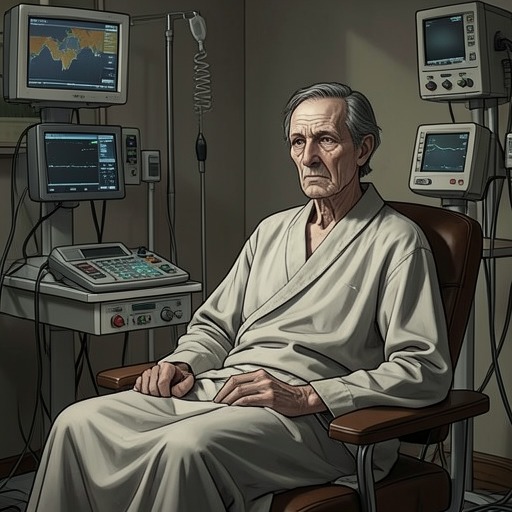
Randolph Ash’s terminal illness
PossessionRandolph Ash’s terminal illness is the prolonged final crisis of his life and the setting for a last, closely shared period with Ellen Ash. Confined to his bedroom for three months, he depends increasingly on her care, while his continuing intelligence and questions about what follows death make the illness more than a bodily decline: it becomes a test of intimacy and belief at the edge of loss.
Course and Daily Care
Ash had never suffered a serious illness before this final one. Its course is long-drawn-out, and although he and Ellen both know that he is dying, neither knows when death will come or how quickly his condition will worsen. For those three months they live together in his bedroom, the illness narrowing their world to a single room and the daily work of tending him.
Ellen adjusts the air around him and his pillow; toward the end, she helps feed him and reads aloud when even the lightest book becomes too heavy for him. She believes she can recognize his needs and discomforts without his having to speak. Sitting beside him, holding his papery white hand, she feels his life ebb day by day and experiences his pain as something she has, in a sense, shared. The scene makes care a sustained form of attention rather than a single act of consolation.
Intelligence and Speech Near Death
Physical weakness does not simply extinguish Ash’s intellectual life. During a feverish period, he becomes absorbed in John Donne’s poems and recites them toward the ceiling in a resonant voice, puffing his beard away from his mouth. When a line escapes him, he calls to Ellen, “Ellen, Ellen, quickly, I am lost,” and she searches through the poems to find it. The episode joins dependence to intellectual continuity: he needs her help, yet the poetic language remains urgent to him.
The pair also recall reading Goethe and the metamorphoses of plants. Ash turns to a hellebore and wonders why its green petals are mysterious, connecting leaves and petals through the thought that all is one. Ellen remembers that this was the year he wrote about Lazarus, and Ash returns to that figure as he asks whether, in their hearts, they think people continue after death. His illness brings earlier intellectual and poetic concerns into the room where his own life is ending.
Ellen and the Question of Survival
Ash tells Ellen that she is a great comfort and that they have been happy together. His words frame the final illness not only as a private confrontation with death but as the closing phase of a marriage marked here by mutual closeness. Ellen’s presence is practical and emotional: she tends his body, supplies the lines he cannot retrieve, and remains beside him as his strength diminishes.
The question of an afterlife remains unresolved between them. Ash invokes the promise that people cannot be lost for nothing; Ellen bows her head and looks for the truth, but admits that she does not know. The exchange gives neither spouse a confident answer. Instead, the illness exposes the difference between Ash’s hope and Ellen’s uncertainty while preserving their closeness in the face of what cannot be known.
Narrative Significance
The illness concentrates the account of Ash and Ellen’s marriage into its final months. Its details are bodily and ordinary—air, pillows, food, reading, a hand held—yet they also provide the conditions for the chapter’s largest questions about memory, poetic language, and survival. Ash’s recitation and his recollection of Lazarus do not overcome his approaching death; they show what remains active in him while Ellen witnesses his decline.
The terminal illness also gives Ellen a consequential position as both caregiver and witness. She attends to Ash’s changing needs and hears his final reflections without being made certain by them. The scene’s emotional force lies in that combination: sustained intimacy, the persistence of thought, and the limits of any answer to death.