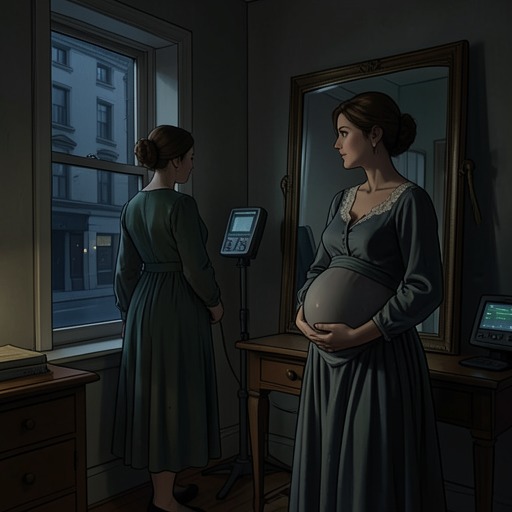
Sabine’s jealousy of Christabel
PossessionSabine’s jealousy of Christabel is a private, increasingly consuming fear that the older woman will take her place in her father’s affection and confidence. Recorded in Sabine’s diary, the feeling is neither simple rivalry nor a settled accusation: Sabine knows that Christabel’s kindness is natural and that her father may welcome her presence, yet experiences their closeness as the loss of a role made singular by her mother’s absence. The diary traces jealousy as both an emotion Sabine condemns in herself and a force she cannot master, while the concealed fact of Christabel’s pregnancy makes their strained intimacy more consequential than Sabine understands how to acknowledge.
The Moment of Displacement
During an evening gathered around the fire, Sabine watches Christabel knit faster as Gode tells a story. Christabel then puts aside her work and brings a hand to her breast and head, as if overheated or short of air. Sabine’s father takes that restless hand and holds it; Christabel lets him. When the story ends, he bends to kiss her hair, and Christabel clings to him with her other hand. The gestures are small and unannounced, but Sabine reads them as a transformation in the household: for a moment, the three of them look like a family.
That image unsettles Sabine’s established understanding of both adults. She has thought of her father as very old and of her cousin Christabel as a young woman near her own age, a friend, confidante, and example. Now she recognizes that Christabel is older than she is, though nearer to Sabine’s age than to her father’s, and that her father is not as old as Sabine has imagined. The changed perception makes the scene feel less like a harmless kindness and more like the arrival of a relationship in which Sabine may no longer be central.
A Place She Fears Losing
Sabine’s diary insists on a distinction between wanting Christabel’s friendship and wanting her to occupy a different place. Sabine has not aspired to replace her mother, but understands that her own position in the household is shaped by her mother’s absence. She does not want another woman to take charge of her father, to become the first person who hears his thoughts and discoveries, or, in the most exposed formulation of her fear, to take the kiss he has given Christabel. Her phrasing turns an ordinary sign of tenderness into a contested possession, revealing how deeply the scene has unsettled her sense of belonging.
Her response afterward is constrained by self-reproach. She does not offer her father an embrace when they go to bed; when he opens his arms, she enters and withdraws quickly, stiffly and dutifully, then runs upstairs and closes her door. Sabine tells herself that she must guard against improper behavior and has no right to resent natural kindness. She also fears that her father may expect her to welcome an event she does not want. The diary’s repeated attempt to correct or discipline her reaction does not resolve it: the wish to be generous coexists with the fear of being displaced.
Jealousy Becomes Anger
By November, Sabine describes hatred as something that seems to come from outside her and take possession of her. She imagines it as a great bird fixing its beak in her, or as a hungry, hot-pelted creature looking out through her eyes while her more agreeable self is left helpless. At the table, as the others exchange metaphysical theories, Sabine feels herself swelling with rage and shrinking with shame, unseen by those around her. The bodily and animal imagery gives the jealousy a double character: it is an emotion she recognizes as hers, yet experiences as an invading presence that threatens to alter who she is.
Her view of Christabel changes with that internal pressure. Sabine dwells on Christabel’s pale head, greenish eyes, and shiny green feet beneath her skirts, recasting her as a serpent that hisses quietly but may strike when warmed by generosity. When Sabine’s father gives Christabel copying work after she asks for employment, his explanation—that Sabine found the copying burdensome and that another pair of skilled hands and eyes is welcome—does not reassure her. His kindness toward Christabel and his practical consideration of Sabine become, in Sabine’s reading, a fresh injury. She imagines Christabel biting him and admits both that her suspicions may be absurd and that she cannot dismiss them as unreal.
Estrangement and Failed Repair
The tension also surfaces when Sabine and Christabel are together outdoors. After Christabel says that trusting women has caused her great harm, she does not explain further. Sabine notices her sigh, her hand at her side, and her laboring return into the wind. She asks whether Christabel needs company in a manner that, Sabine admits, will make pride compel a refusal. She then watches Christabel go, smiles, and continues on, telling herself that she is young and strong. The episode makes Sabine’s conflict active rather than merely inward: she recognizes a possible offer of care, shapes it so it will be refused, and then uses Christabel’s departure to confirm her own distance.
On December 31, Sabine tries to repair the estrangement. She goes to Christabel’s room with barley sugar and a borrowed book from an earlier, more amiable period, apologizes for being disagreeable, and says she has misunderstood matters. Christabel responds coolly and presses her to say what she thinks is happening. Sabine cannot put her suspicions into words; faced with Christabel’s pale, defiant stare, she stammers and bursts into tears. Christabel answers that she is a grown woman who can look after herself and does not want Sabine’s help, though she is glad Sabine is no longer so full of rage. She adds that rage hurts the spirit, as she knows to her cost.
The exchange does not restore their former closeness. Sabine feels that Christabel understands everything she has suspected and resented, but has chosen not to forgive her. She becomes angry again and leaves weeping. At the same time, she disputes Christabel’s claim that she needs no help: Christabel has already asked for employment and is staying in the household for a reason. Sabine wonders what will become of Christabel, of their relationship, and of the child, while still imagining Christabel as a serpent. Her insight and her jealousy remain entangled; recognizing the need for care does not enable her to offer it without resentment.
What the Diary Cannot Yet Say
The jealousy is shaped by incomplete knowledge. Sabine’s questions about Christabel’s condition, their future, and the child show that she understands more than she can bring herself to discuss directly, but she has not yet spoken to her father about Christabel’s state. The diary locates this hesitation in the silence between them and in Sabine’s fear that he, too, may reprove her. Her resentment therefore grows in the very space where disclosure and help might alter its meaning.
As a diary narrative, Sabine’s account preserves the immediacy of feelings she repeatedly revises. She calls herself absurd, then insists she is not; condemns her rage, yet records how it possesses her; seeks Christabel’s company, yet makes refusal likely. These contradictions do not cancel one another. They show how Sabine’s fear of losing her father’s attention turns acts of tenderness, work, and concern into signs of rivalry, while the reader can see that Christabel’s vulnerability exceeds the role Sabine has assigned her. The jealousy matters both as a conflict in the household and as a limit on Sabine’s knowledge: she senses the presence of a child and the need for help, but cannot yet separate those facts from her fear that another woman has taken her place.