Christabel LaMotte’s concealed pregnancy
PossessionChristabel LaMotte’s concealed pregnancy is a sustained crisis of silence in the Brittany narrative, where the signs of an impending birth become increasingly visible while Christabel refuses to discuss her condition or plans. Her silence leaves her relatives uncertain how to act: they want to offer protection, but fear that direct intervention will alienate her. The later revelation that she gave birth to a daughter and arranged for Sophie to raise the child as her own shows that this silence was not simply an absence of knowledge. It was part of a deliberate effort to manage her fate and the child’s future in a society that constrained unmarried women and their children.
The Pregnancy Becomes Visible
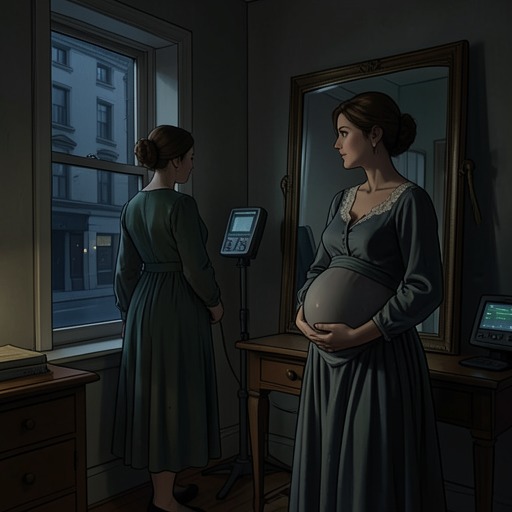
The household’s uncertainty begins with evidence that Christabel is pregnant, but not with any explanation from Christabel herself. Sabine recognizes the condition in church: Christabel is pale, appears stout, and clasps her hands beneath her bosom in a posture Sabine has seen among other pregnant women. The recognition makes clear to Sabine what Christabel has concealed, yet it does not resolve the central question of what Christabel intends to do.
By late January, Sabine decides to speak to her father, Raoul, because the silence between them has become difficult to sustain. She asks what will become of Christabel and the child, whether they are to remain in the household indefinitely, and how she can help. Raoul advises that the best assistance may be to maintain silence. His response reflects the household’s dilemma: Christabel is dependent on their hospitality, but they cannot easily ask about a condition she has made forbidden to discuss.
As the pregnancy advances, its visibility intensifies the contradiction. In April, Sabine writes that Christabel is now unmistakably near term, yet still permits no discussion of her condition or expectations. Raoul wants to tell her that the child is welcome, part of their kin, and will be cared for, but he cannot bring himself to open the subject. He fears that Christabel may be mentally unwell and that confronting her in the wrong way could drive her into alienation and despair. At the same time, her mind appears lucid and sharp in conversation, as she speaks with him about Morgan le Fay, Plotinus, Abelard, and Pelagius. The family’s practical concern for the approaching birth is displaced into courteous conversation and acts of kindness.
A Household Unable to Intervene
The family tries to determine whether Christabel has privately accepted that she is pregnant. Sabine points out that Christabel’s clothing has been let out with careful stitching, which suggests awareness of the changes in her body. Raoul wonders whether Gode, who helps in the household, has assisted her; Gode denies doing so and says Christabel has repeatedly turned aside offers of help, including herbal drinks, as if accepting them only to be polite. The evidence remains ambiguous: the altered clothing suggests practical recognition, while Christabel’s refusal to discuss the matter prevents her relatives from knowing what she understands or plans.
Gode believes she will recognize when the birth is near and can give Christabel calming drinks and practical help at the necessary moment. Her confidence does not entirely reassure Sabine, who doubts whether Gode understands Christabel’s particular state of mind. The pregnancy therefore creates a division between instinctive household care and the relatives’ fear that ordinary signs and routines may not be enough. They see that assistance is needed, but Christabel’s manner prevents them from offering it openly.
Sabine’s own response changes over time. Earlier, she confesses that she has felt jealousy, resentment, and bafflement, and worries that writing these feelings into her journal gives them a lasting force rather than relieving them. She also recognizes that Christabel has come to the household seeking sanctuary and that her own suspicions have not equipped her to respond generously. By April, she resumes writing because the strange situation seems impossible to understand without recording it. The journal becomes both a witness to the family’s concern and a record of how little that concern can overcome Christabel’s silence.
Disappearance and Return
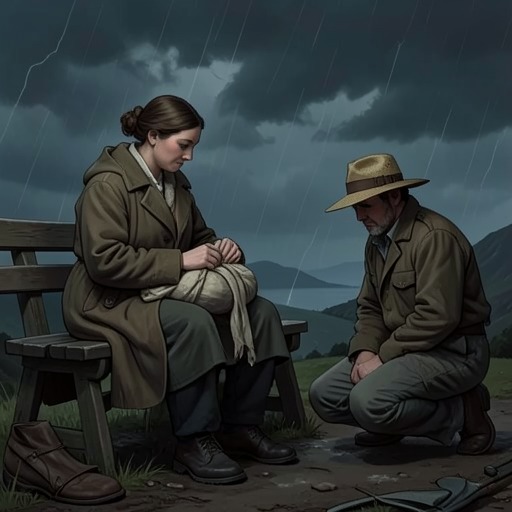
Near the expected time of birth, Christabel goes to the church and is not seen returning. The villagers have noticed her spending long periods there, tracing the figures around the base of the Calvary with her fingers and sitting or praying with her head covered. When she fails to come home, Gode urges Raoul to take out the horse and trap because Christabel’s time is near. Raoul and Sabine search the roads and nearby places, fearing that she may have been taken ill somewhere alone. Their search is driven by concern, but also by shame and uncertainty: they do not know where she has gone or why she left without telling them.
After Christabel’s disappearance, Raoul seeks help from a nun, but the attempt does not resolve the family’s uncertainty. On May 8, Christabel returns to the house. Sabine describes her as thin and frail, with her clothes drawn in by a heavy leather belt and her hair cut short. Raoul moves to embrace her, but Christabel stops him and insists that she is well and can stand on her own feet. Her return confirms that she has survived the absence, but it does not provide an account of where she went, what happened, or the child’s whereabouts. The pregnancy’s central facts remain withheld from the household even after Christabel is back among them.
The Birth and the Child’s Concealed Identity
A later letter from Christabel supplies the history that the Brittany household could not obtain from her at the time. She writes that, when she and Randolph Henry Ash parted, she understood that the separation would have consequences, though she did not then have certain proof. They agreed to leave each other and not look back. Christabel says she intended to keep to that agreement and made arrangements to take responsibility for herself and the child. She enlisted her sister Sophie, who helped construct a false account suitable to conceal the birth.
The daughter was born in Brittany, in a convent, and Sophie took her to England and raised her as her own, as had been agreed. Christabel acknowledges that Sophie loved and cherished the child. The daughter grew up in England, married a man presented as a cousin, and became a squire’s wife. This later disclosure explains why Christabel’s return to the household did not end the pregnancy’s consequences: the child’s existence and parentage had been separated from her public family identity and carried forward under another one.
The concealed parentage also has a later legal and genealogical consequence. Euan explains that children born outside marriage could not inherit at the time, and that Victorian families sometimes placed such children in legitimate families to give them a better chance. Maud Bailey is ultimately recognized as descended from both Christabel and Ash. The concealment thus connects Christabel’s choices to Maud’s ancestry and to the novel’s investigation of how family histories can be preserved through omissions, substitutions, and delayed disclosure.
Independence, Secrecy, and Social Constraint
Christabel’s concealment belongs to a wider history of women attempting to live without dependence on men or conventional household arrangements. Blanche Glover’s account of her own life with Christabel describes their effort to establish a frugal, charitable, artistic, and intellectually purposeful life as independent single women. Blanche concludes that their experiment failed, whether because the world was hostile to it or because they lacked sufficient resources and strength. That account provides a social context for the limited options surrounding an unmarried pregnancy: Christabel’s insistence on managing the matter herself takes place against the vulnerability of women whose independence is difficult to sustain.
The later account does not erase the costs or uncertainties of the silence. During the pregnancy, Raoul and Sabine cannot tell whether Christabel is refusing help, protecting a decision, or unable to acknowledge what is happening; their concern repeatedly turns into restraint. Christabel’s eventual arrangements show that she was making consequential plans, even though her family had no access to them. Her daughter’s upbringing in Sophie’s household and the later concealment of her parentage allowed the child a place in English society, while leaving the truth to surface only generations afterward. The pregnancy is therefore both a private bodily crisis and the origin of a long-lived family secret, whose consequences reshape the present-day understanding of Maud’s identity.