Anga
RamayanaAnga is a kingdom whose narrative significance emerges through the fortunes of its land and its ruler, Lomapád. A period of drought follows the king’s folly, making Anga a setting where the consequences of royal conduct reach beyond the court and affect the country itself.
Kingdom and Ruler
The poem identifies Lomapád as the lord seated on Anga’s throne and associates his rule with public renown. In a separate exchange, a speaker names him as Anga’s ruler and says he bestowed hamlets, cattle, and their wealth. These details present Anga as a realm ordered through kingship and material grants, though the passage does not specify the recipient’s identity in the surviving excerpt.
The Drought
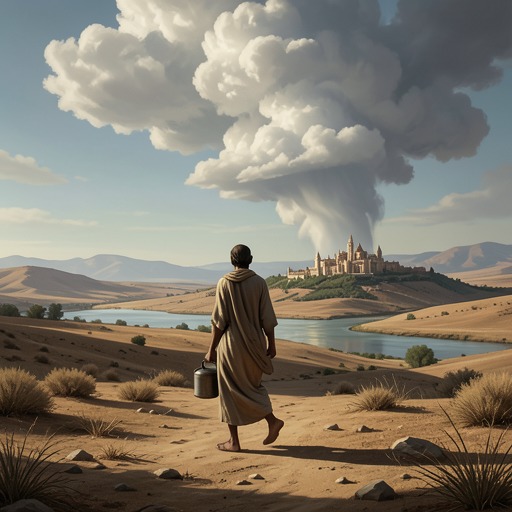
Anga’s political picture is darkened by a crisis of the land: the poem says that folly by the great king brings a plague upon the country, and that rain fails for many years. The drought is not merely background. Its stated cause connects the condition of the kingdom to the conduct of its ruler, turning a natural calamity into a consequence of royal error.
Rishyasringa and the Return of Rain
The account of Rishyasringa’s arrival in Anga gives the kingdom’s crisis a turning point: his coming is associated with the end of the drought and the return of rain. The movement from prolonged want to renewed rainfall makes Anga the setting for a restoration as well as a failure of rule. The available evidence establishes that connection without detailing here the circumstances of Rishyasringa’s journey or the rituals surrounding it.
Narrative Significance
Anga is defined less by a mapped boundary than by a political and environmental sequence: Lomapád’s kingship, the drought attributed to his folly, and the rain that returns with Rishyasringa. The sequence places the fate of a kingdom in a close relation to the actions and fortunes of its ruler. It also gives the landscape a narrative role: the absence and return of rain mark the movement from affliction toward renewal.