Rishyamúk
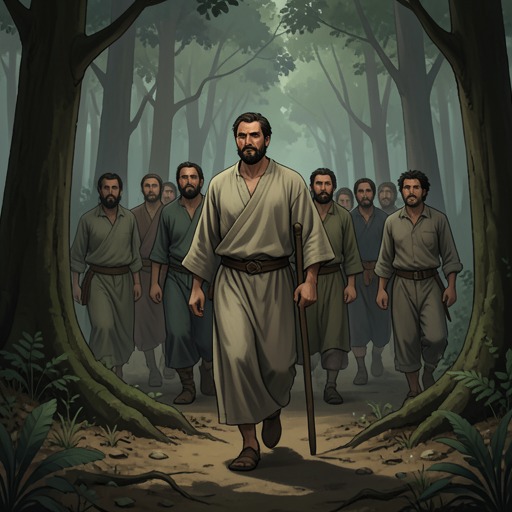
RamayanaRishyamúk is the mountain refuge where Sugríva, driven from his position by Báli, lives with four loyal chieftains and his Vánars. Near Pampá and marked by a cave among roots, fruit, and thickly shading trees, the mountain is both a place of shelter from Báli’s power and the setting for Sugríva’s meeting with the grieving Ráma. Its importance lies in this conjunction: a refuge shaped by political defeat becomes the ground on which a new alliance begins.
Setting and Landscape
The poem places Rishyamúk near Pampá. Its heights appear beside the lake’s fresh waters, establishing the mountain not as an isolated destination but as part of a recognizable landscape. The account offers no precise map or extended description of the routes between these places; instead, the pairing of lake and mountain gives the episode a clear spatial frame. Ráma first grieves on Pampá’s bank and then journeys toward Rishyamúk, so the movement from one landmark to the other also marks a transition from solitary sorrow toward contact with a possible ally.
The refuge is associated with a mountain cave. The surrounding description emphasizes natural provision and cover: roots and fruit abound, while thick trees shade the grassy ground. Sugríva and his Vánars hold the cave, and the chief often seeks it. These details define the place through its practical use rather than through buildings or political ceremony. Food, shelter, and concealment make the mountain habitable for a displaced group; its setting in the wilderness stands in contrast to the authority Báli exercises elsewhere.
Sugríva’s Refuge
Rishyamúk is tied to the aftermath of the conflict between the brothers Báli and Sugríva. Báli, identified as a son of Indra, defeats and expels Sugríva. The dispossessed chief remains on the mountain with four faithful chieftains rather than returning to contest his brother’s power. His residence there is therefore not simply a retreat into attractive scenery: it is the continuing condition of an exile, sustained by a small circle of loyalty and by a place where he can remain apart from Báli.
The text presents both the mountain’s shelter and the continuing force of the threat. The cave offers Sugríva and his followers a place to stay, yet the sight of Rishyamúk’s heights is associated with Sugríva’s fear of Báli’s conquering might. This contrast gives the refuge its tension. It is a haven, but not a restored kingdom or a resolution of the brothers’ dispute; safety is provisional, and Báli’s power still determines where Sugríva can live.
Ráma’s Arrival and the Alliance
Ráma approaches Rishyamúk after an emotionally stark sequence: on Pampá’s bank he weeps uncontrollably, then journeys to the mountain and speaks with Sugríva. The change in setting does not erase his grief, but it brings him into relation with someone whose own life has been broken by loss and displacement. Their friendship, which both have sought, follows this encounter. The poem thus makes the mountain a meeting place between two forms of need: Ráma is searching for help, while Sugríva has a refuge but remains powerless against Báli.
The alliance formed there is grounded in their circumstances, not in a general claim of fellowship. Ráma’s arrival gives Sugríva a prospective ally in his conflict with Báli; Sugríva, in turn, becomes the companion whose connection to the mountain and its surrounding landscape follows Ráma’s passage through grief. The poem’s account of their friendship leads directly into the account of how Báli and Sugríva fought, linking the mountain meeting to the conflict that made Sugríva an exile in the first place.
Narrative Significance
Rishyamúk gathers several strands of the narrative into one landscape: Pampá’s proximity, Sugríva’s political defeat, the loyal followers who remain with him, and Ráma’s search for a new alliance. Its cave and wooded ground give the displaced chief a place to endure, while the mountain’s association with fear prevents that shelter from seeming secure or complete. The refuge is defined by the danger outside it as much as by the resources within it.
The mountain also gives the plot a spatial hinge. Ráma’s journey from Pampá to Rishyamúk converts private mourning into conversation and then into friendship; Sugríva’s place of exile becomes the setting for action against Báli. Rishyamúk is therefore more than a stopping point on a route. It is the landscape in which separation and alliance meet, and where the story begins to turn from the search for what has been lost toward a partnership formed through shared need.