Janasthán
RamayanaJanasthán is a named settlement in a forest landscape where Khara’s violence makes local habitation precarious. The poem presents it both as a place where people dwell and as a center of hostile power: Khara, brother of Rávaṇ, is described as a gigantic figure who persecutes its inhabitants, while the later account of a massive defeat of fiends gives the location a place in Rama’s campaign through the wilderness.
Setting and Inhabitants
The evidence identifies Janasthán as a populated place rather than an empty stretch of wilderness: Khara’s fury is directed against all who dwell there. The account places this threat amid a wider forest setting, where hermits speak together in fear of demonic interference. The contrast is sharp: Janasthán has residents and a settled community, yet its inhabitants live under the reach of a violent supernatural force.
The text offers no detailed description of the settlement’s buildings, boundaries, or administration. Its character emerges instead through the people exposed to danger and the power that menaces them. Janasthán is therefore defined less by physical landmarks than by the condition of its inhabitants: it is a place of residence made unsafe by Khara’s presence.
Khara’s Power and Surpanakha’s Return
Khara is introduced as Rávaṇ’s brother, gigantic in stature and cruel in conduct. His violence is not confined to a single encounter; the account says that he vexes all who live in Janasthán. This establishes him as a continuing threat to the locality, and gives the place a political and moral dimension: its danger arises from an aggressor who acts there with apparent impunity.
The narrative also makes Janasthán part of Surpanakha’s movements. After fleeing through the boundless wood, she goes to Janasthán and finds Khara there. Later, Surpanakha returns with her train to Rama’s dwelling and presents the eager fiends to him. These movements connect the settlement to the chain of hostility surrounding Rama, while the evidence does not establish that Rama’s dwelling itself stood within Janasthán.
Violence and Narrative Significance
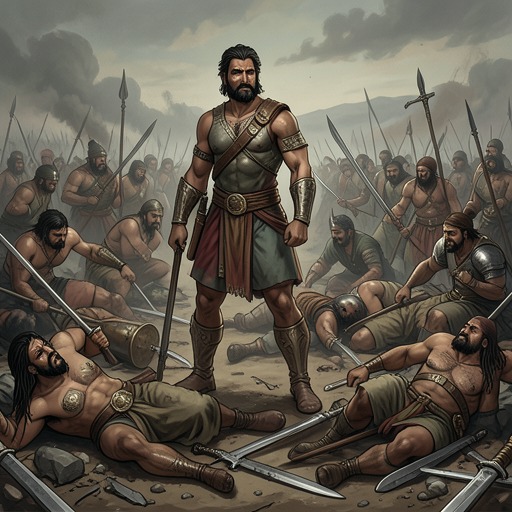
The poem associates Janasthán with a battle whose scale is conveyed through an exact number: twice seven thousand fiends are overthrown by Raghu’s son. The tally turns the place’s earlier atmosphere of intimidation into a decisive reversal. Khara’s menace has made Janasthán a site of fear; the defeat of the fiends makes it a setting in which that force is broken.
Janasthán thus functions as more than a waypoint in the forest geography. Its inhabitants’ vulnerability, Khara’s local violence, and the subsequent destruction of a great band of fiends give the place a clear narrative progression—from threatened habitation to the scene associated with the collapse of its oppressors. The poem supplies little topographical detail, but its human and dramatic geography is distinct: Janasthán is remembered through who is endangered there, who wields power there, and the scale of the defeat that follows.