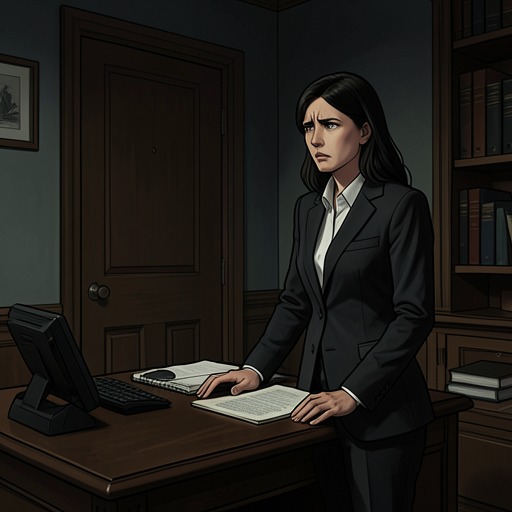
Bantling's first appearance and C.J.'s recognition of her attacker
RetributionWilliam Rupert Bantling’s first appearance in court turns a routine murder hearing into a moment of recognition for C.J. Townsend. As the judge considers whether Bantling should be held without bond, the defendant’s angry protest brings back the voice and identifying scar of the man C.J. remembers from the assault that altered her life. The case against Bantling and her own past suddenly occupy the same courtroom.
The First Appearance and Recognition
Judge Irving J. Katz opened the hearing in the matter of The State of Florida v. William Rupert Bantling. C.J. Townsend appeared for the state, and Lourdes Rubio represented Bantling. After reviewing the arrest form, Katz found probable cause to hold Bantling for trial on the first-degree murder charge in Anna Prado’s death and ordered that he be held without bond. Rubio asked the court to consider Bantling’s community ties, lack of a criminal record, willingness to surrender his passport, and proposed electronic monitoring and house arrest. Katz rejected the request, citing the violent murders under investigation and the discovery of Anna Prado’s body in Bantling’s car.
As Katz continued, Bantling abruptly stood, knocking his chair against the railing, and protested that he was innocent and had never seen Anna Prado. He turned toward Rubio, tugging at her jacket with his handcuffed hands and demanding that she act. The sudden commotion drew the corrections officers’ attention and disrupted the hearing, but for C.J. the decisive detail was smaller: the jagged S-shaped scar on Bantling’s left arm, visible above his watch. His voice and the scar brought recognition together. She understood, in that instant, that the man now before her as a murder defendant was the person she remembered as her attacker.
C.J. could not respond at once. The courtroom seemed to fall silent for her as Bantling was taken from the defense table, still protesting; Dominick Falconetti, seated among the spectators, reached her and tried to bring her attention back to the judge calling her name. The recognition did not remain a private realization for long. With reporters pressing for comment, C.J. left the courtroom and hurried out of the courthouse, while the encounter marked the return of a nightmare she had thought belonged to the past.
The Past Behind the Recognition
The courtroom recognition reached back to an assault that had left C.J. Townsend hospitalized at Jamaica Hospital in Queens. Doctors told her that she would recover, but the emergency hysterectomy required to stop her bleeding meant that recovery could not restore everything the assault had taken. When she began describing how her attacker had immobilized her, Detective Harrison told her that the assault was not her fault. The reassurance answered the question of blame directly, but it could not make the event easier to speak about or return her to the life she had known before it.
The investigation’s gradual retreat made the past feel less settled, not more. The guard assigned to protect C.J. was removed when she was no longer considered in imminent danger, and Detective Harrison shifted from daily visits to a daily phone call. C.J. withdrew from most visitors, including well-wishers whose flowers filled her hospital room, and dreaded being seen with her bandages or drawn into conversations about the assault. Later, when Detective Harrison stopped calling, C.J. called every day herself to ask about the case. With no identification, fingerprints, or other physical evidence, she feared it would disappear into the cold-case files; continuing to call became a way of insisting that the investigation, and the assault, had not simply gone away.
The memory returned with force when C.J. later read the old police reports and hospital records. A former neighbor’s account blamed her clothing and behavior for the assault, reviving feelings of shame and responsibility that she had worked to resist. That history helps explain why Bantling’s appearance in court was not only a sudden identification but also a collision between her professional role and an unresolved personal wound. When Lourdes Rubio later sought C.J.’s removal from the case on the ground that her judgment was clouded, C.J.’s past had become an argument within the prosecution itself.
At the trial, the private wound became public. C.J. told Judge Leopold Chaskel that she had been raped years earlier while studying law in New York City, then stated that Bantling was not the man who had attacked her. She said he had learned about the assault through old police reports and public records and was using a midnight confession to make the proceedings appear improper. Rubio told the court that she had reviewed the reports, spoken with C.J., and did not support Bantling’s accusation. The later account complicates the apparent certainty of the first courtroom recognition: the recognition begins the event’s crisis, while the public disclosure shows how the assault’s history could be invoked, contested, and turned into a question about C.J.’s fitness to prosecute.
Recognition in Public
The recognition unfolded under the eyes of a courtroom already prepared to turn the hearing into news: reporters watched, cameras recorded, and sketch artists worked as William Rupert Bantling’s outburst broke the proceeding. C.J. Townsend’s realization therefore became entangled at once with a public spectacle. After leaving the courtroom, she hurried through the courthouse and past reporters pursuing her; at the later trial, when she disclosed her past assault to Judge Leopold Chaskel III, the courtroom answered with a collective gasp and the revelation was framed as breaking news. The sequence shifts her history from a private memory into contested public knowledge, while making clear that Bantling’s accusation could force her to speak about the assault before the very court where she was prosecuting him.
The Case Behind the Hearing
The prosecution had emerged from an investigation built to connect individual disappearances into a larger pattern. At the Florida Department of Law Enforcement’s Miami Regional Operations Center, the Cupid task force’s wall of family photographs and case records placed the missing women’s lives beside the evidence of what had happened to them; investigators also collected personal materials such as diaries, letters, and photographs. Against that accumulated record, the first appearance gave the Anna Prado case a formal court proceeding, while C.J. Townsend’s recognition introduced a different kind of consequence: the investigation’s central defendant was also linked, in her memory, to an assault that had never been solved.