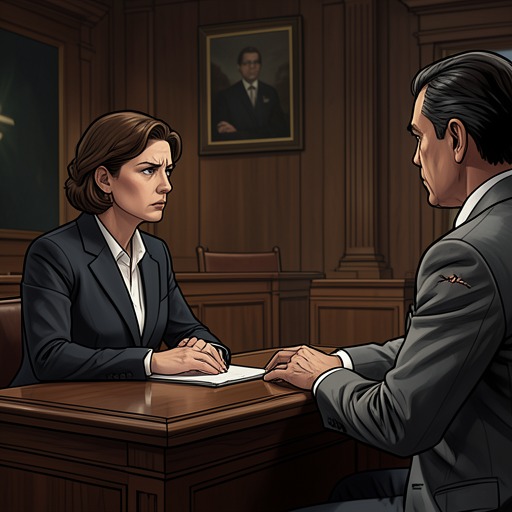
Bantling Reveals C.J.’s Victimhood During a Jail Meeting
RetributionWilliam Rupert Bantling’s jail meeting with C.J. Townsend turns a prosecution meeting into an attempt to make her past the case against her. By revealing that C.J. had been Chloe Larson, and claiming that he assaulted her twelve years earlier, Bantling gives his defense a way to portray her as personally compromised. C.J. answers him directly, but the encounter also makes the threat behind that strategy unmistakable: the man she is prosecuting knows intimate details of her history and is willing to use them to unsettle her.
Background and Stakes
Twelve years before the meeting, Chloe Larson was sexually assaulted in New York while she was a law student. The injuries required emergency surgery, including a hysterectomy, and she was told that she was expected to recover physically. The consequences were not so easily contained. After the assault, she withdrew from most visitors and telephone calls, while the police guard assigned to her room was removed when she was no longer considered in imminent danger. The gradual reduction in police contact left her fearing that her case would be pushed aside.
Years later, as C.J. Townsend, she encountered her old police reports while investigating William Rupert Bantling. Reading them brought back the assault and the self-blame she had struggled to overcome. One former neighbor had blamed her clothing and behavior for what happened; although C.J. understood that the remarks reflected the speaker’s perversity, they revived feelings of shame. The jail meeting therefore lands on ground already made vulnerable by the earlier assault, its investigation, and the damaging language preserved in the case file.
The immediate legal stakes are different. C.J. is prosecuting Bantling in a murder case, while his attorney, Lourdes Rubio, presents a motion to suppress evidence from the stop and formally seeks C.J.’s removal, arguing that her judgment is clouded. Rubio says Bantling maintains that he was C.J.’s attacker and that C.J. has recognized him. Because the statute of limitations has expired, he cannot be prosecuted for that New York crime; the defense claims that C.J. is now pursuing a vendetta and withholding evidence because she knows he is innocent. The allegation thus joins a private history to a public question about whether the prosecutor can remain on the case.
The Jail Meeting
C.J. is caught off guard as Rubio sets out the accusation. Bantling watches her while his attorney speaks, appearing pleased by the disclosure. When he addresses C.J. himself, he claims to remember the assault and uses the nickname Beany, a detail that makes the confrontation feel less like an abstract legal maneuver and more like a deliberate intrusion into her private past. His words are presented as a claim, not proof that he was the attacker.
C.J.’s physical response registers the force of the encounter: her knees shake, she sweats, and she feels an urge to flee. Yet she remains seated. After holding Bantling’s gaze, she challenges the use of her old case in the litigation and rejects the implication that the accusation gives him an advantage. The scene’s decisive movement is from involuntary fear to a response she chooses to deliver: she speaks forcefully about her determination to see him convicted and sentenced, and says she will be present at his execution. Her words make plain the personal anger in the room, even as they expose how readily Bantling’s tactic can be framed as evidence of bias.
C.J. then turns to Rubio. She calls the disclosure unethical and says she will raise it with Judge Leopold Chaskel and possibly the bar. She also insists that future communication come through written motions filed with the court, rather than private exchanges. Her response draws a boundary around the encounter and redirects the dispute to formal legal channels; it does not, however, make the meeting emotionally safe or settle the accusation.
Bantling’s Outburst and Its Aftermath
As C.J. prepares to leave, Bantling turns visibly agitated. He protests that he is innocent and should not be sent to death row, then shouts abuse and threatens that she cannot escape him, invoking the same past identity and nickname he has just exposed. His outburst shifts the encounter from a lawyer’s allegation into an open attempt to intimidate the prosecutor. C.J. leaves through the secured doors visibly shaken, struggling to breathe steadily and steadying her hand as she signs out.
The meeting’s impact continues beyond the jail. At a later court appearance, C.J. addresses Judge Leopold Chaskel and publicly acknowledges that she was raped while a law student in New York. She says Bantling learned of the old case through police reports and public records, and that his claim was an attempt to discredit the proceedings with accusations of impropriety. Most importantly, she tells the court that Bantling was not the man who attacked her and says she had already told Lourdes Rubio as much. The public disclosure transforms the defense’s attempt to expose C.J. into a moment in which she states both the fact of her victimization and the limit of Bantling’s claim.
Significance
The encounter makes the past an active pressure within the murder prosecution rather than a closed episode. Bantling’s claim gives him a tactical opening because C.J.’s history could be used to question her neutrality, while the expired limitation period prevents that old assault from being prosecuted as a separate New York case. C.J. must therefore confront the accusation in the very proceeding where her professional judgment is under attack.
The scene also distinguishes disclosure from truth. Bantling knows C.J.’s former name and uses a private nickname, but those details do not establish that he committed the earlier assault. C.J.’s later statement to the court directly denies his claim. The meeting’s lasting significance lies in this tension: Bantling tries to turn the recognition of her past into leverage, while C.J. insists that acknowledging the assault does not make his account true or invalidate her work on the murder case.