Chavez and others cover up the illegal stop
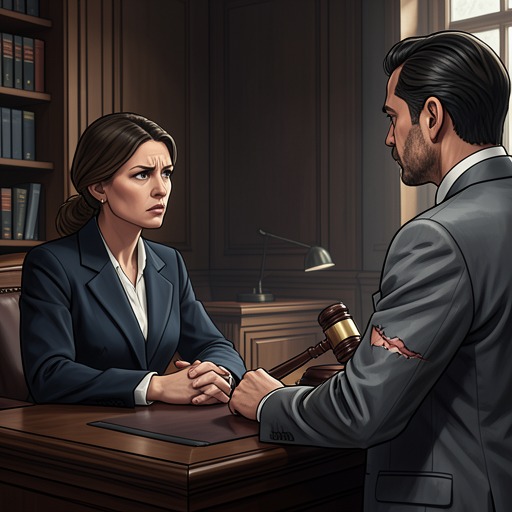
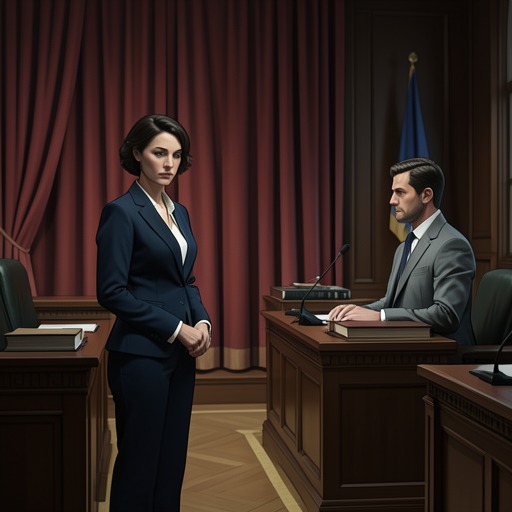
RetributionThe cover-up of the illegal stop begins when C.J. Townsend tests Victor Chavez’s sworn account against the street layout and his changing explanations. The stop had produced the discovery of Anna Prado’s body in William Rupert Bantling’s Jaguar, but the legal basis for stopping and searching the car was weak. When Chavez finally reveals that an uncorroborated anonymous tip set the pursuit in motion, his sergeant, Lou Ribero, proposes a different account. C.J. recognizes the fabrication and its stakes, yet ultimately agrees to proceed with it, trading professional integrity for the chance to keep Bantling in custody.
The account begins to unravel
C.J. confronts Chavez after determining that his claim to have kept the Jaguar in sight does not fit the streets he described. Sixth Street was one-way and did not continue through; cement pilings prevented the turn he would have needed to make to reach Washington in the manner his story implied. His account of watching the car therefore could not explain how he had followed it. C.J. presses him on the contradiction, making clear that she suspects he is lying and expects the truth under oath.
Chavez eventually admits that he was outside his patrol car on Sixth Street, speaking with tourists, when he received a radio call about an anonymous tip. The caller reported that a late-model black Jaguar XJ8 was heading south on Washington toward the airport with two kilos of cocaine in its trunk. Chavez says he saw a Jaguar pass, drove after it, lost it, then spotted a car on the MacArthur Causeway and pulled it over before it left his jurisdiction. His version supplies no plate number, driver description, or explanation of how the caller knew about the alleged drugs.
That omission matters. C.J. explains that an anonymous caller’s credibility cannot be assessed and that the sparse description did not establish probable cause. Nor could Chavez show that the Jaguar on the causeway was the same car described in the tip. When she points out that he had already lost the vehicle, his silence further undermines the pursuit story. His admission changes the stop from a routine account of police work into a serious evidentiary problem.
From suspicion to a fabricated stop
Chavez says that after stopping Bantling, he asked for his license and registration, asked where he was going, and asked what was in the trunk. Bantling reportedly said he was going to the airport and told Chavez to leave him alone. Chavez then called for a K-9 unit. When the drug tip yielded no drugs, Chavez offered another justification: he claimed he had smelled something like a dead body coming from the trunk. C.J. rejects this as another shifting explanation, noting that the body had been dead only a day and accusing him of inventing a smell after the search failed to produce drugs.
Chavez admits that Ribero arrived after the trunk had been opened and was told the full story. Ribero understood that the case might be thrown out, but insisted that Bantling could not simply be allowed to walk. According to Chavez, Ribero said they needed another reason for the stop, one unrelated to the tip. C.J. asks who broke the taillight; Chavez does not answer. He then indicates that Officer Lindeman also knew about the call. The scene establishes not a lone officer’s false account but a widening effort among police personnel to conceal the stop’s actual basis.
The official version and C.J.’s decision
The account C.J. later presents recasts the stop as the result of traffic violations. It places Chavez in a marked patrol car at Washington and Sixth at about 8:15 p.m. on September 19, 2000, and says he saw Bantling’s black Jaguar XJ8, bearing license plate TTR-L57, traveling faster than the posted 25 miles per hour. After following the car onto the MacArthur Causeway, the official version says Chavez noticed a broken taillight and an unsignaled lane change, then activated his lights and siren.
The account continues by describing Bantling as nervous, with shaking hands and little eye contact. It says Chavez saw a substance that looked like blood on the bumper and detected an odor of marijuana, then requested permission to search the car. These details provide an alternative narrative for the stop and the search. Set beside Chavez’s admission that an anonymous tip prompted him to pursue the Jaguar, and his failure to answer C.J.’s question about the taillight, the account reads as a deliberate reconstruction rather than a clarification of what happened.
C.J. understands the legal consequence. An unlawful stop can make a subsequent search unlawful unless an independent basis supports it; evidence obtained through that search may be excluded as the fruit of the poisonous tree. Without the stop and search, police would not have found Prado’s body in the trunk. C.J. reasons that they also would not have discovered the evidence at Bantling’s home, including Haldol, blood, a suspected murder weapon, and pornographic tapes. She believes the prosecution could collapse if Chavez’s real account is exposed.
After Ribero and Chavez leave her office, C.J. recognizes that the pact is made and cannot be reversed. For the first time in her career, she has compromised herself on a case. She justifies the choice as a small sacrifice for the greater good: the effort to keep a suspected serial killer from going free. But the narration also makes the cost explicit. The stop was unlawful, the search was tainted, and C.J. now knows that the prosecution rests in part on a false account. Her decision is therefore not simply a tactical accommodation; it entangles the prosecutor herself in the concealment.
Consequences for the prosecution
The bargain does not resolve the case’s vulnerability. During the trial, the defense presents evidence that Bantling’s Jaguar had been at Louie’s House of Tinting on September 18 and 19, and had remained overnight in an unsecured lot where more than ten employees could access it. The owner says no one had looked in the trunk since Bantling dropped the car off. The testimony supplies a possible opportunity for others to access the vehicle, complicating the prosecution’s account of the evidence found there.
The defense also challenges the forensic interpretation of a number-five scalpel found in Bantling’s shed. The blood on it was too scant for reliable DNA testing; tests indicated animal blood, probably from a bird, and the red blood cells had nuclei, unlike human red blood cells. A pathology expert further characterized the patterns that had seemed to match Anna’s blood as manufactured, including three drops on the shed floor. These trial developments do not undo the earlier concealment, but they intensify the uncertainty surrounding a prosecution already burdened by questionable evidence and C.J.’s decision to let a false stop narrative stand.
Significance
The cover-up turns the law into both the prosecution’s obstacle and its instrument. C.J. knows that exclusion rules can prevent a jury from hearing evidence pointing to a grave crime, yet her response is to help disguise how that evidence was obtained. The contrast is central to the event: a case pursuing a dangerous suspect is advanced through conduct that threatens its legitimacy. The remote crime scene, where forensic teams find no prints, hairs, foreign DNA, or other useful traces, forms part of the larger investigative pressure, but it does not make the unlawful stop lawful. C.J.’s choice may preserve the case for the moment; it also leaves her compromised and the prosecution exposed to the very doubt the cover-up was meant to prevent.