Gregory Chambers
RetributionGregory Chambers’s defining contradiction is the distance between his trusted professional persona and the private experiment he constructs around his patients. A forensic psychiatrist consulted by prosecutors and police, he is also a practiced manipulator who uses confidential knowledge to shape the lives of C.J. Townsend and William Rupert Bantling. His apparent authority and warmth do not merely conceal his crimes; they give him access to the people and information his scheme requires.
Professional Identity and Public Reputation
Chambers works as a criminal forensic psychiatrist, helping the State Attorney's Office and police departments interpret violent crime for juries. In complicated murder and domestic-violence cases, he explains possible motives in language laypeople can understand. His diagnoses are regarded as consistently accurate, and both law enforcement and the private community trust and respect him.
That reputation supports a thriving private practice in Coral Gables, where his fee is $300 an hour. C.J. Townsend receives a law-enforcement discount. Chambers has also worked alongside her at law-enforcement conferences and seminars and offered off-the-record professional opinions on some of her cases. He has never testified in one of her trials: she has deliberately kept a boundary between their professional connection and her courtroom work.
The distinction between the familiar Greg and the professional Dr. Chambers matters to their relationship. C.J. Townsend has known him both as a friend and as a psychiatrist, but when she calls about the Cupid case, she addresses him formally. Chambers’s overlapping roles make that boundary difficult to sustain even before she discovers how much he has kept from her.
Relationships with C.J. Townsend and William Rupert Bantling
For about ten years, Chambers has been C.J. Townsend’s psychiatrist on and off as well as her colleague. In therapy, she has entrusted him with the lasting effects of her assault, including symptoms he later identifies as post-traumatic stress and depression that worsens at difficult times of year. He knows how the memories affect her, what she fears, and how readily she can be reached through the history she has shared with him.
Chambers has also treated William Rupert Bantling. Bantling’s name appears in an address book filled with hundreds of women’s names, and its unexpected appearance prompts C.J. Townsend to question whether the two men knew each other. When she confronts Chambers, he confirms that Bantling was his patient and says their treatment relationship ended after Bantling’s arrest. He says he learned of the connection to C.J. Townsend only when she told him that the man arrested in the Cupid investigation was her attacker.
Chambers invokes patient confidentiality to explain why he did not disclose Bantling’s treatment. He insists that a patient’s identity is privileged, that no known conflict required disclosure, and that he would not reveal information from Bantling’s sessions. He also refuses to discuss those sessions with C.J. Townsend. The professional rule he cites is real within the circumstances he describes, but his later disclosures show that he has used therapeutic relationships for purposes far beyond treatment. His defense of confidentiality cannot undo the larger betrayal: he possessed intimate knowledge of both people and deliberately made their connection part of his design.
After C.J. Townsend accuses him of withholding the truth, Chambers rebukes her for questioning his professional integrity. He says he came to see how she was doing, but then advises her to continue therapy with someone else because he believes she is showing signs of a breakdown. The exchange turns a familiar therapeutic relationship into an unmistakable rupture: the person she trusted to help interpret her distress now uses that knowledge while withdrawing from her as her doctor.
The Experiment Behind the Case
Chambers later describes his plan as an experiment organized around C.J. Townsend and William Rupert Bantling: a victim and her attacker, with the victim now in the position of prosecutor. He wants to see what she will do when pursuing justice also offers the possibility of personal revenge, and how far she will go when ethical restraint conflicts with retribution. The criminal case becomes, in his private account, a study of C.J. Townsend’s choices rather than simply a prosecution of Bantling.
Chambers says the experiment began when Bantling came to his office three years earlier, troubled and without anyone to talk to. As Bantling spoke about his past, Chambers listened and learned of crimes against women. He represents himself as having recognized an exceptional opportunity in the pairing of Bantling and C.J. Townsend. His language of research does not make the arrangement impartial: he has selected people whose suffering and decisions serve his hypothesis without their knowledge or consent.
He admits that his interest in death predated his work with either C.J. Townsend or Bantling, but describes those earlier acts as immature and inconsequential beside the later experiment. He recalls a first victim in the study and presents the sequence as an orchestration. His account makes clear that the crimes are not an accidental by-product of his professional life; he has deliberately made violence part of the project.
Chambers says he considered allowing Bantling to go free so that he could keep his trophies and observe what C.J. Townsend would do if Bantling left custody. The possibility reveals how little the case’s human stakes matter to him: even the prospect of a convicted attacker returning to the world becomes, in his thinking, a way to test C.J. Townsend’s response. After Bantling is sentenced to death and the experiment reaches its conclusion, Chambers says he feels sadness rather than validation. He is disappointed that he cannot share his supposed findings with his peers.
Betrayal and Final Confrontation
Chambers’s final confrontation with C.J. Townsend exposes how he has converted therapeutic access into control. He recalls having her in mind since their first meeting ten years earlier and demonstrates that he can describe her fears, loneliness, and recurring symptoms. He treats knowledge she entrusted to him as proof of his power to reach her, reducing years of treatment to a means of predicting and manipulating her response.
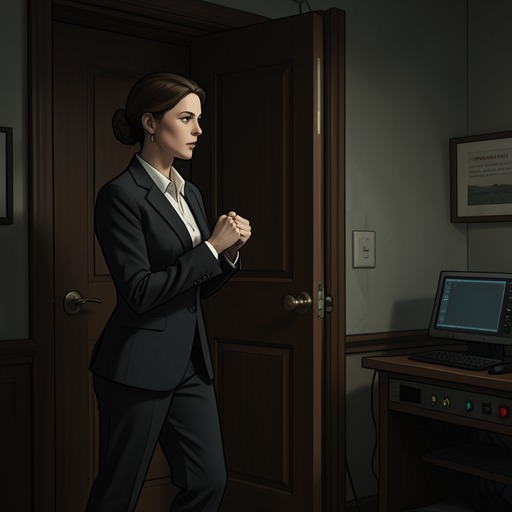
The professional visitor’s manner gives way to an explicit threat. Chambers presents a human heart to C.J. Townsend and reveals that he has brought a syringe and intends to subject her to the same experiment he has described. He refuses to provide a complete explanation or confession, telling her instead that some answers will remain beyond her reach. The refusal is part of his control: even as he reveals the broad design, he reserves the right to decide what she can know.
His attempt to kill her is also the culmination of his fixation on the experiment. He describes watching her prosecute Bantling and wonders whether, given the chance, she would have pursued vengeance herself. He has not simply observed the case from the position of a psychiatrist; he has engineered the conditions and now intends to make C.J. Townsend its final test. The clinical language of hypotheses and study disguises a personal violation of the trust he spent years cultivating.
Character and Narrative Significance
Chambers’s character turns the ethical boundary between treatment and other professional roles into a source of suspense and danger. His connection to law enforcement makes him seem like a reliable interpreter of violent behavior; his work with C.J. Townsend gives him access to a victim’s private history; and his treatment of Bantling gives him knowledge of the accused man. Rather than keeping those roles separate, he makes their intersection the machinery of his scheme.
His appeal to confidentiality sharpens the contrast between legitimate professional restraint and deliberate exploitation. He argues that he could not disclose Bantling’s status as a patient, yet he later uses what he learned from therapeutic relationships to frame an experiment and threaten C.J. Townsend. The novel’s reversal is not that the trusted psychiatrist proves incompetent, but that professional credibility and psychological insight can coexist with calculated abuse. Chambers understands the language of diagnosis and ethics; he uses that understanding to make himself harder to suspect and more capable of betrayal.