Lourdes Rubio
RetributionLourdes Rubio is the defense attorney for William Rupert Bantling in the prosecution for Anna Prado’s murder. Her courtroom strategy is to separate the horror of the accusation from the evidence that can legally support it: she urges the jury not to mistake revulsion for proof, challenges the strength of the physical evidence, and questions the investigation behind it. Yet she does not simply echo her client. When Bantling accuses C.J. Townsend of falsely identifying him as her rapist, Lourdes tells the court that she considers the accusation without merit and does not support it.
Defense Strategy
In her opening statement, Lourdes asks the jury to resist deciding the case from the prosecution’s account alone. She acknowledges the severity of Anna Prado’s death while arguing that the state has offered assumptions and conjecture rather than proof. Her argument turns on the difference between a disturbing narrative and evidence that establishes guilt: facts, she cautions, do not automatically become a conclusive case merely because they are arranged together.
She gives the jury specific alternative explanations for key parts of the prosecution’s case. Lourdes argues that the scalpel found in Bantling’s shed was a tool of his taxidermy work and that the microscopic blood traces on it were animal rather than human. She also disputes the significance of the luminol findings, emphasizing that only three microscopic stains matching Anna’s DNA were found in the shed. She presents these points as weaknesses in the state’s case, not as proof Bantling must provide; her opening repeatedly reminds the jury that the burden does not fall on the defendant.
Lourdes likewise contests the connection between Bantling and the Jaguar’s trunk, arguing that the vehicle had been at a repair shop for two days before he collected it and that he did not inspect the trunk before travelling. She also stresses the absence of physical evidence linking Bantling to Anna or to the other women discussed in court. In doing so, she tries to narrow the jury’s attention to what the state can establish in this particular trial rather than what the prosecution’s broader theory implies.
Conflict with C.J. Townsend
Lourdes’s opposition to C.J. becomes direct when she presents a motion to suppress the stop and announces that the defense will ask Judge Chaskel to remove C.J. from the case. She says the defense believes C.J.’s judgment is clouded and plans to raise the matter with the State Attorney. The challenge places C.J.’s impartiality, as well as the legality of the investigation, before the court; Bantling watches as Lourdes makes the request, while C.J. reacts with visible alarm.
The defense’s attack on the stop is part of a larger effort to undermine the state’s evidentiary foundation. Its force depends not only on disputing what the evidence shows, but also on questioning the judgment and conduct of those who obtained and presented it. Lourdes thus makes C.J.’s role itself an issue in the trial, rather than limiting her defense to the physical evidence.
Advocacy and Limits
As the trial turns against Bantling, Lourdes takes procedural steps on his behalf. After Dominick Falconetti adds ten first-degree murder charges, she waives Bantling’s right to a first-appearance hearing. Later that day, she tells the judge that Bantling will not testify in his own defense. These decisions occur as the courtroom atmosphere shifts and the defense’s confidence appears to diminish; Lourdes’s closing argument does not have the conviction of her opening.
But she draws a line when Bantling publicly claims that he was the man who raped C.J. Lourdes tells Judge Chaskel that she has reviewed the police reports and spoken with C.J., and that she regards Bantling’s accusation as meritless. Her position is significant because it separates representing a client from endorsing everything he says: even while defending Bantling, she refuses to support his attack on C.J.’s credibility.
Doubt After the Trial
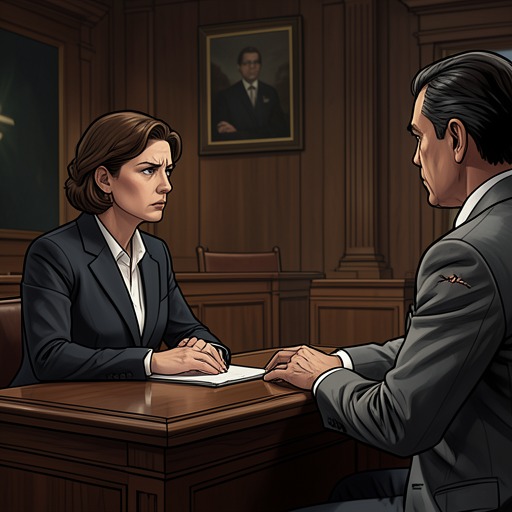
After the verdict, Lourdes speaks with C.J. in the emptied gallery about aspects of the case that trouble her, including matters for which she says she will accept responsibility. She focuses on the late discovery of Bantling’s great-aunt’s house by Dominick, and questions why it emerged so close to the end of the trial after the investigation had been under way for months. She also wonders whether an anonymous tip prompted the discovery, while acknowledging that the answer may never be known.
Lourdes’s final doubts do not establish that the discovery was improper. Instead, they preserve a tension running through her role: she has fiercely challenged the prosecution’s methods and evidence, yet she has also refused to validate Bantling’s accusation against C.J. Her defense is both adversarial and bounded—committed to testing the state’s case, but not reducible to unquestioning loyalty to her client.