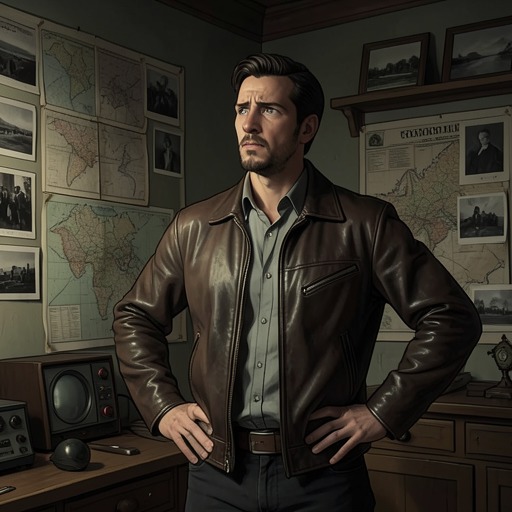
Prophetic Dreams and Telepathy
SatanProphetic Dreams and Telepathy names an unresolved experience that binds Loïc’s dreams to the World Trade Center attacks and to his cousin Roger Bolduc’s presumed death. A nightmare contains details that seem to correspond to the disaster, including Roger’s presence and a falling, burning stone; Loïc wakes to learn that the first plane struck at almost exactly the same time. The coincidence becomes more than a frightening premonition: it raises the possibility that he briefly entered another person’s consciousness, perhaps at the moment of death. The novel neither confirms that explanation nor dismisses it, making uncertainty itself the force that sustains Loïc’s fear and investigation.
The Dream and Its Images
The experience begins after Loïc has gone to bed exhausted, struggling to finish a translation. In the dream, the screen gives way to the firmament and he finds himself in his native village, before the church, surrounded by familiar faces. They appear to be waiting for a speech, while the wind lifts and carries away his papers. The scene shifts into a succession of threatening images: an old woman with dark, burning eyes; shadowy noises and a storm-heavy atmosphere; and the columns and pediments of palaces sliding away along a rolling staircase that ends beneath a black guillotine.
The dream then turns into flight and pursuit. Loïc rises above a dark lake that first seems full of hairy fish but resolves into a crowd of bodiless dead heads. Losing altitude, he struggles to fly away. A howling cavalcade plunges into a red forest, where branches reach for him like bloody hands. Amid the terror, an incomplete phrase pursues him, repeating fragments about the founder and a cameo. The dream finally places him in a vast corridor with a cousin beside him; a horrifying sight appears through a panoramic window, and a fleeing crowd surges around them under the threat of an imminent explosion. Loïc wakes with a scream, as if emerging from the dream into birth.
The nightmare’s imagery joins different registers of threat: the familiar village and its waiting audience, a historical scaffold, a monstrous landscape, and the modern high-rise’s panoramic window. Its fragments do not offer Loïc a clear explanation. Instead, the broken phrase about the founder and cameo connects the terror to an object already charged with family history, while the presence of Roger gives the dream an intimate human focus.
The Coincidence and Loïc’s Interpretation
Loïc wakes confused in his peaceful bedroom. The clock radio reads 8:47. Images from the dream continue to turn in his mind: black wings, a hideous figure splashing against a window, a burning stone falling from the sky, and an explosion. He is unsettled not only by the images but by the presence of Roger, his cousin, whom he had not been thinking about. The flying stone also resembles an object Loïc has known since childhood.
After a call alerts him to events in New York City, Loïc turns on the television and sees the World Trade Center in flames. The coverage shows the planes striking the towers and identifies the first impact as occurring at 8:46. The timing places the attack at the very moment of his nightmare. Loïc is transfixed by the broadcast and troubled by the correspondence, but he does not settle on a single explanation. He considers chance, a telepathic experience, or images generated by his own mind in response to the catastrophe. He wonders whether the scale of the disaster could have produced such images at a distance, or whether some affinity—kinship, friendship, or another connection—linked him to the person whose perceptions he seemed to share.
What makes the possibility particularly disturbing to Loïc is its apparent specificity. He does not understand the dream as a general vision of a skyscraper burning: he wonders whether it carried the thoughts of an individual. He imagines that another consciousness might have crossed his own for a moment, possibly at the instant of death. The account presents this as Loïc’s effort to interpret an extraordinary coincidence, not as proof that telepathy has occurred.
Roger, Isabelle, and the Unanswered Question
Loïc eventually tells Isabelle D’Anjou, Roger’s wife, about the dream. He explains that he saw Roger with him inside a skyscraper with panoramic windows, where something fell upon them like a comet or a burning stone. He also tells her that the nightmare coincided with the moment the first plane struck the World Trade Center. Isabelle is frightened and troubled by the account, but the conversation cannot establish what the dream means or what happened to Roger.
In the weeks that follow the attacks, Loïc becomes convinced that Roger died in New York. He describes his conviction as an intuition reaching beyond immediate conscious perception. At the same time, he tries to discover how Roger might have died by searching the Web for information about victims, affected companies, relatives’ testimony, photographs, and final telephone communications. He studies images and footage closely, making copies so he can revisit them, slow them down, and enlarge them. The search is an attempt to turn an inaccessible death into something visible, but the available images are too indistinct to identify a face, profile, silhouette, or clothing.
Loïc gives particular attention to photographs of people falling beside the towers. He considers whether Roger might have been crushed or burned inside a tower, or whether panic and self-preservation led him to jump. Without being able to verify it, Loïc favors the latter possibility and comes to believe Roger jumped from the North Tower shortly after the plane struck. His hypothesis remains an intuition, not a finding established by the pictures.
Recurrence and the Cameo
The dream does not end with the morning broadcast. That autumn, Loïc repeatedly dreams of falling from a great height along a skyscraper, surrounded by floating bodies and strange, spectral voices. Roger returns within these nightmares, surrounded by a sinister radiance and an atmosphere of approaching explosion. In another episode, Loïc wakes with the persistent feeling that he has fallen into death, and wonders whether he has relived a fragment of Roger’s final moments through a parallel corridor of time. The repetition makes the original experience feel less like a closed incident than a memory that keeps being revisited without becoming certain knowledge.
His fixation extends from Roger’s possible fall to the cameo threaded through the first dream. Loïc wonders whether Roger had time, while falling, to think of the cameo’s curse, or to hope that the object might somehow save him. He recognizes the absurdity of imagining salvation through a Devil’s Stone, yet the cursed object keeps returning to his thoughts. At one point he imagines seeing it shining among the World Trade Center rubble and questions whether it could have survived the explosions. Thus the dream’s burning stone, Roger’s apparent death, and the cameo become entangled: each offers an image of connection or rescue, but none resolves what happened. The novel’s treatment of prophetic dreams and telepathy rests on that unsettled tension between a precise coincidence and the absence of proof.