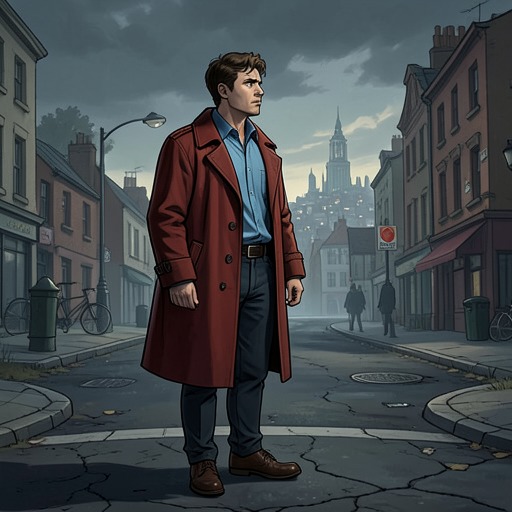
The Ideal of Quebec Sovereignty
SatanThe Ideal of Quebec Sovereignty is both a collective political aspiration and, in Loïc’s experience, a cause whose decline makes the loss of possibility painfully visible. Its spring 1985 crisis is embodied in René Lévesque and the Parti québécois: the movement’s historic champion remains at its head, but his party is turning against him and the promise he helped carry has become entangled with exhaustion, factional maneuvering, and broken hopes.
The Ideal and Its Political Bearer
For Loïc, the sovereignty cause had been part of his commitments since early youth. By 1985, he was working as a communications adviser within the government, preparing speeches and other remarks for Lévesque. Yet he had little faith that language alone could restore a party already adrift. The distinction matters: the ideal retains its force for him even as the political organization meant to advance it appears increasingly unable to act in its name.
The novel frames the crisis as more than an ordinary change of leadership. Lévesque had brought the ideal of independence further than anyone before him, and his political decline therefore seems bound to the weakening of a shared national aspiration. Loïc thinks of a people whose country remains unrealized, and of a once-magnetic leader whose fortunes had gathered collective will around him. When the leader falters, the movement’s confidence falters with him.
The Leader in Decline
At the start of the parliamentary session, Loïc is introduced to a group of ministers and members before an important meeting. Lévesque, coughing persistently, rises to pour coffee; as another coughing fit overtakes him, the coffee spills from the cup trembling in his hand. The scene makes his loss of control legible through a small mishap. In Loïc’s perception, party, power, and health are all slipping beyond the premier’s grasp.
The contrast with an earlier encounter sharpens the sense of reversal. Less than a decade before, Loïc had seen Lévesque triumphant in Ottawa, facing a then-ailing Pierre Elliott Trudeau. Now the sovereignist standard-bearer seems worn down and uncertain. Loïc reads his hesitant, digressive manner as the outward form of a leader trapped between action and inaction. The passage’s Shakespearean comparisons cast the political crisis as tragedy: not the plot of a calculating usurper, but the paralysis of a figure unable to resolve the question of whether to act.
Across the winter’s end and spring, Loïc witnesses the prolonged weakening of Lévesque’s leadership. The premier grows more openly angry as polls turn against the sovereignists. Reports of his health, along with rumors about his drinking and withdrawal, circulate through political life. The account presents these as rumors rather than established explanations; their significance lies in how they feed an atmosphere in which the leader’s private condition and the party’s public prospects become inseparable.
A Party Turning Inward
The government’s crisis is also a crisis of conduct. Two factions gather around potential successors, each maneuvering to attract ministers and legislators. An old college acquaintance of Loïc’s tries to recruit him into one of these efforts. Loïc refuses to join those who would strike at a weakened leader from within. His sense of integrity, which he recognizes as different from the social flexibility that can advance a career, makes loyalty a personal test as well as a political choice.
The wider caucus appears increasingly detached from its public purpose. Some members skip meetings; others are occupied with hockey or play poker into the early morning, giving their card games an official-sounding name. On terraces along Grande-Allée, politicians mock Lévesque’s condition and speculate about his resignation, then profess loyalty to journalists. The contrast between private derision and public allegiance makes the movement’s disintegration seem to occur not only in polling figures but in the gap between what its representatives say and what they do.
When Lévesque finally berates ministers and legislators for leaks that deepen public discouragement, the scene gathers the crisis into a single confrontation. He insists that he will leave when he chooses, not because his colleagues force him out. He also recognizes the bitter reversal: the party he founded is becoming an instrument of his condemnation. The image of a boomerang returning to strike its thrower gives the ideal’s political history a tragic circularity. The cause that once carried its leader forward now turns the consequences of his own creation back upon him.
Defeat, Memory, and the Unfinished Cause
Loïc is not a principal actor in these events. He describes himself as repeatedly placed near consequential moments without playing a major part in them, like an observer appointed to record rather than direct history. That position shapes his account of sovereignty: he can mourn the movement’s failure without claiming to speak for all those involved, and he sees the party’s struggle as part of a larger pattern of historical forces and inherited burdens.
In retrospect, he understands the spring of 1985 as the final act of a decline that began earlier in the decade. He also reads the party’s collapse alongside the unravelling of his adoptive family, as though political defeat and personal loss were distinct forms of a recurring curse. This is Loïc’s interpretation of events, not proof that the political crisis was caused by supernatural forces. Its importance is that it reveals how thoroughly he experiences history as a pattern in which chance seems to give way to necessity.
The day after the session ends, Loïc walks through Old Québec before returning to Montreal. He measures the parliamentary defeat against the heroic history of New France and the resilience of French settlement after the Conquest. What he sees in the present is a diminished collective will, consumed by quarrels and jealousies. Yet his bleakness briefly lifts when he notices a line of graffiti affirming that sight depends on having wept. The ending does not reverse the political defeat or restore the sovereignty project to its earlier confidence. Instead, it leaves the ideal suspended between grief and recognition: its bearer has fallen, but Loïc’s capacity to mourn is also a way of seeing what the cause once promised and what its failure has cost.