The Belief That Stones and Gems Store and Transmit Supernatural Energy
SatanThe Belief That Stones and Gems Store and Transmit Supernatural Energy presents precious stones not as inert possessions but as possible repositories of forces accumulated through history and ritual. Its central image is the family cameo: a material object that may concentrate harmful energies, exert power over people, and carry the traces of violence into the present. The novel does not settle whether this is supernatural fact or an explanatory belief. Instead, it sets ritual warning beside Loïc’s speculative reflections on matter, memory, and the reach of human thought.
Ritual Power and the Cameo
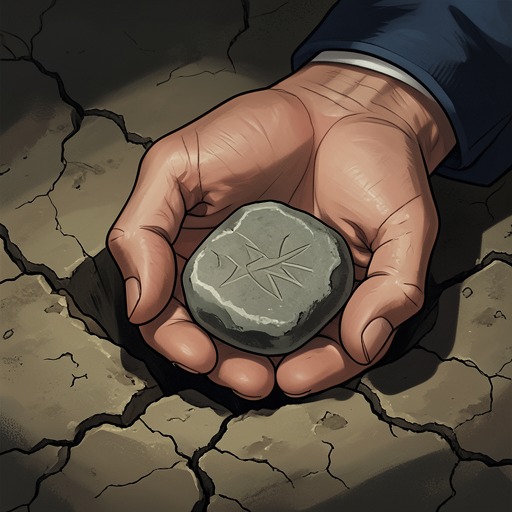
The idea first takes a practical, guarded form in Santería. The stone is described as a concentration of harmful waves in the surrounding air, comparable to a lightning rod that conducts and gathers malign discharges. On that account, it is not merely associated with danger: it concentrates danger, and should be quarantined. This language gives the object an active role in its environment, as though it could collect and redirect forces that otherwise remain dispersed.
Rodrigo Lerbier’s response complicates the warning. A jeweler by profession, he handles the cameo and senses its negative force even as the wrapped object cools in his pocket. He imagines that Santería might turn its exceptional energy to the benefit of its practitioners, provided the stone were kept in a sacred place devoted to Yoruba worship. He is drawn to the power he believes the object could confer, but seeks further knowledge before displaying it as an offering in his Havana temple. The attraction is therefore joined to caution: the cameo might serve as a source of power, but its force cannot be presumed safe or obedient.
To seek an answer, Rodrigo performs divination with palm nuts and asks the Orishas for a verdict. Chango, the deity of lightning and war, appears in an infernal vision and identifies the stone with the forces of evil and Hell. The vision warns that it could enable an extraordinary power to transform reality for someone who knows how to use it, or destroy someone who does not. It also imposes a condition on keeping the stone in a Yoruba place of worship: offerings must always be nearby, preferably human, or at least animal, to appease the spiritual ogre within it. Chango vanishes in a flash. The episode turns the cameo’s supposed power into a perilous obligation, not simply an instrument that Rodrigo can master.
Historical Traces and Radiating Matter
Loïc approaches the question through the histories attached to famous stones. He considers the Koh-i-Noor and the Black Orlov, both associated with India and the mines of Golconda, and with legends that connect their misfortune to removal from sacred images. He contrasts them with the Regent, which lacks the same reputation for a curse, though he wonders whether its history could also be read through the tragedies of the French monarchy and France after the reign of Louis XIV. These comparisons do not prove that stones cause the events around them. They show how a stone’s changing ownership and its passage through violent histories can invite a story of accumulated harm.
From that history Loïc develops a theory of transmission. Stones, whether cursed or not, have passed through many hands and events; he imagines that suffering, violence, cries, and tears might leave them charged with tragic vibrations. Such vibrations could then radiate into the surrounding atmosphere and affect human beings, particularly when the stones are exposed to the open air. The account reverses the usual relation between person and possession: rather than remaining a passive object whose meaning comes only from its owners, the stone may retain what it has encountered and exert an influence of its own.
The family cameo draws this line of thought toward enchantment. Loïc considers the possibility that malevolent forces might be projected into, or inserted into, an object through sorcery, as in rites he associates with African traditions. He then pushes beyond ritual explanations and wonders where evil could reside within the stone’s elementary particles. His questions move toward quantum memory and a nanoscale realm in which stones, trees, animals, and human thought might meet without clear boundaries. Matter, living beings, and thought become parts of a shared field in which forces could mingle, separate, or combine.
Thought, Memory, and the Limits of Explanation
Loïc cannot decide which direction the influence travels. Perhaps thought leaves a trace in the atoms of a stone; perhaps the electronic, photonic, or quantum radiation of thought is itself recorded in matter. He imagines such traces persisting in the vast movement of created nature. Humanity is materially only a small part of that whole, yet, through an intimate connection with Spirit, may be consequential within it. These reflections leave him in a vertigo of speculation rather than at a demonstrated conclusion. The novel’s terms of physics and metaphysics extend the question; they do not resolve it.
The next day, Loïc takes up the subject again with his father-in-law, distinguishing skepticism about stones’ curses from the broader possibility that objects, or even people, can be enchanted. That turn matters: the argument is not confined to whether a jewel is unlucky. It asks whether harmful influence can inhabit material things, pass between them and people, or persist beyond the moment of its origin. The cameo becomes a meeting point between inherited legend, religious interpretation, and a modern vocabulary of particles and radiation.
Narrative Significance
The competing accounts make uncertainty part of the concept’s force. Rodrigo’s divination supplies a vivid and specific warning, while Loïc’s reasoning offers analogies, historical examples, and unresolved questions. One account treats the stone as a spiritual concentration demanding ritual containment; the other considers how accumulated history might become a material trace. Both deny that the cameo is safely reducible to its market value or appearance, but neither gives a neutral measure of its power.
The notion of stored energy also binds past and present. A gem’s movement through owners and violent events supplies the imagined substance of its aura, while the possibility of radiation makes that past active in the present. In this way, the cameo is at once an object passed between people, a focus of ritual risk, and a model for thinking about how history might remain lodged in matter. The novel preserves the tension between supernatural explanation and speculative inquiry: the stone may carry a force, or human beings may be trying to understand history’s lingering weight through the image of a charged object.