Freemasonry
SatanFreemasonry is presented as a diverse fraternal tradition and, in the novel’s darker plotline, as a network that can be exploited by clandestine groups. Aurelio is recruited through a Cuban lodge and induced to steal a cursed cameo; later, Loïc’s research and the testimony of Rodrigo Lerbier connect the episode to a purportedly satanic inner circle. The novel leaves a consequential distinction in view: these characters’ claims about secret teachings and hidden influence are not the same as an account of Freemasonry as a whole.
A Diverse Institution
In conversation with Laurence, Loïc emphasizes that Freemasonry contains many kinds of lodges, rites, and obediences, enough that it might be more accurate to speak of Freemasonries in the plural. He names the Grand Orient of France, the United Grand Lodge of England, and the Scottish Rite as influential examples. In his account, some bodies require belief in God, sometimes described as the Great Architect, while others do not. This internal variety matters to the plot: the organization is not presented as a single, uniform authority, and membership alone does not establish what a particular lodge believes or does.
Loïc’s explanation turns to the Scottish Rite’s growth in the United States in the nineteenth century under Albert Pike, a publicist and former Confederate general who became a senior Masonic officer. Loïc says that Pike’s Morals and Dogma of the Ancient and Accepted Scottish Rite became an important text among American Freemasons. He also reports a claim attributed to Pike at an 1889 meeting of Masonic grand masters in Paris: that, for a true initiate, Lucifer was a god of good and truth, while Adonai represented the opposite. Loïc insists that historians have documented the statement and sees it as matching what Aurelio says he overheard. The claim is thus presented through a character’s research and interpretation, not as a description of the beliefs of Freemasons generally.
Aurelio’s Recruitment and the Stolen Cameo
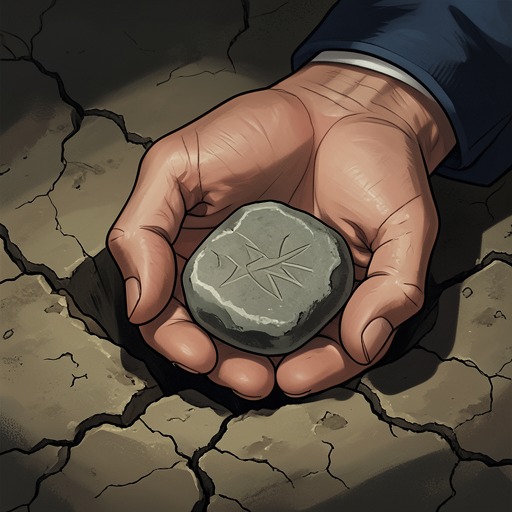
Aurelio’s account gives Freemasonry a direct role in the theft at the center of the supernatural plot. He admits to Rodrigo that he took the cameo for a newly founded Cuban lodge whose founders, he says, had protection within the Castro regime. They pressed him to join, suggesting that membership could bring advantages, including permission to leave Cuba and travel abroad. They also assured him that a Yoruba officiant could be a Freemason, and that some members of the order’s highest ranks held both roles. These assurances eventually persuaded him.
The lodge then made the theft his initiation test. Aurelio was told that malign forces had enchanted the jewel and that, unless it were neutralized or redirected by the collective spiritual force of the Masonic brothers, it could harm society and the world. The mission was framed as a service to humanity. In this account, the language of spiritual responsibility transforms a criminal act into a supposed rescue, helping the lodge secure Aurelio’s participation.
Aurelio says that a more or less clandestine Masonic route enabled him to cross into the United States. There, he was gradually drawn into a group whose members practiced unfamiliar rites; he describes the process as brainwashing. His religious path shifted from Santería to Palo Mayombe, which the narrative associates with invoking the dead and forces of nature. The account traces his increasing involvement in occult practices and his growing fearsome reputation, until Satan took the place of a god and, for Aurelio, a substitute father. The Masonic connection in this passage is therefore a pathway into a darker group, rather than a claim that ordinary lodge membership necessarily leads to such practices.
The Alleged Inner Circle
Aurelio’s suspicion about the group’s doctrine rests in part on a conversation he says he overheard in Florida. Keeping out of sight behind palm trees, he recognized the familiar voices of a sect leader and a masked regular at its rites. He says he heard the masked man describe Lucifer as the god of good and truth and Adonai as the reverse, and later heard the men claim that Lucifer ruled the earth and granted power, wealth, and freedom to his adherents. Rodrigo interprets this as a deliberate reversal of the meanings of God and Satan, and Loïc places that reversal within a wider modern history of inverted values. Laurence, in turn, remarks that the vast majority of people would be excluded from the privilege the men describe.
The conversation also extends the claim from ritual teaching to public symbols. Loïc observes that Masonic imagery appears on the United States dollar and the Great Seal of the United States, and suggests that initiates in the group might read the eye on those emblems as Lucifer’s gaze rather than the eye of Providence. This is the characters’ reading of the symbols, not independent proof of a hidden doctrine. Its narrative force comes from the way public emblems are made to seem newly suspect once the alleged secret teaching has been disclosed.
Networks, Doubt, and Narrative Consequences
When Laurence says that her father is a Freemason, the revelation complicates the discussion. She is troubled by the apparent connection between Masons and Satanists, and asks whether the masked speaker could really have been a Freemason. Loïc answers not by treating all Freemasonry as satanic, but by stressing the variety of rites and lodges and recounting his research into Pike. The exchange keeps a distinction between a broad institution and a secretive faction, even as the plot encourages the characters to wonder where one might intersect with the other.
Freemasonry also functions as a practical network in Charles de Castelmont’s pursuit of the cameo. After concluding that officials in New York had received counterfeits, he considers using influential contacts and what he calls occult Masonic networks to locate the genuine object. Victor Bourdieu and Pierre de Mirbeau might help; Mirbeau, a Mason of higher rank than Charles, could open doors. Mirbeau had also introduced Charles to Jeff, a wealthy and well-connected initiate. Jeff, in turn, relies on intermediaries and covert influence while trying to recover the jewel from a sect whose hidden leader is described as both a senior Scottish Rite figure and a powerful government official. The same associational world that Aurelio experiences as a route out of Cuba and into danger becomes, for Charles and Jeff, a possible instrument of access and recovery.
This double use gives Freemasonry its narrative significance. It is at once internally varied, attractive as a source of advancement and mobility, and vulnerable in the story to manipulation by people who claim privileged knowledge. Its lodges and affiliations offer characters routes across political and social boundaries, but they also make secrecy an instrument of persuasion. The novel’s tension lies in that ambiguity: the characters cannot easily separate genuine institutional variety from the opportunistic claims of people who invoke hidden ranks, rituals, and power.