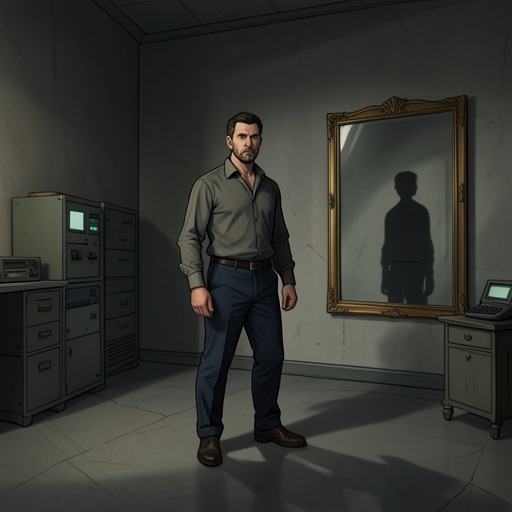
Seeking Union with the Deceased Twin Sister
SatanSeeking Union with the Deceased Twin Sister is the spiritual and emotional pattern through which Loïc tries to understand a sister he never knew he had. The revelation that she died before birth, yet was expelled from their mother’s body after death and remained beside her in the grave, gives a terrible physical image to a presence Loïc says he had sensed since childhood. The sister cannot be recovered as a remembered person; instead, her absence becomes an inward force, shaping his longing for a union no earthly relationship seems able to complete.
The Revelation and Its Uncanny Image
At the disclosure, Loïc is struck less by the medical explanation than by the image itself: his dead twin, almost skeletal, still attached to their mother by a dried umbilical cord. The doctor explains that the rare event is known as postmortem fetal expulsion, or coffin birth, when gases in the mother’s body push the fetus from the uterus. That clinical account establishes how the sister could have been found, but it does not settle what her existence means to Loïc.
He reproaches his uncle for not telling him earlier. The doctor had discovered that the baby was dead during the effort to stop the mother’s hemorrhage, but chose not to burden the family then; he later left the village carrying guilt over both the mother’s death and his silence. Guillaume, Loïc is told, had waited until he was an adult and may not have been able to bear telling him. Loïc accepts that there is now no one left to blame, even as the belated knowledge overturns his understanding of his own beginnings.
The image of the twin in the grave joins birth and death in a single scene: the siblings were physically connected before birth, but Loïc’s life began through separation, while his sister remained bound to their dead mother. He does not say that he remembers her. Rather, he recognizes the disclosure as an explanation for an older, less definite sensation: throughout childhood he had often felt a presence around him, or even within him. The revelation makes that private impression newly legible without proving that the presence was supernatural.
A Longing for Fusion
Loïc later interprets his desire for intense closeness through this lost beginning. He sees a recurring search for fusion in his love affairs and passions, and, less intensely, in his friendships; even his friendship with Régis does not escape the pattern. The relationships disappoint him because the unity he seeks cannot be sustained by physical intimacy or shared feeling. His account does not treat the longing as a simple wish for companionship: it is a hunger for a completeness he associates with a bond that existed before he could remember it and was broken at birth.
The dead twin’s imprint, he conjectures, may have been repressed as memory while remaining active as a bodily or inward sensation. In this reading, the sister is both a lost person and an organizing absence: the original fusion against which later attachments are measured. Loïc imagines a threefold union encompassing mother and sister together, a completion unavailable through ordinary earthly love. The sister’s absence thus becomes paradoxically active, prompting him to seek what her death made impossible.
This pattern also casts light on his troubled intimacy with Brigitte. He reflects on their relationship as having moved from exaltation into conflict: an intense desire for fusion gave way to pain, domination, and emotional exhaustion. He finds no lasting answer in the temporary joining of bodies, which ultimately feels hollow rather than complete. The twin’s story does not erase the specific failures of that relationship; it gives Loïc a larger, tragic framework in which to understand why desire for unity repeatedly exceeds what a human relationship can provide.
Laurence as Soul Twin and Possible Return
When Loïc meets Laurence, he experiences a striking contrast with those earlier disappointments. Their connection makes him feel, for the first time, that he is no longer alone. They often find themselves thinking the same thing at the same moment, sometimes arriving at the same phrase or expression. Their relation feels to him like an exchange in which thought and feeling answer each other, a communion that approaches the unity he has long sought.
That experience leads Loïc to wonder whether Laurence could be the reincarnation of the sister who never lived. This is presented as his speculation, not as a fact established by the narrative. Her empathy for living beings strengthens his sense that she is unusually receptive to others, while their shared fear of entering another painful love makes their cautious physical approach a meaningful part of the bond. The relationship offers him intimacy without immediately dissolving into the destructive pattern he associates with fusion.
The connection also arrives as Loïc’s investigation of the Founder’s cameo has begun to lead toward France. Laurence’s background in an old aristocratic lineage makes her, in his eyes, both a possible soul twin and a key to the historical mystery. He wonders whether events have been guided by forces beyond the visible and immediate, and whether his sister has returned in another life to complete his being. The narrative joins emotional recognition to the search for family origins, but leaves the metaphysical explanation open: Laurence may feel like a providential answer without being demonstrably the reincarnated twin.
From Spectral Presence Toward Spiritual Union
Loïc’s understanding of the sister changes from an unspoken childhood sensation into a consciously interpreted series of encounters. After learning the truth, he regards the uncanny calls he had experienced in childhood—and further calls he expects later—as stages, some painful and some consoling, along a path toward union with God. The desired completion therefore shifts beyond reunion with the dead sister in any literal, earthly sense. She remains the first figure through whom Loïc can imagine an original unity, while spiritual union becomes the possible destination of the longing she represents.
This is an interpretation Loïc reaches through reflection, not a certainty that removes grief or explains every unusual experience. His imagined return of the twin through Laurence, his sense of a presence within him, and his eventual understanding of these episodes as steps toward God remain layered possibilities. The concept holds together what the story does not resolve: a medical event with a physical explanation, an inward experience that cannot be verified, and a religious hope for transcendence.
The motif’s force lies in that unresolved passage from separation to communion. Loïc’s sister is at once the real stillborn child disclosed in the family’s history, the absent companion he believes he sensed, and the figure through whom he interprets failed intimacy and spiritual desire. His search does not restore the lost beginning. It gives its absence a shape—and makes the longing for wholeness, rather than a recovered memory, the continuing consequence of their separation.