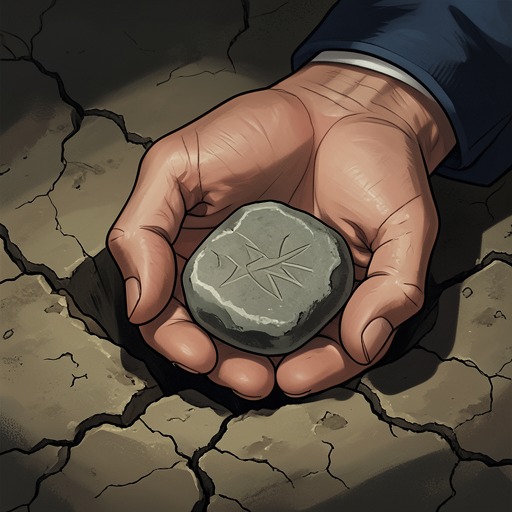
Vibratory Memory of the Past
SatanVibratory Memory of the Past is the name given to Loïc’s dormant ability to sense the lingering traces of past events. Through a state of concentrated resonance, he experiences places and objects as repositories of emotional and historical impressions. The faculty turns his search for the cameo into an encounter with broken images from other times: scenes arrive in fragments, recur insistently, and only gradually suggest a history linking the object to his maternal family.
The Gift and Its Awakening
Loïc’s ability does not appear to him all at once. A series of shocks and upheavals prompts him to rediscover a capacity he had possessed since childhood, though it had remained buried in unconscious depths. The narrative describes him as a kind of dowser of time, able to detect, perceive, and retrace the energetic impressions left by decisive events, intense emotions, and dramas inscribed in places—as if some subatomic memory had preserved them. The image makes memory less a private recollection than a trace embedded in the world, waiting for someone capable of registering it.
His understanding of the gift develops through earlier experiences that only later cohere. On a psychoanalyst’s couch, he had recovered memories of childhood flights at night; he had also sensed invisible presences. More decisively, a session with a medium in the 1990s, shortly before Régis D’Anjou’s death, brought him to fuller awareness of his ability to perceive waves from parallel universes. The account qualifies this power through its conditions: Loïc must attain the right state of resonance by psychic concentration, a nervous paroxysm that lets him sense beyond immediate reality. The exertion is considerable, and he cannot sustain it for long or use it too frequently.
Reading Traces Across Time
After the events of 2001, and with Régis’s papers as a legacy, Loïc takes up the search for the cameo by following its vibratory trace through time and space. This is not presented as a straightforward investigation in which evidence yields a continuous account. Instead, fragments press upon him when he sleeps or enters a meditative, waking-dream state, in a region described as infraconscious. The images pass before him like sequences from expressionist cinema: forms, silhouettes, and ectoplasmic figures first emerge indistinctly, then sometimes sharpen into clearer perceptions.
The method joins concentration to involuntary reception. Loïc seeks the trace, but what he receives remains partial and difficult to control; an image can clarify for a fraction of a second and then dissolve before he can grasp it. His pursuit therefore depends on recognizing recurrence as well as on waiting for detail. The past is not restored as a complete record. It comes through as scattered impressions whose relation to one another—and to the present search—must be worked out over time.
Repeated Images and Historical Clues
Several scenes return like dramatic leitmotifs. One shows a landscape swept by blizzard snow, with a man intermittently emerging from and disappearing beneath the driven flakes. A woman with a darkened face then appears, laboring through the snow while holding something close to her, a bundle she seems to protect. The image changes almost imperceptibly: snow becomes a fall of tiny feathers, spreading across the space and sky until the horizons are covered in whiteness. The shift preserves the scene’s striking visual continuity while making it uncanny; the recurring impression is not a stable picture but a sequence transformed from within.
Another image places the woman in immediate danger. Terror is fixed on her face as she holds a child and flees an approaching fire, which reddens the horizon. She repeatedly looks behind her to see whether she is being followed. Other scenes follow without dissolving into one another, like pieces in an oneiric kaleidoscope. Their abrupt succession denies Loïc the reassuring order of a continuous narrative. Repetition provides a pattern, but not yet an explanation: the woman, the child, the snow, and the fire return before he can establish their historical circumstances.
A more distant fragment shows a young boy shouting amid an excited crowd gathered around a large, sinister black contraption raised on a platform. Its details blur or appear only for an instant. Loïc cannot seize them, and the image deepens his frustration even as it strengthens his sense that he is approaching the key to the cameo and to the origins of his maternal family. The visions thus carry two kinds of promise at once: they offer clues, while withholding enough detail to keep the past unresolved.
From Vision to Historical Recognition
The transformation from impression to knowledge occurs when Loïc reads Régis’s written account. He is overjoyed above the pages, whose nervous handwriting belongs to the person whose research he has taken over. The snowbound woman, previously a recurring and almost eidetic fantasy, now takes on body and life in historical time. What he had experienced as an image becomes recognizable as something that must have happened.
That recognition gives the concept its investigative force without making the visions a complete solution. The fragments have prepared Loïc to recognize a scene when documentary evidence gives it historical form; they have not, by themselves, supplied every circumstance or answered every question. Vibratory memory works through convergence between sensation and the written record. Régis’s papers do not merely add information to an independent investigation: they allow the recurring image to become legible as a trace of the past.
Narrative Function
The concept organizes history as a return of incomplete impressions rather than as a seamless chronology. Snow, feathers, fire, the fleeing woman, and the fleeting crowd scene recur in altered degrees of clarity, making repetition the means by which the past presses into Loïc’s present. Their fragmentary form preserves uncertainty even as it creates the growing conviction that the images belong to a decipherable history.
Vibratory Memory of the Past also binds a personal search to a larger question of origin. Loïc follows the cameo’s trace, but the images increasingly direct his attention toward his maternal family and the events behind its history. In the moment when the woman’s image becomes historical, the distance between private perception and collective record narrows. The narrative leaves the gift’s ultimate status unexplained; its importance lies in how it turns obscure sensations into clues and enables Loïc to recognize a past that ordinary recollection could not reach.