The Narcissistic Mirror
SatanThe Narcissistic Mirror names a recurring pattern in Loïc’s relationships and self-understanding: he seeks in another person a reflection that will make him feel more complete, vivid, or intelligible. The pattern’s most intense expression is his relationship with Brigitte, whose mutual attraction seems to promise fusion but becomes a destructive contest between two egos. Later, Loïc recognizes that the mirror is not a true self, but a substitute that protects him from the risk of existing without an image to confirm him.
The Reflective Couple
An early image of Loïc and Brigitte places them together before large darkened windows, glasses in hand, their attention turned for a moment toward the illuminated skyscrapers downtown. The glass reflects both of them at once. Looking back, Loïc understands this paired reflection as a prefiguration of their relationship: each would need the other to sustain an advantageous image of themselves. The couple’s shared need for a reflection would grow increasingly demanding and tyrannical, and the image that first seems to promise mutual recognition already contains the possibility of fracture.
Loïc later imagines his attraction as a kind of hypnosis, a pull into the orbit of an object at once magnificent and malign. The language of attraction makes the mirror less a calm surface than a force field: each person draws the other in, and neither can easily distinguish desire for the beloved from desire for the self enlarged in the beloved’s gaze. Loïc is captivated by Brigitte’s eroticism, her elusive charm, and her foreign accent; she, in turn, needs his charisma. Their attachment thus begins as an exchange of complementary needs, not simply as affection between two independent selves.
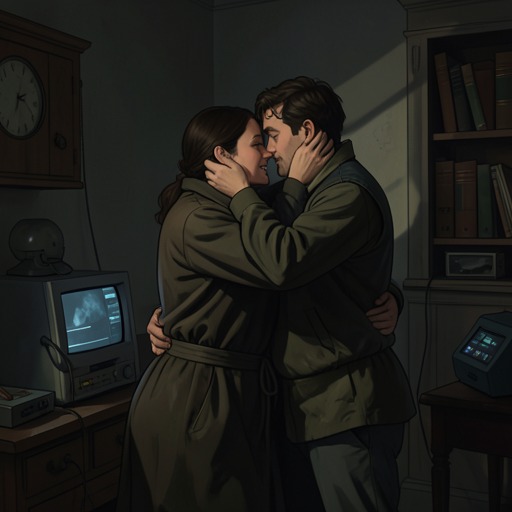
In the first phase of the relationship, the two seem to find a sensuous, nearly wordless accord. Loïc, ordinarily intent on naming what he sees and feels, stops trying to explain the passion. He understands only later that their pleasure included a reciprocal act of self-contemplation: each could see themselves reflected in the splendor of their youth. The apparent union feels complete in the moment, but its promise depends on the other continuing to provide the desired image.
When Intimacy Turns Against Itself
The relationship’s change from exaltation to conflict exposes the violence within the mirror’s promise. The same irrational intensity that seems to magnetize Loïc and Brigitte toward one another comes to animate their fury. Caresses give way to assaults; the impulse to embrace becomes an urge to crush. Their encounters combine sex and violence, tenderness and pain, submission and domination, so that the union they sought no longer offers a stable or sustaining reflection.
The account does not present this deterioration as a simple opposition between a loving beginning and an unrelated later crisis. Rather, the destructive conflict emerges from the same charged connection that first promised self-completion. Loïc’s later interpretation is that the desire for fusion proved to be a false appearance: the bodies could briefly move together, but this momentary unanimity of sensation did not amount to enduring unity. Once that appearance emptied of meaning, the relationship’s acts of intimacy became either mechanical satisfaction or contests between egos.
The mirror is therefore double-edged. It can magnify each partner in the other’s presence, but it also makes each dependent on the reflection and more vulnerable to its failure. The couple’s early self-contemplation and its later struggles for submission and dominance belong to the same structure. Their collapse shows the cost of treating another person as the means to a perfected self-image: when that image cannot be maintained, desire can turn into resentment and aggression.
The Wider Pattern of Fusion
Brigitte’s relationship is the most intense instance of a broader pattern. Loïc reflects that other loves and passions had also disappointed him, though less dramatically, when he sought a comparable fusion. Even his friendship with Régis did not escape the limits of this longing. The recurrence makes the mirror more than a feature of one couple’s private history: it is a habitual way Loïc approaches closeness, hoping that a relationship will bridge the separation he feels within himself.
Loïc connects that hunger, tentatively, to the drama of his birth. He had been tragically separated from his stillborn twin sister; although he had repressed any conscious memory of her, he considers whether an intimate, bodily imprint of that lost twin might continue to exert force in his unconscious. The text presents this as Loïc’s attempt to understand his desire, not as a confirmed explanation. In his speculation, the mirror-seeking and the urge toward fusion repeat, at the level of adult attachment, a separation that preceded conscious memory. The hoped-for union would have to include not only a lover but the lost mother and sister, a complete fusion that no earthly relationship seems able to provide.
Breaking the Mirror
Loïc eventually sees that escape requires breaking what he calls the fatal narcissistic mirror. The task is not merely to leave one damaging attachment behind; it is to accept being without a reflection, to enter darkness without relying on another person or an imagined self-image to make him appear larger. He comes to regard every such mirror as a substitute and a disguise that spares him the risk of being himself without an idealized double.
This recognition is connected to his scrutiny of the succession of mirrors that had served as refuge, defense, and self-enhancement. When those images fall away, Loïc imagines that nothing remains of him, that his unreflected self is minute beside the selves the mirrors had magnified. The fear makes the mirror’s attraction understandable: it offers not just admiration but apparent substance. Yet remaining inside it would preserve dependence on the image rather than resolve the question of who he is without it.
Writing offers a possible way through that impasse. For Loïc, sincere writing, insofar as it does not compromise with truth, can illuminate the enclosed self and pierce the membrane of the ego curled inward upon itself. It does not promise another flattering reflection. Instead, it can expose the defense that reflection supplies and make an encounter with the self possible. The Narcissistic Mirror thus traces a movement from reflected identity and imagined fusion, through the violence of their failure, toward the harder possibility of self-knowledge without a confirming image.