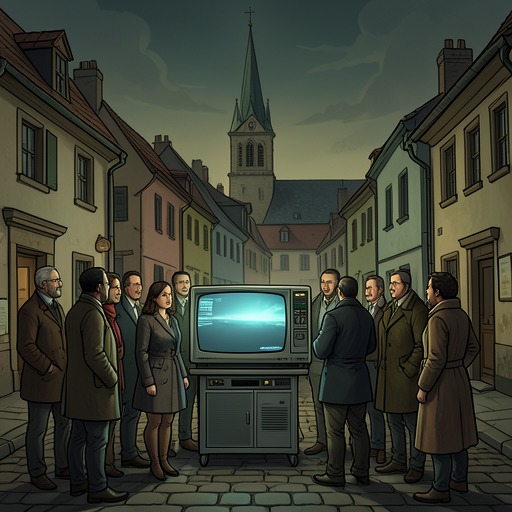
Touladi’s First Television Broadcast Reception (1954)
SatanTouladi’s First Television Broadcast Reception (1954) marks the arrival of television in the village and the start of a rapid change in how its residents gathered, entertained themselves, and understood the world beyond their home. On November 21, a television installed at the Founder’s House drew around a hundred people into and around the home. The first moving images seemed at once miraculous and unsettling; in the years that followed, the screen became a new communal focus, then a force that increasingly displaced older forms of shared life.
Preparing the First Reception
In the middle of the 1950s, the Founder’s House briefly became the village’s foremost home again—not because of its ancestry, but because it was chosen to receive a new technology. Guillaume D’Anjou wanted the D’Anjou family’s heritage house to be the first in Touladi with television, and arranged for the equipment to reach it. A tall mast was erected beside the house to carry a large, many-branched antenna, pointed due north to catch signals coming from Rimouski across the hills.
The television itself was a large, varnished cube. On one face, its glass screen looked like an enormous open eye. Guillaume placed it in a clear corner at the back of the living room, to the right of the Founder’s portrait. The positioning brought old family authority and the new device into the same field of view: the portrait of the Founder watched over a room whose newest object promised to show distant people and places.
The Gathering and the First Images
Loïc remembered the autumn Sunday as a day of impatient waiting. He and his cousins watched for the television’s great eye to begin flickering, while the house filled with visitors. About a hundred people arrived, many hours ahead of the scheduled broadcast; those who could not fit indoors gathered outside and peered through the windows. The occasion had the air of a public ceremony, though its anticipated marvel was not a church service but a machine at the heart of a family home.
On November 21, 1954, the villagers first stared at the head of an Indigenous person displayed on the screen. The image carried a pointed historical resonance in the narration: it evoked the long centuries in which the country’s first inhabitants had lived without memory or representation in the images available to others. Then the television’s luminous eye came alive. Voices and faces, gestures and scenes of life from Montreal and elsewhere appeared in motion, transmitted across hundreds or thousands of kilometres, beyond mountains, rivers, and forests.
The new immediacy disturbed as well as astonished. Radio had already brought distant voices into Touladi homes, but television made faraway people appear almost bodily present. A person in Montreal, roughly 500 kilometres away, could seem to arrive in the living room and address viewers face to face. The shock registered physically: the narration notes clenched jaws, sweat on faces, and trembling lips among those who watched. The screen did not merely deliver information; it made distance feel newly permeable, and this sudden closeness briefly left some viewers stunned.
A New Center of Village Life
The first reception introduced Touladi to what the narrative calls the global village, as electromagnetic signals began drawing the community into a wider network. The change would gather pace from the 1960s onward, especially for the children. The image of the village being caught up and carried away by the waves gives the broadcast a double meaning: television connected residents to places beyond the hills, while also pulling attention away from local habits and shared spaces.
That alteration soon became visible in the daily rhythm of the village. When popular serials were on, the streets and the areas around the houses emptied—more completely, the account suggests, than during Sunday Mass. Evening visits to play cards or checkers, or simply to talk, became less common. At first, residents still went to one another’s homes to watch together; later, as individual families acquired television sets, viewing no longer required the same collective gathering. The technology thus moved from a shared spectacle to a private household possession, changing not only what people watched but where, and with whom, they spent their evenings.
Religious and Cultural Reversal
Television’s arrival also unsettled the village’s religious order. The day of rest had once been set aside for the Lord, but the new device made Sunday an occasion for a different kind of attention. As television’s lessons, described ironically as democratic, attracted its audience, the priest’s sermons increasingly fell on distracted ears. The screen became a modern pulpit, while the blinking eye of the great television goddess displaced, in the account’s sharp contrast, the eye of God and relegated older belief to the status of something archaic and incompatible with progress.
The episode’s significance lies in this transformation from a single, eagerly awaited broadcast to a new regime of attention. The crowd’s initial wonder, the bodily unease of seeing distant strangers appear in the room, and the later emptying of streets form successive stages of the same change. Television made the outside world present in Touladi, but its growing domestic presence also weakened the village’s customary gatherings and competed with the church for the community’s time and regard.