Father Alvito, Jesuit negotiator
ShōgunFather Alvito, Jesuit negotiator, is the Church’s working intermediary in Toranaga’s negotiations with the Portuguese and the Christian daimyos. He moves between languages, institutions, and competing claims of loyalty: presenting evidence that casts John Blackthorne as a pirate, explaining the Church’s position to Toranaga, and bargaining for Christian political support in exchange for a temple in Yedo. His role makes visible the difficulty of separating religion from the trade and power on which the Jesuit presence in Japan depends.
Identity and Position
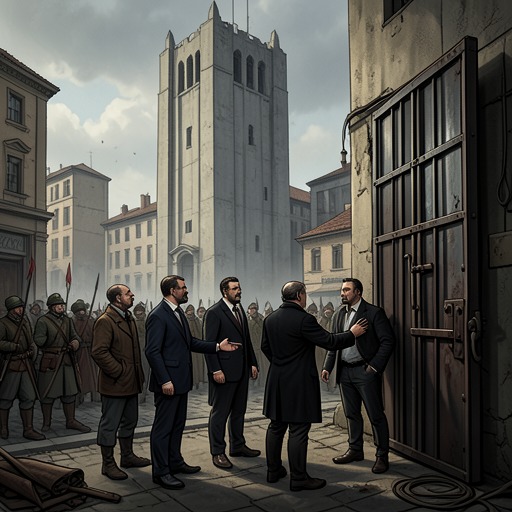
Alvito arrives in Osaka at the head of the Jesuits’ customary mounted escort: forty Japanese Christian samurai, well-born sons educated at the seminary in Nagasaki. They are disguised as Buddhist priests, with rosaries and crucifixes at their waists, but ride and keep formation with the discipline of a daimyo’s retinue. Their appearance combines concealment with unmistakable institutional strength. Alvito’s authority is therefore not merely clerical; he travels with a substantial, trained company drawn from the Christian community.
His destination is the Jesuit Mission, a large European-style stone house near Osaka’s wharves. Its clustered outbuildings include treasure rooms and warehouses where the city’s silks are bartered and paid for. The setting joins spiritual organization to commercial infrastructure before Alvito enters a single negotiation. He rides through the gates, crosses the courtyards and cloistered walk, passes the chapel, and reaches the inner garden. There he composes himself before meeting Carlo dell’Aqua, the Father-Visitor of Asia and the most senior Jesuit in the region. Alvito’s anxiety at the meeting underscores that he reports within a hierarchy even as he acts as its principal voice in dealings with Toranaga.
Toranaga’s Questions and the Church’s Exposure
Alvito carries to dell’Aqua an account of Toranaga’s questions about the Church’s political past. Toranaga has raised a letter Father da Cunha wrote in 1588 to the governors of Macao and Goa and the Spanish Viceroy in Manila, requesting hundreds of Spanish soldiers to support Christian daimyos in rebellion against the Taikō. He also asks whether guns were smuggled from Macao into Nagasaki under the Christian seal, and whether the Father-Giant later seized and secretly shipped those weapons back to Macao aboard the Santa Cruz. Alvito recounts these allegations in detail; afterward, he wipes sweat from his hands. The gesture gives the exchange a physical measure of the danger in questions that turn religious history into evidence of political intervention.
When dell’Aqua asks who interpreted for Toranaga, Alvito rules out Brother Manuel, formerly Masamanu Jiro. Jiro had been educated by the Jesuits from childhood and selected for training toward ordination, but left the Society before becoming a priest and had become a violent opponent of the Church. Alvito says Jiro remains in Kyushu and would not assist Toranaga; he adds that Jiro had never been privy to political secrets. Instead, Alvito identifies Toda Mariko, using her Christian name, as the interpreter. He does not claim Toranaga told him this: he knows Mariko has visited the castle and has been seen with Blackthorne. His conclusion rests on observation, illustrating how information about access and association circulates alongside formal diplomatic statements.
Evidence, Translation, and Political Position
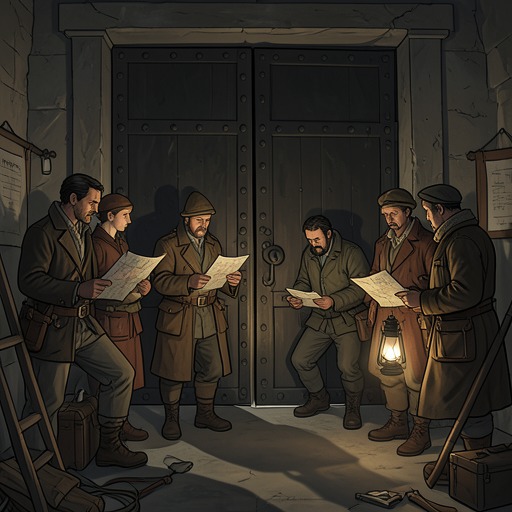
Alvito later brings Blackthorne’s rutters to Toranaga, setting them on the floor and offering the explanations dell’Aqua had suggested. He identifies them as proof of piracy and points to orders authorizing the English to land in force and claim territory they reach or discover. The books are more than a charge against Blackthorne: their written instructions give Alvito a way to present European maritime expansion as a direct concern for Toranaga’s rule. Yet Toranaga frames the wider crisis in terms Alvito cannot resolve by appeal to religious neutrality. The Empire, he says, is being split between his camp and Ishido’s, with no middle course, and asks where the Christians stand.
Alvito answers that Christianity is a religion, not a political ideology, and places the Christians on the side of peace. The answer states the Church’s desired distinction, but the surrounding negotiations put that distinction under pressure. Toranaga points out that the Church’s Father-Giant heads its organization in Japan and that Alvito can speak in the Pope’s name. Alvito is thus asked to answer not only for his own intentions but for the political reach of the institution he represents.
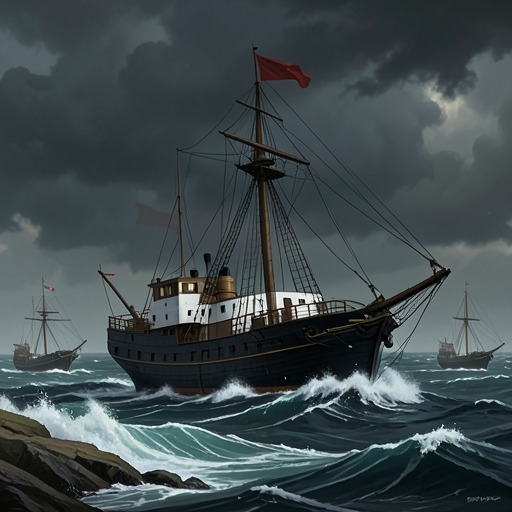
The tension becomes concrete during the confrontation at sea. When the galley carrying Toranaga comes into view, Alvito reports that it is flying Toranaga’s flag. Captain-General Ferriera dismisses the colors as false, but Alvito’s report makes clear that the ship’s identity has been recognized. Later, when Ferriera proposes a pretext to attack, dell’Aqua orders him not to proceed. Alvito then shouts across to the galley, threatening the supposed bandits with damnation and warning that the Captain-General will blow them to eternal torment. The exchange shows him performing both the Jesuit’s religious authority and the urgent work of negotiation amid an armed standoff.
At the subsequent discussion, Alvito does not translate Ferriera’s proposal to trade. Instead, he tells Toranaga that the Portuguese are merely traders seeking to avoid interference in Japanese politics. Mariko immediately says that this is not what Ferriera said. Alvito acknowledges that he has transposed some of the captain’s words, explaining that Ferriera does not understand Japanese politenesses. His intervention is a calculated alteration, not a neutral rendering: he manages what Toranaga hears, but Mariko’s correction exposes that control and restores the dispute to the open.
Temple Bargain and Limits of Mediation
When Toranaga raises the possibility of building a large Christian temple in Yedo, Alvito briefly stops interpreting because he recognizes the importance of the offer. Dell’Aqua has sought such a concession for years, ever since Toranaga became Lord of the Eight Provinces. The proposal comes while the parties are also addressing the problem of the cannon, making the temple part of a larger political bargain rather than a detached act of religious patronage. Dell’Aqua tells Alvito to thank Toranaga and affirm that the Church will endeavor to serve him; Alvito conveys that commitment directly. Toranaga objects that endeavor is abstract and unsatisfactory, reminding the negotiators that assurances must be judged by what they actually promise.
The exchange becomes more specific when Toranaga asks Alvito to help persuade Lords Onoshi and Kiyama to become his allies. Alvito gives his personal word, before God and the Blessed Cross, that he will do everything he can. In return, Toranaga promises that on the forty-first day they may lay the foundation stone for the biggest Christian temple in the Empire. The promise supplies a date and a public, material reward; Alvito’s pledge supplies effort, but not a guarantee that the daimyos will be won over. His final position is consequently both powerful and bounded: he can speak for the Church, translate and shape negotiations, and commit himself to mediation, but the political outcome depends on other actors. Through him, the novel presents diplomacy as a contest over not only allegiance but also who controls the wording by which allegiance is represented.