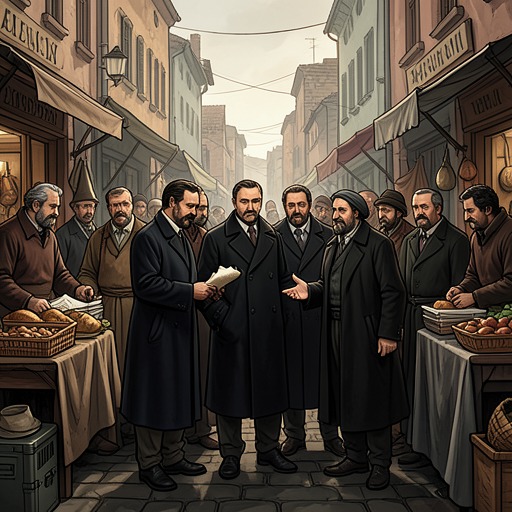
Friar Perez
ShōgunFriar Perez is a missionary of the Brethren of God whose defiance of a papal order brings the conflict between the mendicant friars and the Jesuits into the open. Summoned by Dell’Aqua, he refuses to accept that the Jesuits can speak for the Church or compel his departure from Japan. His confrontation gives the dispute a personal edge, but its stakes are institutional: who may enter Japan, which religious order controls that access, and what kind of conduct constitutes service to Christ.
Identity and Setting
Friar Perez appears in the account as a member of the Brethren of God and a representative of their mission in Japan. The evidence does not establish his earlier history or formal rank within the order. It does show him operating in opposition to the Jesuit Father-Visitor Dell’Aqua, who has summoned him and presents him with an order from the Pope. Perez’s position is not simply that of a subordinate resisting a superior: he rejects the authority of the Jesuits to enforce the order and disputes the religious legitimacy of the institution behind it.
The encounter takes place after tremors and fires have damaged the Jesuit chapel and killed people nearby. Dell’Aqua reports that no one was hurt at the chapel and expects it to be rebuilt within days. Perez, by contrast, says that his own mission was untouched despite fires around it and many deaths. He interprets this survival as divine protection. That claim establishes a sharply contrasting spiritual frame for the conversation: Dell’Aqua speaks from the damaged Jesuit compound, while Perez presents the preservation of his mission as evidence that God watches over the Brethren.
The Papal Order
Dell’Aqua has Soldi intercept Perez as he approaches, but then chooses to receive him immediately. After briefly discussing the earthquake damage and the condition of their respective missions, Dell’Aqua turns the meeting to its purpose and has Soldi bring in a letter. He gives Perez the papal order, which had arrived the previous day by special messenger from Macao.
The order, formally agreed to by the King of Spain, imposes a tightly controlled route for priests travelling to Japan. Priests of every order are to travel by way of Lisbon, Goa, and Macao; direct passage from Manila is forbidden on pain of immediate excommunication. It also directs all priests who are not Jesuits to leave Japan at once for Manila. They may return only if their superiors permit it, and then only by the prescribed route. Its terms therefore do more than demand Perez’s departure: they place the future presence of non-Jesuit clergy under restrictions that could make their return dependent on routes and permissions controlled by others.
Perez examines the seal, signature, and date, reads the order again, and dismisses it as unbelievable. He calls it another attack on the Brethren and argues that the Portuguese, aided by the Jesuits, will use the travel restrictions to deny mendicant friars passage indefinitely. He treats the document not as a neutral rule of church discipline but as a political device that could exclude his order from Japan. Dell’Aqua answers with the immediate consequence: Perez must leave or face excommunication.
Confrontation with Dell’Aqua
The argument expands from travel permissions to the nature of religious authority. Perez maintains that the Jesuits cannot claim the voice of God simply because they act in the Pope’s name. He depicts them as political agents who serve an earthly institution and benefit from silk, land, wealth, influence, and power. Against that image, he invokes Christ as a simple, barefoot man who served others. He declares that neither he nor his brothers will leave Japan, despite Dell’Aqua’s threat.
Perez also challenges Dell’Aqua on conduct and religious understanding. Earlier, after claiming to understand Japanese political violence and to speak the local language, he is told that he does not understand manners. Perez responds that the Word of God requires no such thing. He then pointedly raises adultery and harlots, turning the exchange toward moral failings as well as institutional rivalry. These accusations belong to his polemic against the Jesuits; the scene presents them as Perez’s attack, not as an independent finding about Dell’Aqua.
His appeal is also practical. Perez tells Dell’Aqua that, if he wants to minister, he should come to the Brethren’s mission and serve the poor, sick, and unwanted, following Christ’s example. The contrast he draws is between clerical power and direct care for people in need. Even while refusing the order, he offers an alternative standard by which religious authority should be judged: service rather than political influence.
Claims and Narrative Significance
Perez leaves the encounter insisting that he will write to the Pope, but he also announces that Dell’Aqua should expect a Spanish bishop, a Spanish viceroy, and a Spanish captain of the Black Ship under a royal warrant. He claims that the King of Spain has overthrown the Jesuit General in Rome and that the Society’s enemies have finally defeated the Jesuits. The account does not confirm these claims as fact. Their force lies in the confidence with which Perez presents a reversal of power that Dell’Aqua rejects as lies and rumor.
The meeting ends without reconciliation. Perez leaves after telling Dell’Aqua to come to the mission if he wants to see him again; Soldi watches him go, then returns to find Dell’Aqua visibly shaken. The Father-Visitor stares into the distance, recalling that reports from the Court of Philip of Spain in Madrid had, for the past year, warned of the growing influence of the Society’s enemies. Perez’s announcement thus lands on existing Jesuit anxiety rather than arriving in a vacuum.
As a character, Perez functions as both an adversary and a messenger of institutional change. His certainty, abrasive manner, and refusal to submit make the confrontation combustible, while his account of the untouched mission and his appeal to care for the poor give his resistance a religious rationale. The scene leaves the political truth of his predictions unresolved, but it makes clear that the Jesuits’ authority is contested and that control of access to Japan is inseparable from the larger struggle over power within the Church.