John Blackthorne
ShōgunJohn Blackthorne, the English pilot known as Anjin-san, enters the story as a sea-trained outsider whose practical command of ships gives him leverage long before he can speak directly to the Japanese leaders who want his knowledge. In Japan he becomes Toranaga’s samurai, hatamoto, and chief admiral, yet his authority remains unsettled: it depends on a political order he does not control, ships he hopes to build or recover, and a language he is still learning. His trajectory turns on that tension between belonging and foreignness, and between the freedom of the sea and the constraints of service.
Identity and the Pilot’s Authority
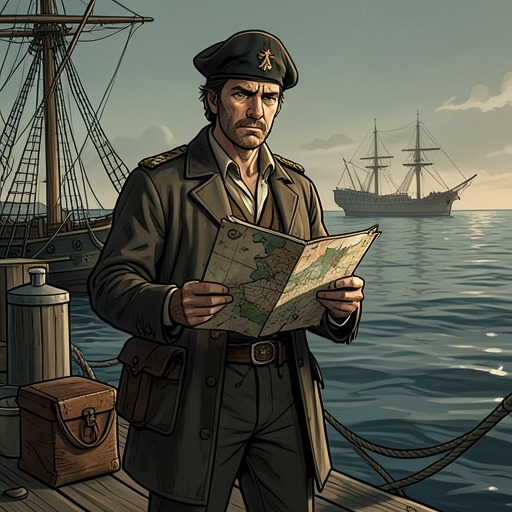
Blackthorne is introduced alone on deck, with Salamon, the mute lookout, huddled in the lee and searching the sea ahead. His professional world is one of danger and incomplete information. The available charts are too vague to be useful, and navigators have no way to determine longitude. Against those limitations, a pilot’s experience is decisive: Blackthorne knows that a pilot sets the course, runs the ship, and brings it from port to port. That authority makes him feared, even by the Captain-General, and hated by much of the crew. His command is technical rather than simply social: the person who can navigate holds power because everyone’s survival depends on that knowledge.
The rutter embodies the kind of knowledge Blackthorne represents. It is a small book of a pilot’s observations, recording compass courses between ports and capes, depths and seabed, winds and currents, storms and fair weather, places to careen and take on water, and where to expect friends, foes, shoals, reefs, tides, and havens. Navigation here is accumulated, practical intelligence: a record of how to go and how to return. Blackthorne’s expertise therefore has a wider strategic value than steering a single ship. It can inform routes, naval operations, and the movement of power between ports.
His authority is also exposed to circumstance. When the expedition reaches land, Blackthorne identifies himself as English and claims leadership, although he knows that the Captain-General is now formally in command ashore. He nevertheless insists on his own command because he judges that the Captain-General cannot exercise it, afloat or ashore, even when fit and well. The moment establishes a recurring feature of Blackthorne’s conduct: he recognizes the difference between a title and the ability to act, but he is willing to assert himself when the practical stakes demand it.
Arrival in Japan and the Uses of Knowledge
Blackthorne’s encounter with Japan places his maritime skill inside a political struggle. Toranaga asks how many ships are in his fleet and presses him to explain the route by which he arrived. These questions make clear that Blackthorne is being examined not merely as a foreign captive, but as a source of information about seafaring and the wider world. Mariko later explains the breadth of Toranaga’s interest: Blackthorne is to be asked about his family, country, queen and previous rulers; about Portugal and Spain and other nations; and about ships, weapons, food, trade, wars, battles, and navigation. Toranaga wants to understand the world Blackthorne inhabits, including what happened on the voyage that brought him there.
The knowledge at issue is concrete. Blackthorne recalls the route taken by Rodrigues’s galley along the east coast of the Izu Peninsula, then west-southwest from Cape Ito across open water toward Cape Shinto, roughly two hundred miles away. He can also read the tactical differences between ships. Near a harbor mouth and close to cliffs, he estimates the next tack of an approaching frigate and weighs its speed against the galley’s greater freedom to maneuver. With little sea room, the difference between a correct judgment and a mistake is measured in yards. Elsewhere, watching a frigate move offshore from a threatened berth, he recognizes a familiar defensive procedure: a European ship in a hostile harbor withdraws into deeper water, prepares its cannon and small arms, and keeps watch in every direction. His expertise includes not just routes but the habits and vulnerabilities of maritime force.
In Osaka, the scale of the setting sharply contrasts with his earlier life aboard ship. Blackthorne sees the immense city and its castle, whose central keep rises above the surrounding buildings with gilded tiles and blue walls. He is now inside a world of concentrated political authority rather than moving between ports. His circumstances become brutally immediate when he is locked in a prison cell-block: naked alongside other convicts, he fights a fellow prisoner for a cup of gruel. Clothes have been taken because they occupy space and can conceal weapons. The pilot who once controlled a ship’s movement is now confined in a place where even food must be won by force.
Service, Rank, and Naval Ambition
Blackthorne’s position changes decisively after the earthquake in Izu. When a second quake opens a fissure across the plateau, he sees Toranaga teetering at its edge and lunges to seize the lord’s sash as Toranaga begins to fall. The act is both immediate rescue and political turning point. Alvito later counts this as the third time Blackthorne has saved Toranaga’s life: twice during the escape from Osaka and once in Izu. Blackthorne uses the moment to put forward a plan involving the year’s Black Ship, gambling that his rescue of Toranaga has given him unusual room to make the proposal.
Toranaga’s reward gives Blackthorne an institutional place in the new order. He receives a fief near the fishing village of Yokohama, south of Yedo, worth two thousand koku a year; the right to recruit two hundred samurai retainers; full samurai and hatamoto rights in Toranaga’s house; ten horses; twenty kimonos; battle equipment for his vassals; and the rank of chief admiral and pilot of Kwanto. The grant is not simply a personal honor. It supplies the men, status, and material support with which Blackthorne can attempt to turn maritime knowledge into naval power.
He immediately imagines what the two hundred samurai might make possible. Having once asked for two or three hundred corsairs, he now considers bringing the samurai aboard the Erasmus as a boarding party and leading an attack himself. The plan shows how he translates the new status into the language of his former profession: retainers become a shipboard force, and the political privilege of recruitment becomes a tactical resource. It also reveals the limits of his confidence. He wonders whether the men will obey him, then reasons that samurai and hatamoto status should secure their obedience even unto death.
Blackthorne’s ambition develops into a plan to seize the Black Ship and use the threat to pressure the priests. He argues to Toranaga that losing the ship would deprive Christian work in Japan and Portuguese interests elsewhere of money, forcing the priests to bend. The proposal is not just an attack on a vessel; it treats shipping and trade as levers in religious and political conflict. Blackthorne later intends to land in force at Nagasaki and lead the samurai in taking the ship. But the scheme remains an intention, not an accomplished victory. His aspirations repeatedly depend on access to ships, allies, and political permission.
Learning, Belonging, and Personal Change
Blackthorne’s adjustment to Japan is neither a simple conversion nor a smooth assimilation. After receiving his new status, he thinks of the day as the best of his life and looks forward to the challenge of trying to be Japanese, enjoy the experience, and avoid embarrassment. The thought marks an important change: he is no longer treating life in Japan only as an ordeal to endure or a temporary obstacle to escape. He wants to participate, even while understanding himself through the foreign identity that brought him there.
Language becomes one of the clearest measures of this unfinished belonging. When Alvito gives him a Japanese word book, Blackthorne distrusts the gift but recognizes its potential. He reasons that the book could give him access to the knowledge Alvito possesses and save years of learning; once he can speak as well as the interpreter, he hopes to teach others and speak directly with Toranaga. His reaction frames language as a practical key to political independence. Until he can communicate without an intermediary, his knowledge and requests must pass through other people’s words.
His new rank becomes visible in clothing and ceremony. In Osaka, he walks through the castle with an honor guard of twenty vassals and a Gray escort ten times larger. He wears a Brown kimono bearing Toranaga’s five ciphers and, for the first time, a formal, broad-winged overmantle; his golden hair is tied in a neat queue, and Toranaga’s swords sit correctly in his sash. The image holds both transformation and dependence: he is dressed as a recognized samurai, but the emblems he wears belong to Toranaga, and the larger escort belongs to the political power watching him.
Blackthorne’s changing relation to fear is more inward. After Mariko’s courage, he reflects that he had wanted to leap into the arena to protect her, but had done nothing alongside everyone else. He insists to himself that fear was not the reason. He is no longer afraid to die, having come to terms with himself earlier, during a night in the village when he had a knife. The passage distinguishes courage from mere readiness to act: the fear of death has diminished, but that does not mean he can prevent every danger or override the situation around him. When a later attack brings violence into the room, he acts decisively, firing his pistol at the leader and using the opening to pull Mariko to safety and bar the door.
Relationships, Conflict, and the Sea
Toranaga is the central political relationship in Blackthorne’s Japanese life. Toranaga turns the foreign pilot’s knowledge into an instrument of statecraft, while Blackthorne seeks recognition, ships, and the authority to act. Their relationship is reciprocal but unequal: Blackthorne has expertise Toranaga wants, yet Toranaga decides the terms on which it can be used. The fief and fleet command deepen Blackthorne’s place in Toranaga’s service without removing that dependence. Even when Blackthorne proposes taking the Black Ship, he must present the idea to Toranaga and persuade him that it will serve the lord’s interests.
His bond with Mariko is marked by both intimacy and restraint. Mariko’s presence can also sharpen conflict: at one point she tells him that his being there takes away her face and gives her neither peace nor comfort, and orders him to go away. Later, when he sees her in danger, his impulse is to protect her, and during the attack he pulls her behind a barred door. The crew remains unaware of important parts of his life in Japan. When he reunites with them, he has told them about his adventures but not that he is samurai and hatamoto, that he is one of Toranaga’s protégés, or about Fujiko and Mariko. He has also withheld the plan to land in force at Nagasaki and seize the Black Ship. His divided disclosures mark the distance between his former companions and the political life he has acquired.
The sea remains the measure against which Blackthorne tests his position. When Toranaga later tells him that he is free to go or stay, the terms distinguish sharply between land and water: in Toranaga’s territory he is a samurai and subject to samurai law; beyond Japan’s shores he is governed by the laws that applied to him before he arrived. He is also granted, for his lifetime, the right to dock at any port controlled by Toranaga without a search, and the two hundred armed men are formally handed over as his vassals. The arrangement offers mobility and command, but it does not erase the boundary between his Japanese status and his former life at sea.
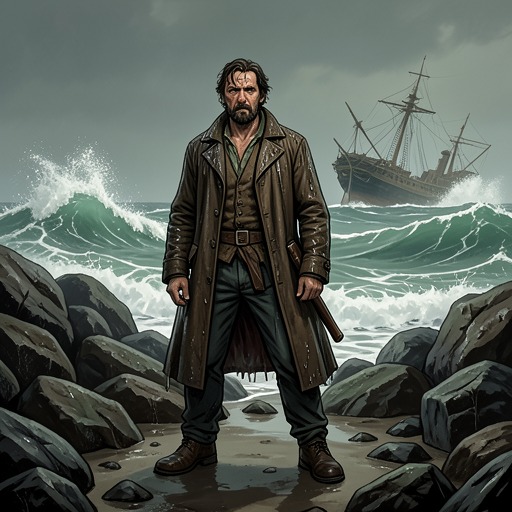
Blackthorne continues to imagine escape as a return to the Erasmus, sailing out with a full, provisioned, armed crew. Yet when he stands in the shallows and looks at the wreck, that possibility has been reduced to a charred skeleton aground in the surf, its masts and decks gone, only keel and ribs remaining. The loss destroys the immediate vehicle of his former freedom, but it does not extinguish his commitment to ships. At the end, when Toranaga reveals that Mariko left a sealed scroll for him on the condition that he survive Osaka, Blackthorne’s attention turns at once to rebuilding: he demands men and money and asks how quickly another ship can be built.
Narrative Role and Ending
Blackthorne’s story repeatedly sets movement against enclosure. A pilot who once crossed uncertain oceans is brought ashore, questioned, imprisoned, watched, and made subject to laws he is still learning. Yet the very knowledge that marks him as foreign becomes useful to Toranaga, and the captive is remade as a landholding samurai and naval commander. His passage into Japanese life is not completed by a title or uniform: the dictionary, the vassals, and the proposed fleet all point toward work still to be done.
The destruction of the Erasmus makes that unfinished transformation especially clear. Blackthorne does not return to his old life by recovering his old ship; he faces the wreck and turns toward another vessel. The final demand to build again carries both material urgency and personal resolve. His career began with the ability to guide a ship through waters that maps could not adequately describe. By the ending, that same pilot’s instinct has become a plan for constructing a new future in a country where he remains at once foreigner, samurai, servant, and would-be admiral.