Friar Domingo
ShōgunFriar Domingo is an aged Franciscan prisoner whose disordered appearance and speech conceal a long history in the Spanish empire. When John Blackthorne encounters him in the crowded jail, Domingo is tending a dead inmate; their meeting turns a moment of physical and mental disorientation into an opening onto the competing religious and commercial claims surrounding Japan. His testimony is valuable to Blackthorne, but it is also a partisan account, delivered by a man who regards the Jesuits as responsible for his own suffering and the fate of his fellow Franciscans.
Identity and Introduction
Blackthorne first sees Domingo stooped over a dead man, closing the corpse’s eyes, praying, and holding up a wooden cross caught briefly by a shaft of sunlight. The old priest’s filthy hair, matted beard, broken nails, and threadbare smock make him seem almost indistinguishable from the misery of the prison around him. He is so astonished to see Blackthorne that he asks whether the Englishman is real, then identifies himself haltingly as Friar Domingo of the Order of St. Francis. His words break apart into Japanese, Latin, and Spanish, and he wipes away the saliva running from his chin.
Domingo’s age and illness shape the encounter. He is described as diseased, with a twitching head and a persistent ache, and he drifts into sleep while speaking. On waking, he resumes his account as though no time has passed. Yet his condition does not erase his command of Spanish or the force of his memories. He explains that others assume a former peasant cannot understand, while insisting that he can read and write and once served as a secretary to the Spanish Viceroy. His agitated manner and his stated literacy exist side by side: the prison has reduced his physical presence, but it has not removed his sense of the authority his experience gives him.
A Life Between Spain and the New World
Domingo tells Blackthorne that his home is a village outside Madrid and that he has been away for forty years. His account traces an imperial itinerary through Mexico and the Philippines, where he says he accompanied the conquistadores. He recalls the conquest of Luzon in 1575, describing the defeat of its native king and the subsequent establishment of the Church there. He also claims that Japanese converts fought alongside the Spanish during that campaign, and presents the Church as firmly planted in the Philippines before the conflict that brought him to Japan.
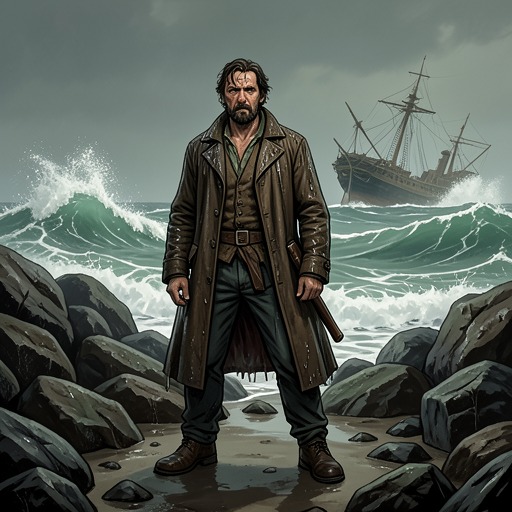
The journey home that Domingo expected to make gives his imprisonment an especially bitter shape. He says that his ship was the San Felipe, sailing from Manila toward Acapulco in Mexico. From there, his planned route continued overland to Vera Cruz, followed by a passage across the Atlantic and, at last, a return to his village. Instead, a storm drove the galleon onto the shores of Shikoku. Domingo recalls that the vessel broke its back on a sandbar on the third day, after the survivors had already brought ashore the bullion and most of the cargo. He says the Taikō then confiscated everything, declaring the ship’s people pirates. The account ends at the moment he reaches this accusation, making the seizure a dividing line between the homeward voyage he anticipated and the confinement he now endures.
His Case Against the Jesuits
Domingo uses his first sustained conversation with Blackthorne to set out a sweeping indictment of the Jesuits. He accuses them of acting as traders, gunrunners, and moneylenders; controlling the silk trade and commerce with China; and wielding authority over religious activity in Asia at the expense of other orders. He further claims that they trade for profit against the commands of the Pope and King Philip, secretly supplied arms to Christian rulers in Japan, interfered in politics, and spread false accusations against the Franciscans. These statements are Domingo’s allegations, not independently established facts in the encounter, and his anger over his own treatment is inseparable from his larger account of church and imperial rivalry.
His accusations become most specific when he recalls the fate of the Franciscans in Japan. Domingo says he had spent nearly two years there before returning to Manila because the Jesuits betrayed his order. He blames them for his imprisonment and for the martyrdom of twenty-six holy fathers. He also alleges that the Jesuit superior secretly asked the Spanish Viceroy in Luzon for conquistadores to invade Japan, supposedly to conceal Portuguese mistakes. As he develops this charge, his speech again collapses into a jumble of Spanish and Latin. His testimony reaches Blackthorne as both information and polemic: it exposes a conflict hidden behind the public language of evangelization, while revealing how personally Domingo experiences that conflict.
What He Tells Blackthorne About the Black Ships
Blackthorne listens closely because Domingo’s account raises questions about guns, gold, trade, and the Black Ship. The priest says that the annual Portuguese Black Ship is worth a million in gold and later describes the great carracks as almost two thousand tons. According to what he has heard, each needs as many as two hundred men and boys to sail it, while the crew and passengers together may bring its complement close to a thousand. He distinguishes their sailing qualities too: they run well before the wind but handle clumsily when the wind is abeam. When Blackthorne asks how to speak Japanese, Domingo supplies a short greeting; Blackthorne then uses it before returning to questions about the Black Ships.
This exchange makes Domingo an interpreter of an unfamiliar political and maritime world for Blackthorne, although not a neutral one. His knowledge comes from years in the Philippines and Japan, service within the Viceroy’s household, and experience among the Franciscans, but some of his claims are explicitly hearsay. The scale of the ships, the value attributed to their trade, and the alleged reach of Jesuit influence give Blackthorne a new set of practical questions. Domingo does not resolve them; he supplies the first charged account through which Blackthorne begins to understand that European religious divisions and commercial competition extend into Japan.
Narrative Role and Limits
Domingo’s introduction follows Blackthorne’s nightmare of imprisonment and near-death. The priest’s Latin benediction first reaches him as part of that confused, terrifying experience; waking, Blackthorne sees the cross and the old man performing the final rites. The transition from nightmare to the concrete sight of a fellow prisoner gives Domingo’s arrival an immediate weight, while the shared language of Spanish allows the two men to speak across the disorientation and crowding of the jail.
Domingo’s importance lies less in a detached history than in the collision of histories his speech brings into the cell. He connects a shipwreck and confiscated cargo to the broader contest among Franciscans, Jesuits, Portuguese interests, and Spanish ambitions. His account is fractured by illness, sleep, and anger, and the book does not confirm every charge he makes. That tension matters: Blackthorne gains a source of information, but also hears a version of events shaped by an old prisoner’s grievances. Domingo’s presence therefore enlarges the political world of the novel without making that world simple or his testimony automatically authoritative.