Toda Buntaro, Lord of Sakura
ShōgunToda Buntaro, Lord of Sakura is Mariko’s husband and a formidable warrior in Toranaga’s service. He is defined by the force with which he answers perceived threats: at the gate in Osaka he challenges Ishido’s contempt with a boast of Brown strength and nearly helps turn a tense encounter into a battle. Yet when the danger becomes immediate, he can be restrained and redirected. In Toranaga’s disguised escape, Buntaro’s violence gives way to a more controlled duty: he protects his master’s litter as the party moves out of the castle.
Identity and Bearing
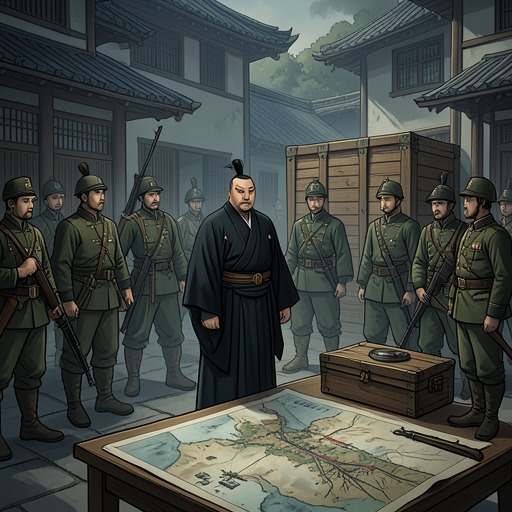
Buntaro appears among the escort accompanying Kiri, with Mariko nearby and the pregnant Lady Sazuko waiting on the veranda. He is described as short, thickset, and nearly neckless. Unlike the unarmed Blackthorne, Buntaro is equipped for combat: he wears chain mail, carries a bow and quiver, and has a horned steel war helmet. The armed escort around him is drawn up in ordered ranks, with every third man carrying a flare. These details place Buntaro within an organized military force even before he speaks; he is not merely a hot-tempered individual but a warrior accustomed to acting as part of Toranaga’s armed household.
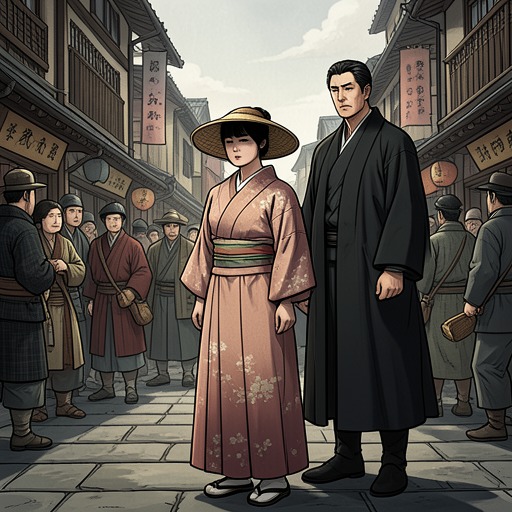
His marriage to Mariko is stated directly, but the scenes here give little account of their private relationship. Instead, they place him beside her in public and political danger. His identity is also tied to Hiro-matsu: Hiro-matsu calls him his only living son, a family bond that becomes decisive when Buntaro’s anger threatens to ignite a fight.
The Confrontation at the Gate
When Ishido remarks that the heavily armed party looks prepared for battle rather than a ceremonial escort, Buntaro steps forward and blocks the gateway. He answers the taunt with a declaration of the Browns’ readiness to fight, claiming that they can face ten opponents for every one of their own and fifty of the “Garlic Eaters.” He condemns the Grays as cowards who abandon their comrades, then presses the challenge further: “How soon? Why not tonight? Why not here?”
The exchange makes Buntaro’s pride public and dangerous. His words are not an abstract boast: a Gray hand moves toward a sword, Browns follow, and more Grays are poised to respond. The confrontation has reached the edge of violence, with the armed men waiting for Ishido’s sword to signal an attack. Buntaro’s challenge thus puts the escort’s purpose at risk. The party is supposed to accompany Kiri, but his response to Ishido turns the passage through the gate into a possible battlefield.
Hiro-matsu intervenes before the moment becomes a general clash. He moves out of the shadows with his sword already loose in its scabbard, then addresses Buntaro as his son. His calm reminder that Toranaga has friends throughout Osaka is both a statement of political support and a direct appeal to Buntaro’s judgment. Buntaro makes an effort to control himself, nods, and steps back. He still blocks the way into the garden, so his anger has not simply disappeared; nevertheless, he has yielded enough to let the confrontation continue without a sword being drawn. The scene shows restraint arriving not through Ishido’s authority but through Hiro-matsu’s intervention and Buntaro’s response to his father.
Violence, Restraint, and the Escape
During Toranaga’s disguised departure from Osaka Castle, another crisis tests Buntaro’s readiness to act. When Ishido pulls aside the curtains of the litter, Blackthorne creates a sudden diversion by shouting and behaving as if he has gone mad. Toranaga is momentarily visible behind Ishido. Blackthorne then lunges toward Ishido, and Buntaro grabs him after Yabu catches Ishido’s sword arm. Blackthorne has already seized Ishido by the throat; four Browns are needed to pull him away, and Buntaro strikes him on the back of the neck to stun him.
The violence does not resolve the danger. Grays rush to protect Ishido, Browns surround Blackthorne and the litters, and the two armed groups face one another in a stand-off. Mariko and the maids add to the confusion with deliberate cries, while Yabu tries to placate Ishido. Buntaro’s physical intervention is forceful and immediate, but it serves to stop Blackthorne’s attack rather than to begin a fight with Ishido’s men. The distinction matters: in a scene where one uncontrolled movement could provoke a massacre, Buntaro uses violence to contain violence.
Once Ishido allows the procession to continue, Buntaro takes the initiative in moving the Browns onward. He bows to Ishido, then places himself behind Toranaga’s litter, positioning himself to protect his master from arrows if fighting begins. He does not stop to question how Toranaga came to be concealed in the procession; the narration emphasizes that Buntaro’s concern is that his master is in danger and almost defenseless. His conduct shifts from the challenge at the gate to a practical, protective role. He helps the party proceed while remaining prepared for an attack, and his position behind the litter makes his loyalty visible as action rather than declaration.
Loyalty and Uncertain Fate
Buntaro’s service is presented through readiness, hierarchy, and control under pressure. At the gate, he is willing to answer an insult with a fight, but Hiro-matsu’s appeal draws him back from the threshold of violence. In the escape, he again acts physically and decisively, first restraining Blackthorne and then placing himself between possible arrows and Toranaga. These are not identical situations: in one, Buntaro’s aggression intensifies the danger; in the other, his force helps the escape continue. Together, the scenes show how the same martial readiness can threaten a plan or protect it, depending on the discipline and purpose governing it.
Buntaro’s later fate is left unresolved. When Jozen asks about him, Naga has no confirmed news. Jozen says no one collected Buntaro’s head and admits that no one knows for certain what happened; he offers capture or dismemberment as possibilities, not established outcomes. The uncertainty is pointed: in a world where a warrior’s death may be confirmed by possession of his head, its absence prevents a firm conclusion. Buntaro is therefore not declared dead in this account, nor is his survival confirmed. The last report preserves him as a missing figure whose fate remains unsettled.