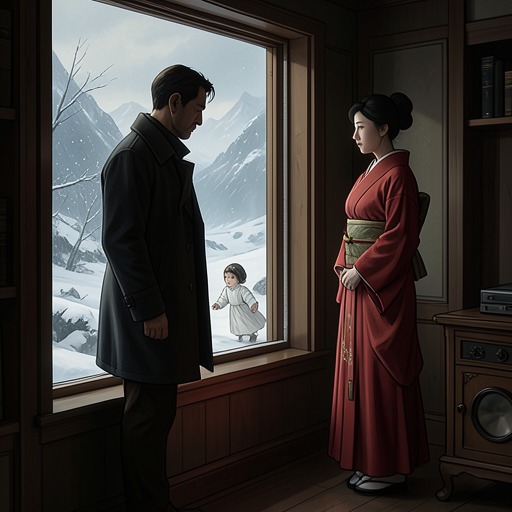
Maximilian Croocq
ShōgunMaximilian Croocq is the youngest of the stranded expedition’s men, but the violence and losses he has witnessed have made him feel older than his years. His brief history gives the crew’s ordeal a particularly troubled human face: he entered the voyage expecting a fortune and carries the memory of what that pursuit cost.
Identity and Background
Croocq was sixteen when the crew’s ship reached Japan. He had signed on because his father, himself a captain of one of the expedition’s ships, was involved and the voyage promised wealth. During the crew’s earlier sack of the Spanish town of Santa Magdellana in the Argentine, Croocq saw his father die violently. Amid the plunder, he also witnessed rape and tried it himself; afterward, he hated himself, describing his response to the bloodshed and killing as a kind of glutted revulsion. More of his friends died as the expedition dwindled from five ships to one. By the time he speaks of these losses, he feels as though he has become the oldest among the survivors.
Conduct During the Captivity
When the prisoners faced a lottery to decide who would die, Croocq objected to the uncertainty of the drawing: they could not know for certain whether the person who drew the short straw would actually go. Jan Roper proposed replacing uncertainty with a religious oath, so that the chosen man would die for the others in God’s name. The crew agreed. Croocq’s insistence on certainty sits uneasily beside the ritual solution: the oath gives the sacrifice a meaning, but cannot remove the danger that brought them to it.
During the cellar revolt, Croocq took an active part in resisting the samurai who came down among the prisoners. As the crew surged toward the ladder, he hammered his fist onto one attacker’s instep, breaking a small bone. The samurai threw his sword out of the pit before tumbling into the mud, and Croocq followed Blackthorne up the ladder with Jan Roper and Salamon. The men confronted swords at the entrance despite knowing their own weapons were inadequate; a kick drove Blackthorne back underground, and the samurai regained control of the trapdoor.
After the ladder was pulled away and the cellar sealed again, Croocq helped clean the mud from the unconscious Blackthorne’s face. He feared the attackers had broken Blackthorne’s neck or shoulder and compared his still body to a corpse. The moment links Croocq’s physical courage in the revolt with the fear and care that follow its failure: he has seen death repeatedly, yet remains shaken by the possibility of another loss among the survivors.
The Risks Behind the Promise of Fortune
Croocq’s memories of the expedition’s shrinking fleet and mounting deaths belong to a voyage shaped by profound navigational uncertainty. Available charts could be too vague to guide a ship reliably, and sailors had no way to determine longitude. A pilot’s rutter offered practical knowledge gathered from earlier voyages: courses between ports and capes, soundings, seabed conditions, winds, currents, storms, safe anchorages, and places to find water or danger. Such information could make the difference between a route imagined on a chart and a passage a ship could actually survive.
That knowledge was scarce and imperfect. Portuguese and Spanish pilots guarded accounts of overseas waters as national secrets, while rival English and Dutch sailors sought them; even a copied or translated rutter could contain errors, deliberate or otherwise. Croocq’s father’s captaincy and the promise of a fortune had drawn the sixteen-year-old into an expedition whose ambitions depended on precisely this hard-won maritime knowledge. The gap between the riches he expected and the deaths, violence, and dwindling ships he witnessed gives his account its force: the voyage’s promise was inseparable from risks no chart or book could entirely dispel.
Greed, Guilt, and Providence
In another moment of crisis, Croocq agrees with Jan Roper that greed had brought the expedition to its present danger and suggests that their suffering might be punishment from God. Blackthorne cuts him off before he can finish, and Croocq immediately apologizes. The brief exchange gives his earlier account of the sack of Santa Magdellana a wider moral frame: his guilt is not only personal, but bound to the expedition’s pursuit of wealth and the violence committed along the way. His appeal to divine punishment also shows how the survivors try to make sense of their losses, even as Blackthorne’s command leaves little room for that explanation.