Jozen
ShōgunJozen is Ishido’s hard-edged senior lieutenant and political envoy, a man whose authority reaches both the battlefield and the Council of Regents’ struggle for power. Sent to question Yabu about training Toranaga’s troops with guns, he gathers intelligence on the new regiment and witnesses its tactics firsthand. The demonstration overturns his initial scorn: what first looks vulnerable to a samurai charge proves capable of inflicting devastating losses.
Identity and Mission
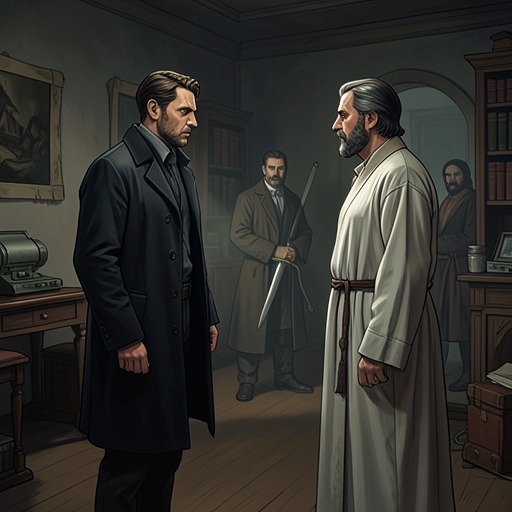
Jozen arrives in Yabu’s domain twelve days after an earlier encounter, accompanied by ten samurai whose horses are lathered and nearly spent. His Gray uniform kimono is torn and mud-stained, his eyes red with fatigue, but he refuses food and drink and demands an immediate audience. The narrative identifies him as one of Ishido’s chief lieutenants, senior in rank and known for ruthlessness; his exhausted, urgent arrival makes clear that he has come on business he considers too important to delay.
His questions concern the precise military development Yabu has been concealing: why Yabu is training Toranaga’s soldiers alongside his own, and why they drill with so many firearms. Yabu keeps his temper despite Jozen’s rude insistence, but is unsettled that another leak has exposed the training. Their meeting is therefore not simply a formal inquiry. Jozen’s presence confirms that the secret force has attracted the attention of Ishido’s faction, while Yabu’s carefully courteous answer tries to conceal how much the questions threaten him.
Political Authority and the Osaka Invitation
Jozen also brings news of a change in the Council of Regents. Ishido’s master, he reports, expects Lord Ito Teruzumi to take the vacant place and himself to become President of the Regents. Yabu is alarmed: Toranaga had believed that the four Regents could never agree on a fifth. Ito’s appointment threatens to alter the political balance, and Jozen’s announcement leaves Yabu trying to buy time rather than openly reveal his reaction.
The invitation Jozen presents calls on the daimyos to be in Osaka in time for a formal meeting on the twenty-first day. It says that a Flower-Viewing Ceremony has been authorized by Emperor Go-Nijo to mark the occasion. Yet the scroll does not carry the Council of Regents’ seal. Jozen explains that Ishido has issued the invitation in anticipation of the new Council’s approval, invoking the invitees’ loyalty to the late Taikō and to Yaemon, his son and heir. The distinction matters: the summons wears the language of lawful succession and imperial ceremony, even as its authority rests on Ishido’s expectation of political control.
Secret Reporting on the Firearms
After leaving Yabu, Jozen continues his investigation covertly. At night, in a small brush lean-to, he rewrites an earlier message on thin rice paper and adds a report that the five hundred guns are lethal and that massed surprise attacks are planned. He notes that a full report has already gone with Masumoto, so the new message supplements information already sent rather than serving as his only account.
Jozen dates the message, extinguishes the candle, and slips out from under his mosquito net. He attaches the paper to a carrier pigeon, then gives the bird to one of his men with instructions to hide it in the brush until dawn, as far away as possible without drawing attention. The care he takes to protect the pigeon shows that his intelligence work is not incidental to the mission: he recognizes that the firearms may alter the balance of power and works to get that warning safely to Ishido’s side.
Witness to the Musket Regiment
Jozen’s understanding changes during a staged battle. Seeing the attackers without swords, he objects that samurai who fight unarmed will be massacred. Instead, the attackers form five disciplined phalanxes, each four ranks deep and twenty-five men wide, with three formations forward and two held in reserve. They charge, halt on command, and fire a coordinated salvo. As the front ranks kneel to reload, successive ranks fire over them. The defenders appear to fall amid the noise and confusion, and Jozen protests that Yabu’s men are killing their own. He is told that the ammunition is blank and the casualties are acted; the demonstration is meant to show what live fire could do.
When the defenders launch their final charge, Jozen expects the formations to be crushed. The phalanxes break and flee, drawing their pursuers away before regrouping in a V and firing again. The attack falters and stops. The exercise ends with the supposed dead getting up, weapons being collected, and men laughing, groaning, or limping from their injuries. Jozen’s response is no longer scorn. He sincerely congratulates Yabu and acknowledges that he now understands what the others meant. He has seen that the regiment’s apparent weakness under a conventional charge can be part of its method: retreat, regrouping, and renewed volleys can turn pursuit into a killing ground.
Character and Narrative Role
Jozen is presented through a tension between official authority and practical observation. He arrives as Ishido’s forceful representative, presses Yabu about a dangerous secret, and carries a politically consequential summons. But the mock battle gives him more than information: it forces him to revise his judgment in the face of what he has witnessed. His initial assumption that sword-bearing samurai will overwhelm gunmen gives way to recognition that disciplined formations and coordinated fire may defeat vastly larger conventional forces.
That change makes Jozen an important witness to the novel’s conflict between the inherited honor of individual combat and the emerging power of organized firearms. Yabu’s broader plan envisions five hundred musket-armed samurai spearheading twelve thousand conventional troops, supported by twenty cannon. Jozen’s report and reaction show how rapidly that military innovation becomes a political threat: once its effectiveness is exposed, it cannot remain merely Yabu’s private theory.