Heir Yaemon
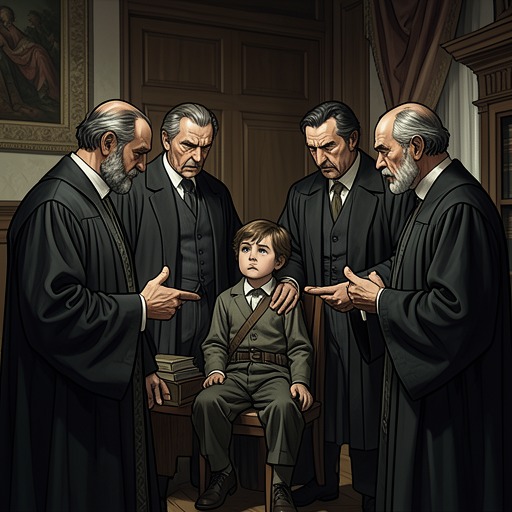
ShōgunHeir Yaemon is the seven-year-old son and designated successor of the Taikō, whose death leaves the empire without an adult ruler. His youth makes him the center of a precarious political settlement: five great daimyos are charged with governing until he reaches fifteen, while the two most powerful among them, Toranaga and Ishido, contend over the authority that will determine whether his inheritance survives. Yaemon is thus less an active political player in these passages than the person around whom their promises, fears, and rivalries gather.
Identity and Background
The Taikō’s death turns Yaemon’s childhood into a matter of state. He is too young to inherit supreme power, and the empire’s recent peace rests on arrangements that cannot simply transfer authority to him. The Taikō had subdued the provinces and held their daimyos in check; a year after his death, Mura imagines that renewed war may break the empire into warring provinces and villages. The boy, like the people caught between the great lords, is described as being in pawn. The Taikō’s power had protected both his son and the political order around him; his death leaves neither protection assured.
Yaemon’s family position is inseparable from Lady Ochiba. The Taikō’s first son, born when he was fifty-three, was sickly and died young. Four years later, Lady Ochiba gave birth to another son, healthy and surviving: Yaemon. The Taikō’s grief at the first child’s death had been intense, and his delight in Lady Ochiba and Yaemon is remembered as excessive, even irrational. These details establish Yaemon as the living heir after an earlier loss, while also making his mother’s place at court central to the succession.
The Regency and Its Rules
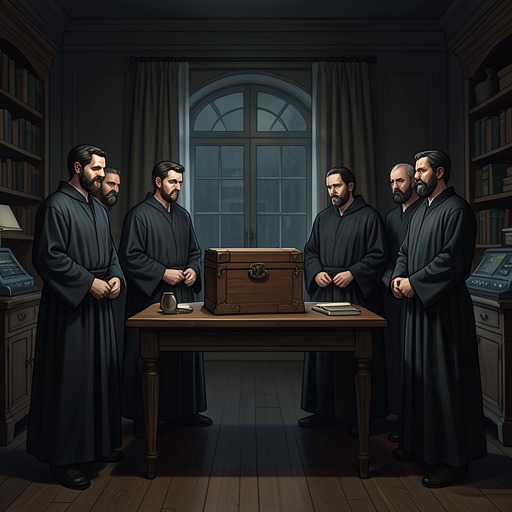
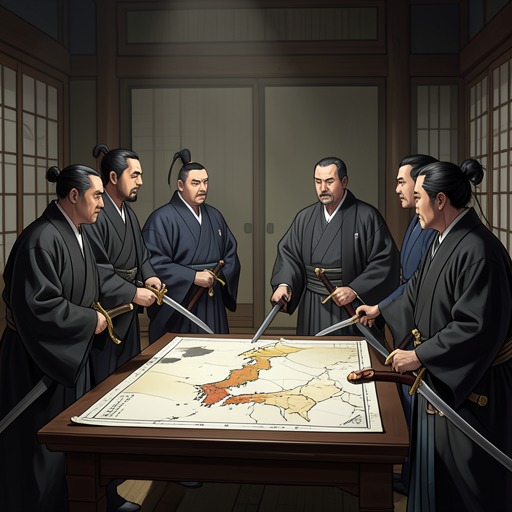
The Taikō appointed five eminent daimyos to govern during Yaemon’s minority. Before taking power, they swore allegiance to the Taikō, his son, and his line, and pledged to rule unanimously. They also promised to preserve the realm intact until Yaemon’s fifteenth birthday, when he would come of age. The unanimity requirement was intended to prevent any one Regent from changing the settlement by himself; in practice, it makes agreement difficult among men who despise one another.
The system places Yaemon’s future behind a formal threshold. Until he turns fifteen, the Regents are bound to preserve the existing order, even as Toranaga and Ishido struggle for practical dominance. Yabu recognizes the design’s danger: a coalition of four Regents might bend the Taikō’s instructions far enough to make war on the fifth, defeat him, and divide his lands. The victors would then need to appoint a replacement Regent, leaving the balance vulnerable to another four-against-one conflict. Yaemon’s promised inheritance is therefore protected by rules that can also provide a framework for their circumvention.
The Taikō’s arrangements also draw other daimyos into Osaka. The Regents must meet in the castle keep for at least ten days, at least twice a year, bringing no more than five hundred retainers within its walls. Other daimyos are likewise required to visit twice yearly with their families to pay respects to the Heir. These obligations make Yaemon’s court a mechanism of political supervision: powerful lords must periodically enter the Taikō’s fortress and leave themselves, their families, and their forces exposed to the pressures of the succession. The obligations help explain why Toranaga’s attendance at the council cannot be refused without risking an accusation of treason, even when Ishido’s influence makes Osaka dangerous for him.
A Contested Inheritance
Yaemon’s claim is formally recognized, but the passages leave his biological paternity unresolved. One reflection asks whether the Taikō fathered him and admits that no proof may ever settle the question. The uncertainty is not presented as established fact: it remains speculation, sharpened by the memory that the Taikō’s father-in-law, stepfather, and mother had all died because of the Taikō. Lady Ochiba’s capacity for political calculation is consequently imagined as a possibility, not demonstrated as a confirmed scheme. The text preserves the suspicion without resolving it.
That ambiguity matters because Yaemon’s place in the succession gives any question about his parentage political force. The Taikō’s apparent devotion to mother and son sits beside the possibility that Lady Ochiba could have conceived an heir with another man and then eliminated him to protect herself. Yet the evidence does not identify such a man or confirm that this occurred. The uncertainty instead exposes how much depends on a child whose legitimacy is treated as vital while remaining, in private speculation, open to doubt.
Political Stakes and Narrative Role
Toranaga’s opponents regard him as the principal danger to Yaemon’s succession. In a conversation about Lady Ochiba’s fate, Yabu argues that the Heir is safe in Osaka if Toranaga is dead, describing Toranaga as the only serious threat capable of using the Council of Regents to seize the Taikō’s power and kill the boy. Yabu’s judgment reveals how the struggle is framed by those around Yaemon: removing Toranaga could appear to secure the heir, even as Toranaga’s rivals compete for control of the institutions meant to govern in Yaemon’s name. Toranaga, for his part, rejects the belief that he alone stands between the boy and succession, calling those who hold it fools. The exchange distinguishes political accusation from confirmed intention.
The Taikō’s fortune and Osaka Castle further anchor Yaemon’s position. Alvito reasons that as long as the fortune remains intact and Osaka remains secure, with Yaemon its de facto custodian, the boy will rule when he comes of age despite Toranaga, Ishido, or anyone else. This is a calculation about the resources and stronghold supporting the succession, not evidence that Yaemon himself governs them. His importance lies in the conjunction of an heir, a treasury, and an impregnable political center.
Across these passages, Yaemon’s stillness is consequential. He neither speaks nor directs events in the evidence presented; instead, the Regents’ oaths, Osaka’s ceremonial demands, rival lords’ calculations, and doubts about his birth all take their measure from the future assigned to him. The Taikō’s design promises that the realm will pass intact to Yaemon at fifteen, but the surrounding conflict makes that promise fragile. His inheritance is both the stated purpose of the regency and the prize whose defense may become a pretext for renewed war.