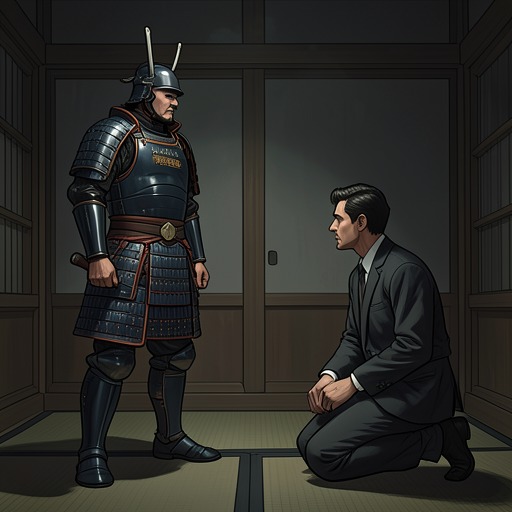
Ishido Kazunari, Lord of Osaka
ShōgunIshido Kazunari, Lord of Osaka, is Toranaga’s principal political adversary in the struggle over the Council of Regents and the Heir’s government. His authority is practical as well as formal: he commands Osaka Castle and its Gray soldiers, can bargain over Christian influence and trade, and presses for a restored Council capable of acting against Toranaga. Yet his power depends on timing and public legitimacy. Again and again, he approaches the edge of violence, then holds back when an immediate clash could damage his position.
Position and Political Leverage
Ishido’s influence reaches beyond the castle walls. In a discussion of Portuguese policy, Ferriera argues that the Portuguese Black Ship and its trade make Japan dependent on Portuguese goods. Father Alvito counters that the Portuguese also depend on the favor of Toranaga and Ishido: without it, they risk losing influence over the Christian daimyos and Nagasaki, where their presence and trade are concentrated. Ishido is therefore one of the powers whose support can shape the position of the Christian lords and the Portuguese, even when he is not personally directing the discussion.
Reports from Toranaga’s spies describe another use of that influence. They say a bargain had been struck in Ishido’s household for support when war began, including an attack on Toranaga’s southern flank and responsibility for the assassination of Toranaga’s three sons, Noboru, Sudara, and Naga. This remains reported intelligence rather than an independently confirmed action. When asked whether he had accepted, Toranaga answers in a way that indicates he had not. The episode nevertheless establishes the severity of the threat Ishido is believed to pose: the contest is not only about council seats or territory, but may reach Toranaga’s family.
Command in Osaka
Ishido’s physical presence makes the political contest visible. He approaches through the avenue between the castle walls at the head of two hundred Gray soldiers and stops in the forecourt. No one has yet drawn a sword or raised a bow, but both sides are ready. His courteous greeting to Yabu sits against the armed standoff around him: in Osaka, ceremony does not replace force so much as keep it temporarily sheathed.
The confrontation over access to Toranaga shows how Ishido uses the castle’s rules while challenging their limits. He offers a scroll near the curtains concealing Toranaga. Blackthorne realizes that taking it would require Toranaga to extend a hand and reveal himself; even politeness has become a trap. When Ishido’s Gray soldiers are stopped at the gate under an agreed protocol, Ishido claims that his offices as Governor of Osaka Castle and commander of the Heir’s bodyguard give him the right to go anywhere. The competing claims of protocol and command turn a seemingly minor threshold into a test of who controls the castle.
Ishido does not always force that test to its conclusion. After an insult, he lets it pass, though the affront angers his men. He has nearly lost control at the thought of Buntaro’s head in the dust, but decides that lighting the fuse is not yet to his advantage. He says that the commanders responsible for the earlier attack have already been sent to the Great Void, describes the Amida Tong as acting beyond the law, and says the Regents will be asked to suppress them. The distinction matters: Ishido presents himself as able to punish those under his command while treating the assassins as a separate problem for the Council to resolve.
Toranaga, Yabu, and the Cost of Restraint
Ishido’s dealings with Yabu reveal a calculating capacity to read fear and sincerity. When Yabu insists that Blackthorne is more valuable alive, Ishido recognizes desperation in his face and believes the plea. He agrees to spare Blackthorne for the present, but warns that he may later demand him alive and hang him by his heels over the pit. Mercy here is neither forgiveness nor release from danger; it is a postponement that keeps a useful prisoner available to Ishido.
Toranaga later explains to Yabu that his resignation has left the Council unable to function until it again has five members. In Toranaga’s account, that paralysis has neutralized Ishido and bought time, while also checking Ikawa Jikkyu’s designs on Izu. This is Toranaga’s reading of the balance of power, not a declaration that Ishido has ceased to be dangerous. The Council’s inability to act temporarily frustrates him precisely because his authority depends on converting political advantage into decisions with formal standing.
Restoring the Council
Ishido’s response is to reconstitute that authority. Through Nebara Jozen, he announces that Ito Teruzumi will take Toranaga’s place and that Ishido will become the new President of the Regents. Jozen brings an appointment letter bearing the signatures of Ishido, Kiyama, Onoshi, and Sugiyama, along with Yodoko’s confirmation that the document is genuine. Its distribution and the seals of lords who have already accepted make the appointment more than a threat delivered at Yabu’s castle: it is presented as an official act backed by the other Regents.
The timing makes the invitation to Osaka a political snare. All the daimyos are summoned to attend the formal meeting, with a flower-viewing ceremony authorized by Emperor Go-Nijo. Jozen emphasizes the obligations of those who served the late Taikō and the future authority of his heir, framing acceptance as loyalty rather than submission to Ishido personally. Yabu understands that the appointment could close the trap on Toranaga and his allies; the official scroll, however, also gives Jozen and his men protection while they deliver the demand.
The danger is sharpened by Omi’s warning that Ishido will have the Emperor’s mandate in twenty days. Omi argues that Toranaga’s trained guns could decide one battle if enough time is gained, but that this advantage matters little if Ishido can secure imperial authority without fighting. The conflict thus turns on two competing forms of power: military readiness and the legitimacy conferred by an Emperor-backed Council.
Character and Narrative Role
Ishido’s actions are marked by the tension between force and procedure. He arrives with two hundred armed men, asserts broad authority over the castle, threatens a brutal fate for Blackthorne, and is associated through reports with a plot against Toranaga’s sons. At the same time, he postpones violence when it would be premature, invokes the Council against the Amida Tong, and seeks to bind the daimyos through appointments, signatures, invitations, and imperial sanction. His restraint is strategic, not evidence of reconciliation.
That combination makes Ishido a consequential antagonist without reducing the struggle to a contest of personal strength. Toranaga can exploit a vacant council seat to buy time; Ishido answers by restoring the Council and moving toward an imperial mandate. Each man’s position depends on what others will accept as lawful, and on whether the appearance of order can be maintained long enough to command obedience. Ishido’s defining threat is therefore not simply the Gray Army at the castle gate, but his effort to turn political procedure into an instrument capable of making that army’s power seem inevitable.