Ishido, Osaka’s powerful lord
ShōgunIshido, Osaka’s powerful lord, stands at the center of the struggle over who will govern Japan during the minority of the Taikō’s seven-year-old heir, Yaemon. He is not merely Toranaga’s opposite in a contest of armies: he commands the western political and military stronghold, while the regency’s procedures and the hostage obligations binding the daimyos give him means to constrain his rival without immediately beginning open war. His campaign to contain Toranaga makes the structures of power—castle walls, family hostages, council votes, and control of trade—part of the conflict itself.
Identity and Political Setting
The Taikō’s death has undone the settlement that held the country in peace for the preceding ten years. He had risen from peasant soldier to samurai, general, and absolute ruler, but his son is too young to inherit supreme power. The resulting regency leaves the child and the realm exposed to a contest between powerful lords. Ishido is Lord of Osaka Castle, protector of the heir, conqueror of Korea, and chief general of the western armies. Toranaga, by contrast, commands the eastern armies and rules the Kwanto. The Tokaido, the Great Coastal Road between Yedo and Osaka, links their principal centers across roughly three hundred miles; it is at once a route for armies and a measure of how close the rivals stand to war.
Their titles do not make their power equal in every respect. Toranaga holds the presidency of the Council of Regents, but Ishido is described as one of the two regents with real power. Osaka is his base, and the city’s immense castle can shelter tens of thousands of soldiers. From the perspective of villagers caught between the rival domains, the conflict threatens to spread beyond the two leaders: alliances may break, provinces may fight provinces, and the violence may descend again to village against village. Ishido’s contest with Toranaga therefore menaces the fragile peace established by the Taikō, not just one lord’s position.
Osaka as a Political Prison
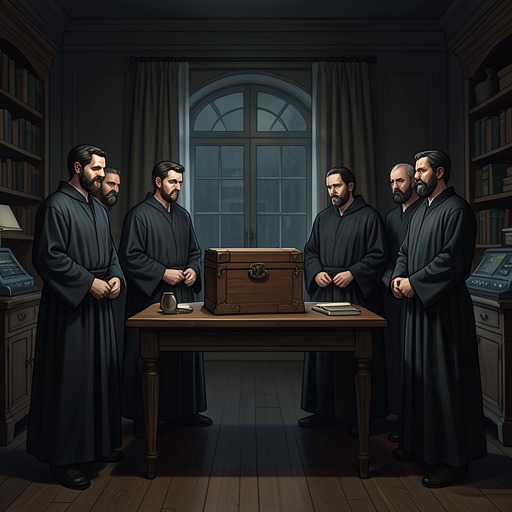
The council’s rules help explain how Toranaga can be placed in danger without being openly attacked. The Taikō required the five regents to meet for at least ten days, at least twice a year, inside Osaka Castle’s keep, with no more than five hundred retainers within the walls. Other daimyos were also required to visit Osaka with their families twice a year to pay respects to the heir. These arrangements made attendance an obligation and left powerful visitors temporarily surrounded by a rival’s forces. Toranaga went to Osaka because refusing the scheduled meeting could be treated as treason; his presence there, with only a few hundred men against Ishido’s strength, left him vulnerable to pressure.
Ishido’s advantage is made tangible in the castle itself. Its gigantic stone gate is set in a thirty-foot wall; beyond it lie a broad bridge over the moat, another gate, further moats and portcullises, fortified houses, and a deliberately twisting system of roads. John Blackthorne, an experienced observer with an exceptional memory for direction, becomes lost in the successive turns. Gray soldiers are everywhere: on the ramparts, on foot, guarding, marching, training, and tending horses. The castle’s layered defenses and the disciplined presence of its troops turn Ishido’s capital into a mechanism of surveillance and confinement as well as a fortress.
Toranaga believes Ishido intends to keep him inside until the final meeting of the regents. In Toranaga’s assessment, Ishido would promise the other regents whatever they wanted, even sacrifice a hostage, and use the meeting to have Toranaga impeached and put to death. That plan depends on a legal danger as well as military force: Toranaga, as president, would be bound to commit seppuku if the other four regents voted against him. Ishido’s strategy thus seeks to make Toranaga’s own office and oath instruments of his destruction.
Military Reach and Trade Leverage
Ishido’s strength extends beyond Osaka’s walls. Reports place eighty thousand samurai in and around the castle, while Toranaga’s force on arrival is described as only a few hundred. Ishido also controls Kyoto and the majority of the regents. Through the daimyos Onoshi and Kiyama, his reach extends across much of Kyushu, including Nagasaki, the principal center of trade. That influence gives him leverage over the year’s Black Ship and the commerce on which foreign merchants and religious intermediaries depend. A confrontation with Ishido therefore risks more than a battlefield defeat: it could also leave Toranaga’s opponents in command of the principal southern port and its trade.
This balance shapes the Europeans’ choices during Toranaga’s escape. The people aboard the Portuguese frigate recognize that an overt attack would place them openly on Toranaga’s side against Ishido, a dangerous commitment while Ishido controls Osaka, Kyoto, and much of the regency. The frigate moves away from its berth into deep water when danger rises; its cannon are prepared, and its position gives it room to defend itself. But maritime strength does not erase political exposure. The Europeans must weigh the immediate danger at the harbor against the possibility that Ishido will prevail, while Toranaga tries to use the ship and its crew without forcing them into an unmistakable act of war.
Escape and the Limits of Control
Ishido’s effort to contain Toranaga is challenged when the latter’s concealed escape succeeds. Toranaga had expected Ishido to watch the forecourt, not the main gate. When an officer of the Gray forces recognizes the escaped lord outside the castle, he orders Toranaga to wait and sends a man to report to Ishido. The order makes the danger explicit: the escapee is outside the walls, but Ishido’s authority and troops are still close enough to try to stop him. Buntaro kills the messenger before he can carry the news, and the encounter erupts into a street fight between Gray and Brown samurai. Mariko uses a flare to interrupt an attack on Toranaga; Yabu and Blackthorne also fight to protect him.
The escape exacts a heavy price. Of the fifty Brown guards who formed the escort, fifteen are killed and eleven mortally wounded; forty-eight Grays are left dead. The losses underscore how difficult it is to pass through Ishido’s controlled space, even for a plan prepared in secret and supported by hidden troops. Toranaga’s escape does not mean that Ishido’s military power has vanished. Rather, it prevents that power from completing the immediate political purpose of keeping Toranaga under guard until the council can act.
Toranaga’s resignation then turns the escape into a constitutional countermeasure. He sends Ishido his formal resignation as president of the council and the official seal of his office, arguing that resignation releases him from the oath that would otherwise require him to submit to an impeachment vote. Yet the same move complicates Ishido’s control of the government: the Taikō’s testament established a council of five, and the four remaining regents must agree on a fifth member before they can exercise the Emperor’s mandate. As Toranaga points out, his enemies must choose someone acceptable to all of them. Their disagreement can halt decisions while war preparations continue. The tactic does not settle the contest; it shifts it from the castle’s gates to the question of who can exercise lawful authority.
Narrative Role and Significance
Ishido’s power is most revealing where it appears nearly absolute and then meets a constraint. He can command a vast army, dominate the capital, and use the regency’s attendance rules to make a rival’s presence in Osaka perilous. Yet those same political arrangements require agreement among the regents, and Toranaga can exploit the difference between controlling the meeting place and possessing an uncontested legal mandate. The conflict consequently turns on more than the number of soldiers each lord can field: it depends on who can make confinement, resignation, and council procedure serve their purpose.
The chapters represented here leave Ishido as an active threat rather than a defeated opponent. Toranaga has escaped, but Ishido still commands the Gray forces and retains extensive political and commercial influence. His absence from the fighting does not make him less present: the castle, its guards, the threat of impeachment, and the risk of committing oneself to the wrong side all bear his imprint. Through him, the novel gives military rivalry an institutional and geographic shape, showing how a road, a fortified capital, a child heir, and a vacant council seat can become as consequential as a drawn sword.