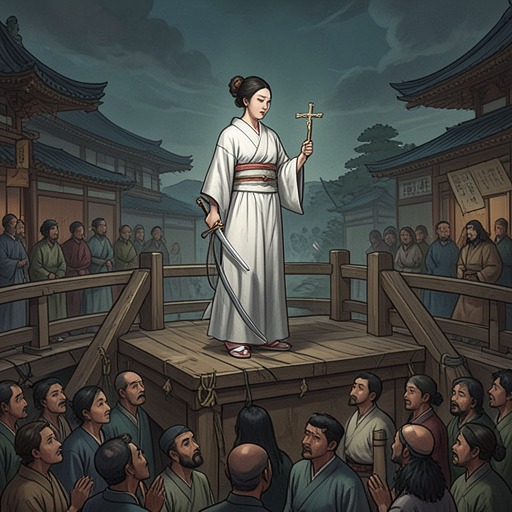
Kiritsubo-noh-Toshiko
ShōgunKiritsubo-noh-Toshiko, usually called Kiri, is Toranaga’s longtime consort, household manager, and trusted aide. Her significance rests on a bond forged before she entered his household: as a young woman, she and her first husband treated Toranaga honorably when he was a hostage, then followed him into rebellion. In the present, she remains a source of counsel and practical reliability, a figure whose intimate familiarity with Toranaga coexists with the rank and ceremony surrounding him.
Identity and Background
Kiri is fifty-three and the oldest of the women in Toranaga’s court, serving as matron of his ladies-in-waiting. Her gray-flecked hair, substantial figure, and bright, enduring cheerfulness make her presence vivid, but the narrative places equal weight on her judgment and competence. She has run Toranaga’s household for years and kept it as free of trouble as such a household could be. Her authority is domestic, yet it is not merely ornamental: Toranaga trusts her with the ordinary work and confidential errands on which his larger affairs depend.
Her connection to Toranaga reaches back more than thirty years, to the time when he himself was held hostage. Kiri was then seventeen and the second wife of the samurai charged with ensuring Toranaga’s good conduct. She and her husband treated the young hostage honorably and gave him wise counsel. When Toranaga rebelled against his captor and joined Goroda, they followed him with many warriors and fought at his side. Kiri’s early loyalty was therefore enacted through risk and political commitment, not just affection or household service.
From Hostage Household to Toranaga’s Consort
During the fighting for the capital, Kiri’s husband was killed. Toranaga later asked her to become one of his consorts, and she accepted. The account marks the passage of time through their ages at that point: Kiri was in her nineteenth year, while Toranaga was twenty-four. From then on, she became a continuing presence in his household. The relationship grew out of shared history and demonstrated loyalty, linking her role beside him to the earlier household in which both had faced danger.
That history also gives weight to their ease with one another. Near dawn, as Toranaga prepares to go out among the hills with his hawks, Kiri arrives with cha for him and his guest and reproves him for being awake so late. He responds with familiar affection, while she immediately insists that familiarity should not erase the respect due to her position. Her humor and their teasing do not dissolve the hierarchy between lord and consort; instead, they reveal a closeness in which she can address him with unusual directness.
Household Service and Political Trust
Kiri’s service includes more than managing the women’s quarters. After Toranaga gives instructions for a message to Sudara, she accepts the task without hesitation: three racing pigeons are to be released at dawn and three more at noon, each carrying the reassurance that all is well. The precise timing makes the errand part of a larger communication effort, and Toranaga entrusts its execution to her. Her contribution is quiet and logistical, but the message’s reliability depends on her carrying out the order.
Her relationship with Toda Mariko is courteous and measured. Waiting at the veranda of a small thatched hut in Toranaga’s private garden, Kiri greets Mariko warmly and compliments her beauty without jealousy. Mariko answers with modesty before sitting down. The scene places Kiri among the women who inhabit Toranaga’s private world, but it also presents her as secure enough in her position to receive another woman with generosity rather than rivalry.
Presence, Disguise, and Narrative Significance
Kiri’s identity has a further, indirect significance when Toranaga’s movements require concealment. During an attempted escape, he appears behind curtains in disguise; Blackthorne thinks that, at a distance, the veiled figure could pass for Kiri. The resemblance provides cover in a moment of political danger. The episode does not establish that Kiri knows of or participates in the deception. Instead, it shows how her recognizable place in Toranaga’s household can be invoked as part of a disguise, and how that intimate domestic world can intersect with public power.
Kiri’s character is defined by the combination of long memory and present usefulness. She has known Toranaga as a captive and as a rising rebel, stood beside him through the loss of her first husband, and remained at the center of his household for decades. In later scenes, affection appears in familiar teasing, while trust is demonstrated through practical assignments. Her role offers a domestic counterpart to the novel’s political maneuvering: she does not command armies or speak for Toranaga in public, but her loyalty, competence, and knowledge of his household make her a durable part of the world on which his rule depends.