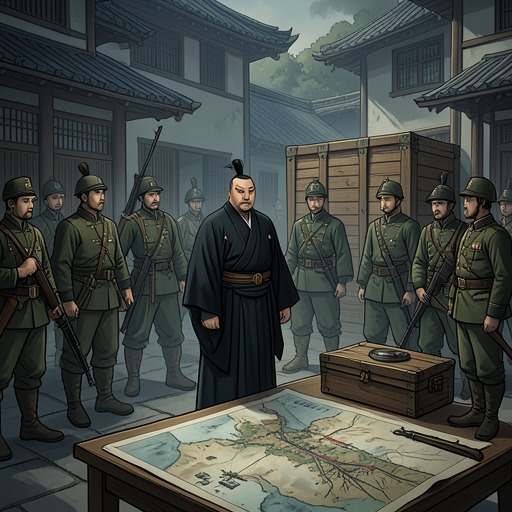
Kiyama, the Christian daimyō
ShōgunKiyama, the Christian daimyō, is one of the Christian lords whose opposition helps turn Toranaga’s political isolation into a looming war. His position is consequential not simply because of his faith, but because his alliance with Ishido reaches into Kyushu, Nagasaki, the Christian daimyōs, and the struggle over the Taikō’s successor. The novel presents him chiefly through the negotiations, fears, and schemes of others, making his political weight clearer than his private character.
Identity and Political Position
Kiyama belongs to the Christian daimyōs and stands with Lord Onoshi against Toranaga. Toranaga tells Father Alvito that Kiyama and Lord Onoshi are strangely opposed to his wishes; he fears their example will draw the other Christian daimyōs after them. If that happens, he warns, his enemies could outnumber his own forces twenty to one. Kiyama’s importance lies in this capacity to turn a factional disagreement into a wider alignment.
That danger is reinforced by geography and trade. Through Kiyama and Lord Onoshi, Ishido controls much of Kyushu, including Nagasaki, the main center of trade. The Portuguese Black Ship and the commerce it carries are therefore entangled with the political balance: control of the port gives Ishido’s side leverage over the trade on which the Europeans depend. Kiyama is not merely one more lord in a council dispute; his position helps connect the southern island, the port, foreign merchants, and the contest for authority at the center.
The Christian Alliance and Political Bargaining
The Jesuits’ discussions with Ferriera expose the uncomfortable consequences of Kiyama’s alignment. Ferriera challenges the churchmen for supporting Kiyama and Lord Onoshi when they have sided with Ishido against Toranaga. The churchmen’s reply is cautious: the two lords informed them of their decision, but the Jesuits did not discuss it with them. Their influence over Christian rulers is real enough to be demanded by others, but not equivalent to direct command.
Toranaga presses that distinction from the opposite direction. He asks Father Alvito how he might influence the Christian lords and argues that open support from all the Christian daimyōs would avert war. In his calculation, their public alignment would curb Ishido’s ambitions; even if Ishido revolted, the Regents could suppress him. Alvito refuses to interfere in Japanese politics. His inward knowledge makes the exchange more charged: Kiyama and Lord Onoshi have secured Ishido’s written promise that they may appoint the Heir’s tutors, including one Christian tutor, and have sworn a Holy Oath because they believe Toranaga would betray the Church after defeating Ishido. Their choice is thus tied to a concrete stake in the Heir’s education as well as to distrust of Toranaga.
The negotiations also show how religion becomes part of a political bargain. Toranaga proposes that the Taikō’s edicts be repealed while other, unwelcome priests are kept out of Japan, and he offers a major Christian temple as an inducement. In return, Tsukku gives his word to do everything he can to persuade Kiyama and Lord Onoshi to become Toranaga’s allies. The foundation stone may be laid on the forty-first day. Kiyama does not personally accept this offer in the available scenes; rather, the promise reveals how much Toranaga and the Jesuits believe his allegiance is worth.
Surveillance and the Plot Against Blackthorne
Kiyama’s reach also appears in a covert operation against Blackthorne. Before an ambush, a captain identifies Kiyama as his master and recalls being warned that Mariko was exceptionally clever and that Blackthorne was dangerous. The captain had been told to watch and listen, hoping Mariko might incriminate herself and provide the Regents with further evidence against Toranaga, and to kill Blackthorne when the ambush began. This places Kiyama in a chain of surveillance and intended violence directed at Toranaga’s foreign ally.
The evidence does not establish that Kiyama ordered the particular attack in the street. The captain dies in the arrows, realizing that the intended ambush had been planned for farther on, near the wharves, and was meant to target Blackthorne rather than the group as a whole. Toranaga subsequently wonders whether Kiyama, Lord Onoshi, the Portuguese, or the Christian Fathers ordered the attack. That uncertainty matters: the novel links Kiyama to the plan against Blackthorne through the captain’s warning, while leaving the command behind the disrupted ambush unresolved.
Conflict, Leverage, and Narrative Role
Kiyama’s political power is shown through the pressure exerted on him and the effects his allegiance could produce, rather than through a direct account of his decisions. Ferriera sees the Christian lords’ alliance with Ishido as a threat to Portuguese influence; Toranaga sees it as a possible route to overwhelming military odds; the Jesuits fear being drawn into politics while also trying to preserve their position. Each perspective makes Kiyama a point where religious loyalty, commercial dependence, and political survival meet.
His characterization consequently remains partly indirect. The secret arrangement with Ishido suggests that Kiyama and Lord Onoshi are securing influence over the Heir’s upbringing, while their oath reflects their fear of Toranaga’s intentions. The captain’s account further associates Kiyama with efforts to monitor Mariko and remove Blackthorne. Yet the novel does not resolve Kiyama’s private motives or establish that he directed the street attack. That restraint keeps him from becoming a simple emblem of Christian opposition: he is a consequential political actor whose importance is conveyed through bargains, rival interpretations, and the uncertain reach of his influence.