Lord Harima
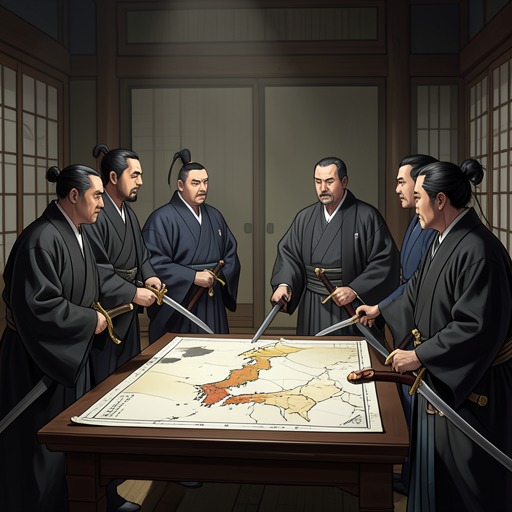
ShōgunLord Harima, the daimyō of Nagasaki and its hinterland, stands at the intersection of Japanese territorial authority, Catholic networks, and foreign commerce. He is not shown directly in the supplied scenes, but accounts of his land, family, religious policy, and political alignment make him a consequential figure: once he joins Ishido’s side, Toranaga must consider not only a rival lord but the foreign influence concentrated around Harima’s port.
Identity and Territorial Authority
Nagasaki belongs to Harima, including the surrounding territory, rather than to Toranaga. Its importance is therefore not merely commercial. Control of the harbor and hinterland rests with a Japanese lord, even though Blackthorne argues that Portuguese and Jesuit influence makes the port function as if it were foreign-controlled. The distinction matters: influence over trade does not, by itself, erase the daimyō’s formal authority.
The land’s history sharpens that distinction. Harima’s father had sold land in Nagasaki to the Jesuits, but The Taikō took it back. By the time Blackthorne raises the matter, foreigners are not permitted to own land in Japan. The episode therefore presents Nagasaki as a contested space without making it foreign territory in law: the Jesuits may wield influence, but the land remains within the Japanese political order, and Harima remains its lord.
Christianity and the Jesuit Connection
Harima is Christian, and his family’s relationship with the Jesuits reaches into the education and service of his nephew, Uraga-noh-Tadamasa. Uraga recalls that Harima ordered his vassals to become Christian, sent him to a Jesuit school, and later dispatched him as one of the Christian envoys to the Pope. He also says that Harima gave land to the Jesuits and courted their favor. These details depict religious affiliation as something built into Harima’s household and political network, not simply a private belief.
Uraga nevertheless doubts the depth of his uncle’s faith. He describes Harima as perhaps a Rice Christian: in his view, Harima adopted Christianity because it served his interests, while remaining Japanese in his heart. This is Uraga’s judgment, not an independently confirmed account of Harima’s motives. Its importance lies partly in the tension it exposes. Harima can promote Christianity among his vassals and maintain close relations with the Jesuits while, according to his nephew, keeping his deeper allegiance elsewhere.
The Jesuits’ practical influence over Nagasaki and its trade is likewise raised as a political claim rather than settled fact. Blackthorne presses the argument that they mediate commerce and exercise control in practice; Mariko distinguishes religious influence from the authority of daimyos over their own lands. The exchange frames Harima’s port as a place where commercial power, religious institutions, and local sovereignty overlap without being identical.
Political Alignment and the Stakes of Nagasaki
Harima’s position changes decisively when he publicly commits himself to Ishido’s standard. Toranaga learns of this alignment only after reaching Yedo; Blackthorne says he heard the news at Hakoné, from Gyoko, who had heard it in Mishima. The chain of transmission gives the report a concrete route while also showing how information about Harima moves through personal and political networks. Toranaga regards Gyoko as unusually well informed, but the source of the news remains reported speech rather than a scene with Harima himself.
Once Harima has joined Ishido, Blackthorne identifies him alongside Kiyama and Onoshi as one of the Christian lords he hopes to obtain or influence. Toranaga immediately challenges the idea that Blackthorne should interfere in Japanese politics as the priests do. The exchange makes Harima part of a wider contest over Christian daimyos: their allegiance could affect the balance between Toranaga and Ishido, but Toranaga insists that the initiative belongs to Japanese rulers.
Harima’s connection to Nagasaki also gives the port a military significance. Blackthorne reasons that if Harima, or the Jesuits leading the Portuguese, became hostile, Nagasaki could serve as a way to reach them. Toranaga rejects a land attack by one foreign power against another on Japanese soil, and says he would not permit foreigners to kill Japanese people. He distinguishes that prohibition from action against enemies of the Emperor and allows for action against a foreign enemy at sea. In this argument, Harima’s political alignment can make him a potential adversary, but it does not give Blackthorne license to turn Japanese territory into a battlefield between foreign powers.
Family, Intelligence, and Uncertain Allegiances
Harima’s influence over Uraga is both familial and political. Uraga warns Blackthorne that he cannot protect him in Nagasaki because of his uncle, and later says that his final allegiance will always be to Harima. The warning marks a limit to Uraga’s usefulness as a retainer and source of information: his service elsewhere does not remove the authority of his family connection. Harima’s reach is thus felt even when he is absent, through the loyalties and risks attached to his nephew.
Reports about a possible secret agreement deepen the uncertainty around Harima’s position. Toranaga hears that Onoshi had allegedly confessed to a secret treaty with Ishido against an unnamed Christian daimyō. Under the reported arrangement, Ishido would support Onoshi in the present and, after Toranaga’s death, have the unnamed lord impeached for treason so that Onoshi’s son could inherit his lands. The Christian lord is not identified. Toranaga considers whether the target might be Kiyama or Harima, then decides that Kiyama is the more useful possibility for his own purposes. Harima’s possible involvement is therefore a strategic suspicion, not an established fact.
After Uraga dies, Kiyama asks Mariko to inquire whether Harima was party to the alleged arrangement. Kiyama immediately recognizes that Harima would be unlikely to disclose such a secret. The question remains unanswered in the available account. Harima’s position is consequently defined by a mix of confirmed public alignment and unresolved private dealings: his support for Ishido is reported as public, while the treaty remains hearsay.
Narrative Role
Harima matters less as a personally depicted character than as a concentration of political stakes. His lordship over Nagasaki establishes who formally controls a port associated with Portuguese and Jesuit power; his Christianity links him to a network whose political loyalty Toranaga wants to understand; and his public alignment with Ishido makes that network more dangerous to Toranaga. At the same time, the book keeps a boundary between what is known and what is suspected. Harima’s Christian policy is recounted by Uraga, his political turn reaches Toranaga through Gyoko and Blackthorne, and his alleged place in a secret treaty is never confirmed. This distance makes Harima a figure through whom the characters test competing claims about sovereignty, religion, intelligence, and allegiance—without granting any one report the certainty of direct testimony.