Lord Sugiyama
ShōgunLord Sugiyama is the wealthiest daimyo in the realm, a Regent whose ancient family gives him standing comparable to Toranaga’s. Though he appears chiefly through other characters’ reports and political decisions, his changing place in the Council connects Toranaga’s isolation, a secret maneuver over the vacant regency, and the murder that becomes a weapon in the struggle over legitimacy.
Identity and Characterization
Hiro-matsu describes Lord Sugiyama as the land’s richest daimyo and says his family is as ancient as Toranaga’s. That formidable inheritance does not, in Hiro-matsu’s judgment, make him a dependable leader: he calls Sugiyama a gutless turncoat, adding that he has known him to be one for a very long time. This is a hostile political assessment, not a neutral account of Sugiyama’s character, and its bluntness is significant. In the Council, wealth and lineage confer influence, but they do not guarantee courage or loyalty.
Toranaga offers a markedly different personal description after Sugiyama’s death. Addressing Zataki, he calls Sugiyama their friend and comrade, and an honorable samurai. The contrast between Hiro-matsu’s contempt and Toranaga’s tribute leaves Sugiyama resistant to a single judgment: he is remembered both as a politically unreliable turncoat and as a valued companion whose honor deserves vindication.
Position in the Council and Shifting Alliances
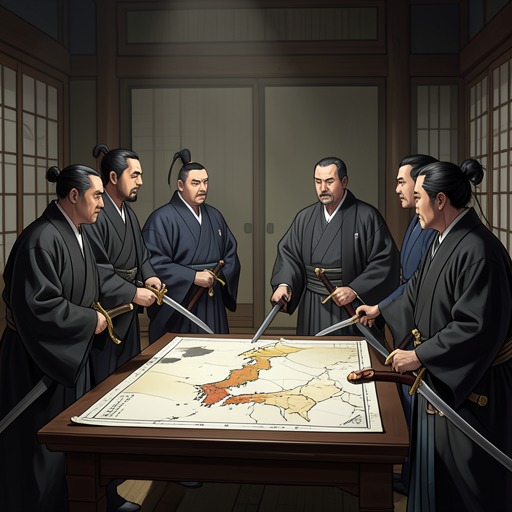
As one of the Regents, Sugiyama belongs to the body whose balance of votes determines whether Toranaga can be isolated. Toranaga has managed the Council so that votes remain split two to three; neither he nor Ishido has been able to secure a four-to-one decision. When Sugiyama, Onoshi, and Kiyama join Ishido in demanding Mariko’s immediate return to Osaka, Sugiyama personally identifies himself among those requesting her presence. Their signed demand is more than a summons: it signals a united front against Toranaga at a moment when his careful balance is breaking.
Toranaga recognizes the danger at once. A four-to-one alignment, he understands, would mean isolation and disaster. He is especially puzzled by Onoshi’s and Kiyama’s apparent defection, since both had long been his implacable enemies; the new configuration leaves him asking what leverage Ishido has gained over them. Sugiyama’s participation helps make the shift politically consequential, even though the evidence does not establish what persuaded him to sign or precisely how he understood the alignment.
Sugiyama also appears in the postponement of a formal Council meeting. Ishido reports that Kiyama is ill and that Sugiyama and Onoshi have agreed to delay the meeting; he then presents the four seals supporting the postponement. Toranaga argues that the meeting can proceed without Kiyama, but Ishido insists that the Regents have agreed otherwise. For Toranaga, the delay is dangerous because it costs him time while the Council’s decisions remain unresolved. Sugiyama’s agreement therefore has consequences even in his absence: his seal helps turn postponement into a collective act rather than Ishido’s unilateral choice.
The Reported Scheme Around the Vacant Seat
A later account gives Sugiyama a different and more covert political role. Zataki tells Toranaga that one of Ishido’s counselors confessed to a plan involving Sugiyama: Sugiyama would accept Ito Teruzumi in Toranaga’s place, then resign on the day before the first Council meeting and escape by night, throwing the realm into confusion. This reported scheme places Sugiyama inside a maneuver over the Council’s composition, not simply among the men who vote against Toranaga. It also suggests that his resignation and disappearance were meant to destabilize the Council at a carefully chosen moment.
The evidence does not resolve how this reported plan fits with Sugiyama’s other apparent alignments. Hiro-matsu judges him a turncoat; his name appears on a demand that strengthens Ishido’s position; and Zataki later describes a scheme in which Sugiyama would cooperate with Toranaga’s side of a plan involving Ito. These accounts reveal a court where allegiance is difficult to read from a single vote or signature. They do not, by themselves, establish Sugiyama’s private motives or whether every detail of the reported scheme was carried out as described.
Death and Competing Accounts
Sugiyama’s death creates a vacancy Ishido’s faction quickly fills. In a letter to Toranaga, Hiro-matsu reports that Zataki has become a Regent in Sugiyama’s place. Zataki presents an appointment signed by Ishido, Kiyama, Onoshi, and Ito Teruzumi, making the new alignment visible in the very document that confirms Sugiyama’s absence. The succession is politically immediate: Sugiyama’s place on the Council passes to a half-brother who has openly joined Ishido.
When Toranaga challenges Zataki over the killing, Zataki denies that he or Ishido ordered it. He says that overzealous ronin killed Sugiyama, while also insisting that Sugiyama deserved to die. Toranaga counters with a specific account of torture in a filthy cellar and the killing of Sugiyama’s children and consorts in front of him. Zataki dismisses that description as rumor spread to discredit Ishido, Ochiba, and the Heir, and says there is no proof. Toranaga points to the bodies as evidence. The account thus remains contested in the exchange: Zataki concedes the killing by ronin but rejects responsibility for ordering it and disputes the reported brutality.
Toranaga nevertheless states directly that Ishido murdered Sugiyama and says he can obtain proof in time. He presses Zataki to recognize the importance of the truth about their friend’s death. Zataki instead demands an immediate decision under threat: if Toranaga takes his head or if he dies in Izu, Sugiyama’s death will be followed by the death of Toranaga’s mother. He produces a formal impeachment and an order requiring Toranaga to commit seppuku, then threatens to meet him on a battlefield. Sugiyama’s murder is therefore not only a loss recalled between former comrades; its disputed circumstances become part of the coercion and accusations driving the next confrontation.
Political and Narrative Significance
Sugiyama’s importance lies in the gap between his limited direct presence and the reach of the claims made in his name. His signatures help form the four-to-one pressure against Toranaga; his reported plan connects him to a covert attempt to alter the Council; and his death supplies the occasion for Zataki’s accession and Toranaga’s accusation against Ishido. The same political world presents him as both a turncoat and an honorable friend, without fully reconciling those portraits.
That unresolved tension makes Sugiyama a measure of how unstable the Council’s apparent loyalties are. A signature can strengthen Ishido, a reported resignation scheme can serve a different design, and an unexplained death can be asserted as murder while its perpetrators dispute the circumstances. Sugiyama’s absence does not remove him from the contest: it makes his memory, his vacant seat, and the competing accounts of his death instruments in the struggle for power.