Osaka
ShōgunOsaka is both Ishido’s capital and the fortified center of the political crisis that drives the novel toward war. Its castle turns power into a question of who may enter, leave, command, or be held: Toranaga’s rivals use the city to constrain him, while its streets and gates become the setting for escape, violence, and Mariko’s decisive sacrifice. The distance between Osaka and Yedo is more than a matter of travel; it separates the capitals of opposing powers while the Tokaido provides the route along which their armies must eventually move.
Capital and Strategic Position
Osaka stands at the western end of the great coastal road linking it with Yedo, Toranaga’s capital, about three hundred miles to the east. Ishido rules from Osaka Castle and holds the titles of conqueror of Korea, Protector of the Heir, and chief general of the western armies. Toranaga, by contrast, commands the Kwanto and the eastern armies. The geography makes the political division visible: two powerful lords hold rival centers, and the road between them is the corridor along which their forces may meet.
The city’s significance is also shaped by the succession crisis. After the Taikō’s death, the five Regents are meant to govern during the minority of his seven-year-old son, Yaemon. Toranaga is president of that council, but his position in Osaka is precarious. His invitation to the city’s political gathering cannot safely be refused, and the independent daimyos and their families who have been asked to wait for his return understand that they are effectively hostages securing his safe return from the enemy stronghold. Osaka thus functions not simply as a seat of government but as a mechanism for holding political power in place.
The Castle as a System of Control
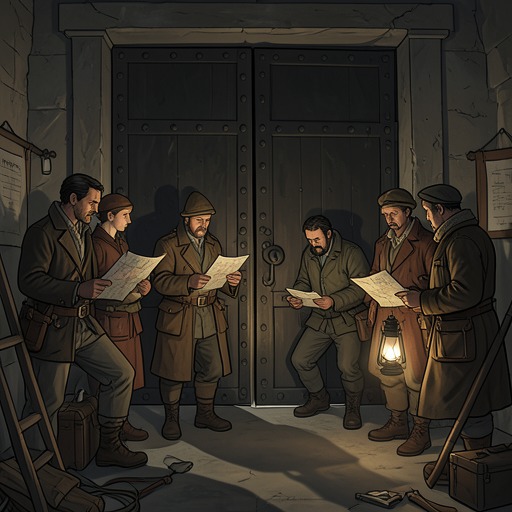
The approach to Osaka Castle makes its defensive depth palpable. A gigantic stone gate is set into a thirty-foot wall fortified with battlements, bastions, and outworks. Beyond it, a broad wooden bridge crosses the moat to a massive drawbridge and another gate in a second wall. Entry is not a single threshold but a succession of barriers, each reinforcing the impression that the castle can regulate movement at every stage.
Inside, the route bends through more gates, document checks, portcullises, moats, and fortified districts. The road turns into a deliberate maze among heavily defended houses, while soldiers watch from ramparts and patrol, march, train, and tend horses. Blackthorne, despite his sharp memory and sense of direction, loses his bearings. The confusion is not incidental: the castle’s layered defenses make movement legible to its guards and disorienting to those being escorted through it. The thousands of well-armed, meticulously dressed Gray soldiers give physical form to Ishido’s control of the city.
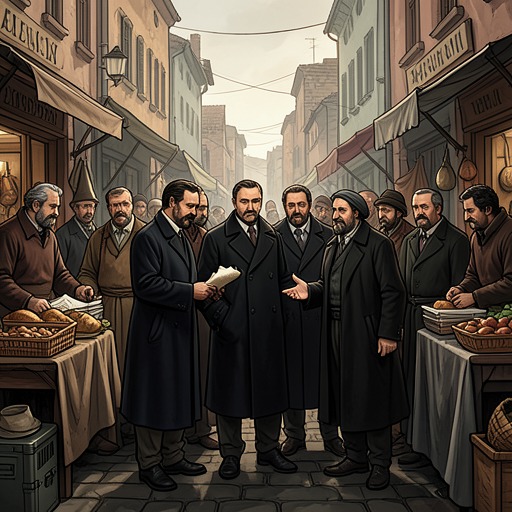
Osaka’s political gatherings carry that same force of containment. When Jozen conveys a formal invitation to a flower-viewing ceremony authorized by the Emperor, the summons is presented as an occasion shared by all the daimyos, with the date set for the twenty-first day. But the ceremonial invitation cannot be separated from the city’s coercive function. Later, Ishido’s treatment of Toranaga’s position is accompanied by the immobility of their households: Toranaga and Mariko both understand that Hiro-matsu’s ladies, including Lady Sazuko, will not be allowed to leave while Toranaga is beyond Ishido’s reach. A face-saving explanation about Sazuko’s health masks the reality of their detention.
A City of Summonses, Traps, and Resistance
The struggle over who can act freely in Osaka repeatedly turns formal procedure into a weapon. After Sugiyama resigns as planned, Ishido’s ronin intercept him on the outskirts of the city before he can escape. Ishido offers him a bargain: delay the resignation until the Regents can convene and legally impeach Toranaga, and Ishido will promise Sugiyama the Kwanto and release him and his family. Sugiyama refuses to betray Toranaga. Ishido then has Sugiyama’s children and consort tortured before him; they die, followed by Sugiyama himself. The city’s political crisis therefore reaches beyond council chambers into the bodies of families caught within its reach.
Osaka is also the place from which Toranaga must escape Ishido’s hold, and its routes and waters shape the risks of flight. At the wharf, Toranaga studies the galley from the shadows of a warehouse with Yabu and a samurai nearby, while the rest of the party waits down an alley. The escape is constrained by the city’s built environment and by the threat of fire: burning a street would bring the public execution by burning of the guilty person’s entire family, across generations. Because wood and paper make homes, warehouses, hovels, and palaces vulnerable to flames, the law treats arson as an exceptional danger. In Osaka, even a possible diversion has consequences that extend beyond the immediate fighters.
Later, the summons to return becomes more explicit. Toranaga is ordered to go to Osaka with two thousand men in full ceremonial equipment; the journey is expected to take thirty days, and only six days remain. The language of escort and ceremony cannot erase the question beneath it: whether going to Osaka means submitting to the council’s authority or walking back into a trap. Toranaga’s refusal to give an immediate decision about the future of his house leaves that conflict unresolved, while the deadline makes delay itself a political act.
Mariko and the Breaking of the Hostage Deadlock
The decisive confrontation in Osaka centers on Mariko’s attempt to leave. She approaches the gates along a crowded, sunlit avenue with ten Brown guards behind her, dressed for travel in a pale green kimono, white gloves, and a broad-brimmed hat. The gates swing open and remain open. The visible passage does not end the contest over her freedom: Ishido’s authority over the city has made departure a political challenge, and Mariko’s movement forces that authority into the open.
The crisis intensifies when ninja attack the Browns’ stronghold two or three hours before dawn. A first wave of ten stealthy attackers crosses the gap between rooftops using cloth-covered grappling hooks and ropes. In tight black clothing and masks, they carry chain knives and poisoned, star-shaped throwing weapons. The attack reveals how vulnerable even a guarded refuge can be inside Osaka, where the city’s divisions and defenses provide routes for both protection and assault. Ishido announces an inquiry but says the truth may never be discovered; he cancels passes and forbids everyone to leave until the twenty-second day. The response transforms the city into an even tighter enclosure.
Mariko’s death breaks that enclosure’s political logic. Toranaga later measures the change in terms of the struggle’s pieces: he has sacrificed his queen, but Ishido has lost two castles. He asks whether Mariko died honorably and by choice, confirming that the manner of her death matters as much as the fact of it. Toranaga subsequently credits Blackthorne with saving her honor, the honor of his ladies and youngest son, and the safety of the hostages still held in Osaka. Without that intervention, Toranaga says, the hostages would remain in the city and he himself might be dead or in Ikawa Jikkyu’s hands in chains. Osaka’s hold is therefore broken not by the simple opening of a gate, but through a costly act that changes what the city can compel.
Narrative Significance
Osaka concentrates the novel’s political and physical conflicts in one place. The castle’s walls, layered gates, and controlled routes make confinement visible; the summonses and ceremonies give coercion a formal face; and the hostage system makes the cost of political submission intimate and familial. At the same time, the city is not an unbreakable fortress. Its wharf, streets, gates, and guarded strongholds become sites where escape and resistance can be attempted, even as each route carries new dangers.
The city’s central role culminates in a reversal of leverage. Ishido’s control of Osaka allows him to hold people and restrict movement, but that very arrangement makes Mariko’s challenge consequential: her death changes the political calculation and helps free the hostages from the city’s grip. Osaka remains the seat of Ishido’s power, yet the crisis there demonstrates that control of walls and passes is not the same as control of the political future.