Saigawa Zataki
ShōgunSaigawa Zataki, Lord of Shinano, is Toranaga’s younger half-brother and a newly appointed Regent whose defection to Ishido transforms an old sibling rivalry into an immediate crisis. His arrival brings the Council of Regents’ demand for Toranaga’s submission, but Zataki makes the summons personal: he threatens his brother, invokes their mother’s life, and offers Sudara’s elevation as the price of ending the conflict.
Identity and Political Position
Zataki rules Shinano and is five years younger than Toranaga. The brothers share a broad build and prominent nose, and their resemblance is striking when they are apart. Together, however, their differences become conspicuous: Zataki is taller, with a flat stomach, heavy black stubble, and narrowed eyes. His rich kimono, glittering ceremonial armor, and well-used swords announce both rank and readiness; Toranaga, by contrast, receives him in a plain kimono and straw sandals.
Zataki has openly transferred his allegiance to Ishido. He has also taken the vacant regency following Lord Sugiyama’s removal, presenting an appointment signed by Ishido, Lord Kiyama, Lord Onoshi, and Ito Teruzumi. The change is more than a family quarrel or a private shift of loyalty: Zataki now speaks with the authority of a Council that claims to act in the Emperor’s name. His new office gives the brothers’ confrontation an official form, while his personal hostility makes that form dangerously unstable.
The Journey to Anjiro
Hiro-matsu reports that Zataki has come from Osaka seeking safe conduct to meet Toranaga at Anjiro. He travels with a hundred samurai and bearers under the cipher of the newly constituted Council. The party also includes Tsukku-san, a foreign priest who arrived by sea at Numazu from Nagasaki and requested an audience with Toranaga. Hiro-matsu sends the priest onward with Zataki’s party and assigns two hundred of his own men to escort them; they are expected at Anjiro within two days.
The report frames the visit as a calculated danger. Hiro-matsu urges Toranaga to leave Anjiro by sea for Yedo, warning that Jikkyu is secretly mobilizing and that northern clans may join Ishido now that Shinano has turned against him. Toranaga instead orders preparations for a possible encounter: Buntaro is to contain the party at Yokosé, while Yabu takes temporary command of the Musket Regiment and positions it in ambush across the Heikawa Road to cover a retreat. Toranaga expects treachery, reasoning that Zataki would not place himself within his brother’s reach without a plan. Yet Omi raises the possibility that Zataki might be ready to become an ally again. The uncertainty reflects the brothers’ history: their rivalry had long been friendly, but the new political alignment has made its meaning impossible to take for granted.
The Council’s Summons
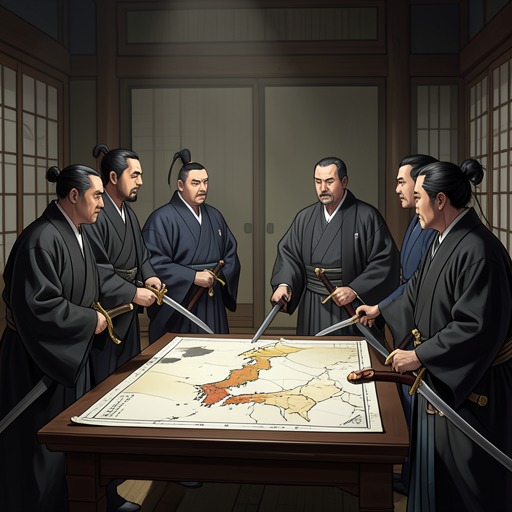
Zataki’s arrival is staged as a public ceremony. Heralds bearing the Regents’ cipher cross the bridge first, followed by his rich palanquin and guards. Villagers kneel to watch, though most can only observe from windows and doorways. Toranaga steps down from the dais to greet his brother, and both begin the elaborate formalities that now govern their dealings. Courtesy initially holds the encounter together, but it cannot conceal the ultimatum beneath it.
Zataki produces two scrolls. The first, issued in the name of Emperor Go-Niji and bearing the Council’s seal, invites Toranaga to come to Osaka at once and make obeisance. It also requires him to tell Zataki, acting as the Council’s ambassador, whether he accepts or refuses. Toranaga studies the scroll at length rather than answering immediately. The demand’s insistence on an answer forthwith turns delay into a political choice, while Zataki’s position as messenger makes him both a half-brother and the representative of the power confronting Toranaga.
Threats, Family, and Succession
The encounter breaks from ceremony into open menace. Zataki demands an answer and declares that if Toranaga takes his head, has him assassinated, or causes his death in Izu for any reason, their mother will die as well. He says ten carrier pigeons will race north to Takato as soon as his head is severed. Trustworthy men, he claims, are positioned north, east, and west within a day’s march, with others safe beyond Toranaga’s borders. The threat makes his own vulnerability part of a prepared system of retaliation: killing him would not resolve the danger but trigger it.
Zataki also challenges Toranaga to prove that he is not plotting against the Heir. His proposed remedy is absolute: Toranaga must immediately surrender all titles and power to his son Sudara and commit seppuku that day. In return, Zataki promises that he and all his men will support Sudara as Lord of the Kwanto. The offer presents itself as support for orderly succession, but its terms require Toranaga’s political extinction and death. When Toranaga says he will consider it, Zataki places the second scroll before him: a formal impeachment and an order to commit seppuku. He predicts that their next meeting will be on a battlefield and says he intends to see Toranaga’s head on a spike before sunset that day.
Character and Narrative Role
Zataki’s actions combine public legitimacy with intimate coercion. The Council’s sealed summons, his regent’s appointment, and the impeachment give his pressure an institutional face; the threatened killing of their mother and the proposed support for Sudara reveal how that official challenge is entangled with family and succession. His insistence that Toranaga choose between submission and death leaves little room for the old, friendly rivalry to survive in its former shape.
The episode does not settle whether Zataki’s threats will be carried out or whether the brothers can ever return to alliance. Instead, it establishes the cost of either response: Toranaga must weigh his own survival, his authority, his son’s position, and their mother’s safety against an ultimatum delivered by a brother who is also a Regent. Zataki therefore embodies the convergence of kinship and state power that makes the crisis so perilous. His presence turns a distant political alignment into a confrontation at close range, where ceremony, military precautions, and family leverage all operate at once.