Toda Mariko
ShōgunToda Mariko is a samurai, Christian, and interpreter whose command of languages and political judgment make her indispensable to Toranaga. Her defining act is not simply her death in Osaka, but the deliberate public challenge that makes it possible: by insisting on her duty to her liege lord and threatening seppuku when that duty is obstructed, she exposes the force behind the hostage system. A letter she leaves for John Blackthorne discloses the private cost of her plan: she accepts the loss of his ship because she believes his life matters more.
Identity and Background
Mariko is the daughter of Lord Akechi Jinsai, remembered for treacherously assassinating his liege lord, Dictator Goroda. Sixteen years later, the day of the assassination remains painfully vivid to her. Her brother had whispered that their father meant to take revenge on Goroda and kill him; Mariko’s memory of that moment binds her to the family’s shame as well as its history. When she tells Blackthorne who she is, she describes herself as her father’s daughter and accepts a sense of responsibility for what he did. Her identity is thus formed not only by inherited rank but by an act of betrayal whose consequences continue to define her.
Mariko’s loyalties are ordered, not interchangeable. She is a Christian, but she explains that she would obey a direct order from the Pope if it were addressed to her personally and concerned her salvation; until then, she obeys her liege lord, the head of her family, or her husband. She identifies herself first as a samurai. This position makes her religious faith neither a simple rejection of Japanese duty nor a private refuge from political demands. Instead, the two codes remain in tension, and she must decide how to act when authority, conscience, and obligation pull in different directions.
Her linguistic ability gives her a public role through which those conflicts become consequential. When she meets the Portuguese priest, she identifies herself immediately as his interpreter and speaks Portuguese with near fluency. She also translates for Toranaga and carries communications between people whose interests do not align. In one exchange, she delivers a closely written scroll to him; elsewhere, she passes on a private dispatch to Hiro-matsu and reports what she witnessed at Yokosé. Translation in her hands is not merely a technical service: it places her between political and religious powers while allowing her to convey information that can shape their decisions.
Counselor and Political Interpreter
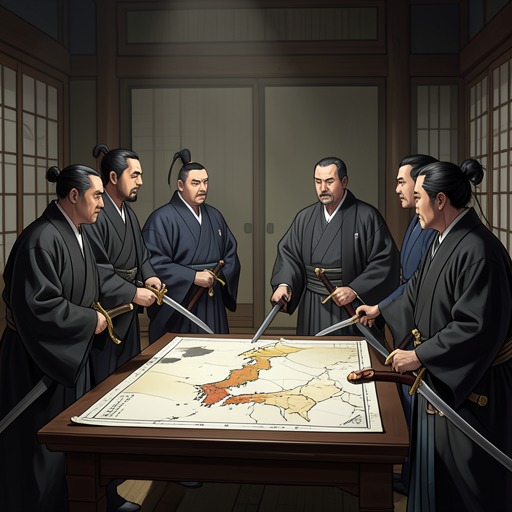
Mariko’s value to Toranaga extends beyond her ability to interpret words. When asked to assess his strategy, she analyzes his apparent moves as a calculated performance: she suspects that he has arranged a secret understanding with Zataki, reads the supposed defection as a possible deception aimed at Ishido, and argues that a public order for Crimson Sky could confuse the enemy without committing Toranaga to attack. Her account attends to timing, spies, weather, and the likelihood that Ishido will have to disperse his forces in response to a threat that may never arrive. She speaks to Toranaga as an equal in that conversation, offering a political reading rather than simply carrying out an instruction.
She also helps explain Blackthorne to Toranaga. She warns that his hatred of the Jesuits exceeds even his hostility toward the Portuguese, and that his courage makes him dangerous in a naval attack. She identifies money as his continuing objective, but places that desire in a wider account of European power: wealth buys ships, land, and position. Toranaga recognizes the difficulty of her position as a Catholic Christian and a friend to someone he regards as an enemy, yet tells her that he values her counsel. Mariko’s usefulness depends precisely on her ability to understand opposing interests without reducing them to a single allegiance.
Her account of Toranaga’s teaching on patience further shows how she mediates between his outlook and Blackthorne’s. She passes on the idea that patience means holding back the seven emotions—hate, adoration, joy, anxiety, anger, grief, and fear—and links that restraint to understanding and harmony. Elsewhere, she tells Blackthorne about Toranaga’s maxim that the strong are patient. She transmits these ideas without erasing the difference between the men who voice them: her role is to make one political and cultural world legible to another.
Duty, Friendship, and Private Affection
Mariko’s bond with Blackthorne grows within constraints she cannot simply set aside. Toranaga later tells him that he had ordered her to become his friend. At Anjiro, before the earthquake, Mariko had already proposed going to Osaka to free the hostages by challenging Ishido publicly and forcing a crisis through her own death. The friendship therefore has both a personal and a political dimension: it brings Blackthorne into her confidence, while also placing their relationship within Toranaga’s larger design.
On the nine-day journey to Mishima, Mariko and Blackthorne meet secretly during part of each night. Their adjacent rooms are chosen as a security arrangement, and the surrounding travelers’ noise and activity help conceal her visits. Mariko’s maid Chimmoko alone knows the secret. The concealment gives their intimacy a precise shape: it is recurrent, but it remains hidden within the practical routines of travel and the obligations of Mariko’s public life. Later, when Toranaga asks whether she wishes to confess, he limits the confession to nonpolitical matters, explicitly excluding anything concerning him and his hatamoto. Even religious disclosure takes place within the boundaries created by political duty.
Mariko also arranges for Blackthorne to spend a night with Kiku. Toranaga explains the custom behind the gesture: when a woman belongs to another man but wishes to give someone she cares for something she is forbidden to offer directly, she may arrange for a courtesan to take her place. The arrangement is therefore more than an ordinary introduction. It offers Mariko a socially possible way to give Blackthorne a gift while acknowledging the limits imposed on her own relationship with him.
Her personal attachments do not keep her from accepting responsibility for her household. When asked why she wants to go to Osaka, she gives family arrangements as her reason: she must settle the money, dowry, and lands for Saruji’s marriage to Kiyama’s family, formalize the increase to the fief, and oversee the house. Toranaga then authorizes her journey, first directing her to Mishima with a private dispatch for Hiro-matsu and then onward with Blackthorne. He makes her responsible for Blackthorne until they arrive and reserves the decision about whether they will continue to Osaka by sea. Mariko’s private relationship and household duties unfold alongside, rather than instead of, her official service.
The Osaka Mission and Public Defiance
Mariko has experience at the highest levels of Osaka society. She says she has been lady-in-waiting to Yodoko, the Taikō’s widow, and Ochiba, the Heir’s mother, and considers herself honored to be their friend. She believes this standing makes her safe enough to travel there, even though she warns Blackthorne that he would not be safe in Osaka after Toranaga’s escape and the events involving Ishido. Her familiarity with the court gives the mission a personal as well as political dimension: she is returning to a world where she has served and formed relationships, but now as an emissary whose presence tests the limits of Ishido’s control.
Before her final journey, Mariko passes a private account of events at Yokosé to Hiro-matsu. Toranaga’s dispatch orders him to hold the frontier and the passes into Kwanto against intruders, while allowing messengers from Ishido and from the east to proceed. It also gives instructions concerning the renegade Christian and Blackthorne. Hiro-matsu reads the message twice, then asks Mariko to tell him everything she saw or heard that could affect Toranaga. She obeys, serving as both bearer of the written order and a witness whose spoken report supplements it.
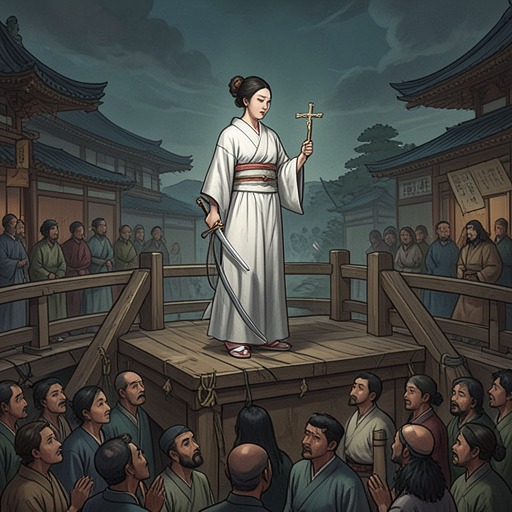
In Osaka, Mariko walks toward the gates with ten Brown guards behind her, dressed for travel in a pale green kimono, white gloves, and a wide-brimmed hat. She formally identifies herself as Toda Mariko-noh-Buntaro, says Toranaga has ordered her to escort his ladies to meet him, and asks to be allowed through. When she is prevented from fulfilling that duty, she turns back rather than force her way through the men. She tells Kiyama that the obstruction has made it impossible to obey her liege lord and that she cannot live with the resulting shame. She announces that she will commit seppuku at sunset and formally asks Kiyama to serve as her second.
The threat converts a blocked passage into a public test of authority. Mariko is not merely trying to pass through a gate: her refusal to accept the obstruction silently makes Ishido’s treatment of her, and by extension his control over those held in Osaka, visible. Toranaga later confirms that she has acted deliberately and in public as he wished. Her threatened death is therefore both an expression of her own understanding of duty and the means by which the political crisis is brought into the open.
Death, Letter, and Legacy
Mariko’s preparations make clear that her proposed death is no improvised gesture. Blackthorne recognizes that she has been planning her suicide for a long time. At the lily pond, she removes her blue kimono and changes into a brilliant white formal death kimono; after removing the green ribbon from her hair, she continues on without looking back at him. The change of clothes marks a passage from the hidden, intimate world of the road to the public ritual through which she intends to make her protest consequential.
During the attack in Osaka, Blackthorne opens a side door and ushers the women onto the veranda. Mariko remains pressed against the iron and declares that she protests the shameful attack by her death. Afterward, she appears to be sleeping. Blackthorne moves her kimono aside and finds her pulse almost imperceptible; then it stops. Toranaga later asks whether she died honorably, by choice rather than through accident or mistake. The question underscores that the manner and intention of her death matter within the political and personal order she inhabited. Her death is also the completion of the threat she made when her duty was blocked.
The full extent of her care for Blackthorne becomes clear in the Latin letter she leaves for him. She writes that he may discover it after her death in Osaka and acknowledges that her actions may cost him his ship. She says she may sacrifice that prized possession because of her faith, to safeguard her Church, but more importantly to save his life. She believes the ship is doomed whether he is there or not; she urges him to build another and says that Toranaga will need his ships. She has also bequeathed him the money necessary from her personal estate. The letter changes the meaning of her apparent choice between Blackthorne and his ship: she has already chosen his survival, and has arranged materially for the future she asks him to build.
After Mariko’s death, Toranaga confirms to Blackthorne that he had ordered her to become his friend and that the two had been friends, while denying that their intimacy had brought shame upon either of them. Fujiko later remembers Mariko as the person who saved Blackthorne—not Toranaga, the gods, or Blackthorne himself. Her final significance lies in the convergence of what had seemed separate: family shame, Christian faith, samurai obligation, political counsel, friendship, and love. She uses the public language of duty to confront the hostage regime, then leaves a private letter that reveals how far beyond political calculation her sacrifice reached.