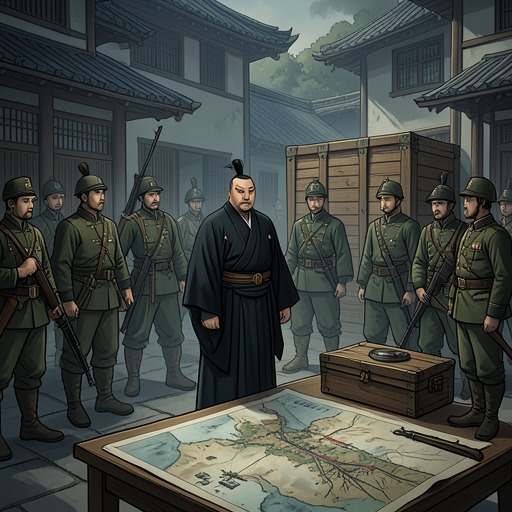
Toda Mariko, Toranaga’s interpreter
ShōgunToda Mariko, Toranaga’s interpreter, is more than the voice between Toranaga and John Blackthorne. A Christian samurai trusted with political business, she turns language into protection, explanation, and action. Her work brings her into contact with the rival demands of religious conscience, service to her lord, and a foreigner’s struggle to understand the society holding him captive.
Identity and Position
Father Alvito identifies Mariko as the interpreter serving Toranaga. Her baptismal name is Lady Maria, and Alvito knows she has been visiting the castle and has been seen with the Ingeles. He does not learn her information from Toranaga: he infers her role from her movements and connections. His confidence in her presence, however, does not mean that he can obtain what she knows. Although he is her confessor, Mariko refuses to disclose political matters, invoking the privacy expected in the country and asking whether Portugal and the Society of Jesus maintain similar boundaries. Her position thus rests on both access and restraint: she is close enough to power to interpret its conversations, but does not treat that access as permission to reveal them.
The distinction matters particularly to Alvito and Alessandro dell’Aqua, who want her brought to them for questioning. Alvito has already approached her, yet she anticipates his purpose and makes clear that she will not speak. Her Christian identity does not make her an instrument of the Church’s political interests. Instead, she maintains a private religious life and a separate duty to Toranaga, refusing to let the confessional relationship collapse those obligations into one.
Interpreter and Cultural Mediator
Mariko’s interpreting allows Blackthorne to communicate with Toranaga, but it also makes her responsible for explaining the assumptions beneath their words. When Blackthorne interrupts an audience just as Toranaga is ending it, he apologizes and asks whether Mariko may speak with him before he leaves. Toranaga gives an affirmative grunt, and Mariko is able to meet him. The brief exchange shows how even a request for a private conversation has to pass through court etiquette and the authority of the lord who controls the audience.
Her explanations extend beyond words. When Blackthorne resents Toranaga’s arrangements for him, Mariko interprets the appointment as a hatamoto not as an insult or arbitrary burden, but as a mark of exceptional favor, almost kinship. She specifies the scale of the distinction: there are only about a thousand hatamoto throughout Kwanto. She likewise explains that Lady Fujiko’s lineage and accomplishments make her an honorable choice, and that accepting her would be regarded as an honor rather than an imposition. Mariko does not deny Blackthorne’s anger; she translates the social meanings he cannot yet see, helping him understand why his hosts believe they have treated him generously.
That mediating role becomes sustained work. After Toranaga leaves Blackthorne at Yabu’s location, Mariko explains that she has been assigned to interpret for three days, though she does not know what work Yabu intends for him. Later, she remains with Blackthorne through extended military discussions with Yabu, Omi, and other officers. She speaks for Blackthorne and for Yabu while scribes take, read back, and revise their notes. Over twelve days and roughly a hundred hours of detailed explanation, this labor helps produce an exact and potentially lethal war manual. Translation here is not ornamental: it carries military knowledge from one system of warfare into another, where it can be used against Toranaga’s enemies and against the European powers Blackthorne fears may seek conquest.
Duty, Faith, and Cultural Explanation
To explain the importance of duty to Blackthorne, Mariko recounts a family story from her youth. Her father, then a general serving Goroda, invited his lord and principal vassals to a feast without having enough money to meet the customary expense. Her mother had already managed the household so carefully that her husband could field 5,300 warriors despite having official revenues sufficient for only 4,000. The family itself had barely enough to eat, but her father’s men were equipped with the finest weapons and horses in service to their lord. To pay for the feast and preserve her husband’s honor, Mariko’s mother sold her long, dark hair to wigmakers in Kyoto, who cut it off and gave her a cheap wig in return. Mariko presents the sacrifice not as an eccentric hardship but as an example of duty: the household accepts deprivation so that service and honor can be maintained.
The story gives Blackthorne a way to understand the logic behind actions that otherwise appear irrational to him. When he explains his own intervention through a Christian teaching about rendering to Caesar what belongs to Caesar, Mariko recognizes a correspondence between his language of obligation and her own. She connects respect for earthly authority with the divine order rather than treating loyalty to an emperor as a rival to faith. The exchange briefly brings their moral vocabularies closer, even as Blackthorne privately wrestles with his own conscience and attraction to her.
Mariko also challenges his assumptions about women’s place in action. When Blackthorne objects that a woman should not be sent to perform a man’s task, she answers that women are equal as samurai and that, for this particular plan, a woman would be more suitable than a man. Her reply is practical as well as declarative: she grounds equality in the capacity to serve and in what the plan requires, rather than asking Blackthorne to accept an abstract principle detached from events.
Action Under Threat
During the escape from Osaka, Blackthorne’s feigned madness makes him a target. Ishido takes up a bow and aims at him, while the Gray guards scatter and the crowd watches. Mariko leaves her protective position near Toranaga’s litter and approaches Blackthorne, telling Ishido that the madness is momentary and that she can help. Despite her fear at seeing Blackthorne’s exhausted, maniacal appearance, she urges him to stop dancing and walk out with her. He obeys; she follows one pace behind, in keeping with custom, as the two cross the bridge under the threat of arrows. The image concentrates her role in the crisis: she uses explanation to create a possible opening, then places herself physically beside the person in danger.
On another occasion at the gangway, Mariko commits her soul to God and pretends to faint. Her head strikes the wooden slats, and the commotion draws Blackthorne toward her; he lifts her and carries her through the men toward the quarterdeck. The feigned collapse is a deliberate and costly intervention, not simple helplessness. As at the bridge, she uses the expectations of others and her own vulnerability to alter what can happen next, accepting bodily risk as part of the action.
Toranaga’s reliance on her is not limited to escape or interpretation. After an encounter involving Ferriera and his armed men, Toranaga tells Mariko to take one of his guards, find Blackthorne, and stay with him until summoned. The order places her between Toranaga’s household and the foreigner whose knowledge Toranaga is using. Her service consists not only of rendering speech but of maintaining the human and political connection between them.
Loyalty, Change, and Narrative Significance
Toranaga eventually asks Mariko whether she will become an apostate and give up Christianity, telling her that her faith must be kept behind rather than in front of her spirit. She answers shakily that her religion has never interfered with her loyalty to him and that she has always kept it private; she asks how she has failed him and what she must do to please him. The exchange reveals both the strength and the pressure of her position. She insists that faith and loyalty have coexisted in her conduct, while Toranaga anticipates a future conflict between them. Her answer does not erase that conflict; it exposes the demand that she prove her service without surrendering the private conviction she has guarded.
Mariko’s guidance to Blackthorne offers a different kind of discipline. When he is overwhelmed by the village’s threatened fate and by questions about what may happen later, she urges him to attend to the present rather than attempt to settle every future consequence. She points him toward the sunset, emphasizing that this particular moment exists now and will never recur. Blackthorne watches until the sun disappears. Her counsel does not promise that danger will pass or that the burden of karma can be calculated; it redirects attention from unknowable outcomes to the life immediately at hand.
By the time Blackthorne is training and teaching under Yabu, Mariko is no longer merely the interpreter assigned to a stranger. She is always present in his work, speaking for him and for Yabu, and the narration registers that she has become part of his life in Japan. That change is quiet but consequential: language has made cooperation possible, while repeated shared labor has turned the interpreter into a trusted companion. Mariko’s importance lies in this double capacity. She carries messages across political and cultural boundaries, but she also decides what those boundaries require—what must remain private, what can be explained, and when explanation must give way to action.