Uraga-noh-Tadamasa
ShōgunUraga-noh-Tadamasa begins as Brother Joseph, a Japanese Jesuit trainee whose rupture with the Church is also a protest against the order that trained him but denied him a priest’s status. His passage from acolyte to armed retainer makes that conflict political as well as religious; after he joins Blackthorne’s company, he is killed in an attack on the Erasmus.
Identity and formation
At thirty, Joseph is described as thin and frail, and as having been in the Jesuits since he was eight. He belongs to a group of Japanese acolytes of noble samurai birth from provinces in Kyushu. Their tonsures and rigorous preparation mark them as men formed for the priesthood, yet none has been ordained. Joseph has undergone sixteen years of training; some companions have trained even longer. Their knowledge of prayers, catechisms, and hymns, and their practical work preaching and debating with Buddhists and converting others, sharpen the contradiction between their responsibilities and their exclusion from priestly office.
The boundary is institutional, not a measure of their competence. Joseph points out that he and other Japanese brothers speak Latin and Portuguese, and that he and fellow trainees have travelled to Rome and met high Church authorities. Yet they cannot take the fourth vow or be ordained as Jesuits. Joseph asks whether their exclusion rests on their being Japanese rather than Portuguese or Spanish. The question gives his personal grievance a wider scope: the men who do much of the missionary work remain barred from the office their training prepares them to hold.
Confession and rupture
Joseph’s confrontation with Father Alvito begins with a confession of sexual sin. He acknowledges that the first incident was four nights earlier in Mishima and that he has sinned again. His distress is intensified by the fact that he received the Eucharist after the earlier sin without confessing it. He appeals to Christian forgiveness, but Alvito insists that Joseph has committed a mortal sin and broken his oath. In the exchange, repentance does not resolve the dispute: it opens into an argument over who is permitted to become a priest.
Joseph insists that the Japanese brothers are not professed or ordained priests and therefore cannot take the same vow as Alvito. He asks why none of them can be ordained after years of service and study. Alvito orders him to stop, but Joseph continues, contrasting the brothers’ actual preaching and debating with their exclusion from priesthood. His challenge is not merely that the institution has failed to reward his effort; he directly questions the national and racial boundary governing religious authority.
Alvito excommunicates Joseph and orders him away. Joseph answers by renouncing the Christian God, identifying himself as Japanese and Shinto, and declaring his soul his own. The break is enacted amid immediate danger: Michael has come close with a hovering blade, but Alvito commands him to stop. Joseph puts his own knife into his sash, leaves the room, and walks across the courtyard toward the gate, where a samurai halts him. The departure changes his position from a member of the Jesuit community to a man exposed to the consequences of its rejection.
From acolyte to armed retainer
Joseph does not disappear from the political story after leaving Alvito. When Father Alvito later sees him among the guards, Joseph is wearing a military kimono and carrying swords awkwardly. Captain Yoshinaka explains that Toranaga ordered him taken to Mishima and then handed over to Lord Hiro-matsu. The image of the former trainee among armed men makes his change of circumstance visible: the Church has cast him out, while Toranaga’s command gives him a place within a military household.
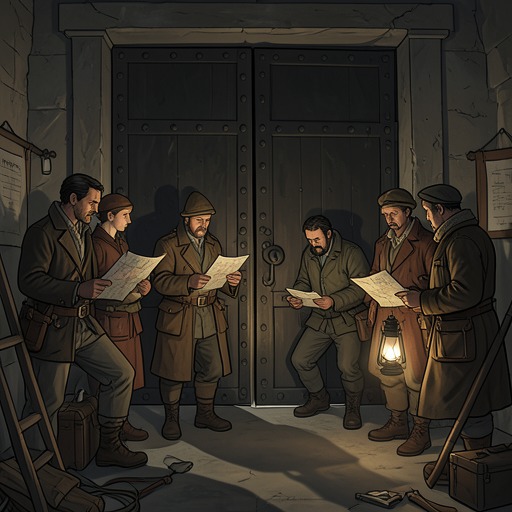
In the darkness before dawn, Joseph is among a ten-man party leaving Osaka Castle with Naga, Yabu, and Blackthorne. Naga leads the group through side passages and across the castle’s moat; sentries let them pass when shown a silver cipher. At First Bridge, the party turns south and disappears through the alleys toward the sea. Joseph’s presence in this carefully managed escape places him within the operation, though the evidence does not assign him the lead or the cipher-bearing role.
Later, aboard the galley near Yokohama, Joseph acts as a cautious intermediary between Blackthorne and the assembled vassals. He asks Blackthorne to delay dismissing the men until he can find out whether any are Christians. He explains that Blackthorne is their most dangerous enemy and presents the inquiry as protection for his lord. The exchange shows him using religious knowledge as practical intelligence: the faith he has renounced remains essential to understanding the threats around Blackthorne.
Family ties, service, and death
Joseph also explains why Christianity shaped his earlier life. His uncle, whose fief is Nagasaki, became Christian and ordered his vassals to convert; he also sent Joseph to a Jesuit school and made him one of the Christian envoys to the Pope. Joseph regards his uncle’s conversion as expedient, saying that his uncle’s heart remains Japanese. That history helps distinguish Joseph’s own religious rupture from the calculated conversion he attributes to his powerful relative: his training was imposed through family and political authority, but his later challenge to the Jesuits arises from years spent serving within their mission.
Joseph’s service to Blackthorne ends aboard the Erasmus. After an uneventful journey from Yedo, he speaks with Blackthorne on deck and tells him the inquiry among the vassals cannot wait. Blackthorne acknowledges that he may already be an outlaw and mentions that his uncle is Christian, perhaps only a nominal convert. Joseph’s concern is immediate and concrete: he wants Blackthorne to know which men may be dangerous because of their faith.
The conversation is cut off by arrows from the sea. Blackthorne hears the danger and moves to pull Joseph down; one arrow passes Blackthorne and strikes the bulkhead, while another hits Joseph in the throat. A second volley sends the men scrambling for cover as attackers in fishing boats vanish into the night. Joseph’s cries subside into agony while Blackthorne returns to him. His death comes during the very act of trying to protect the man he serves, turning his final role into a grim counterpoint to the earlier argument over whether he could be trusted with religious authority: the former trainee now reads a danger his companions cannot safely ignore.