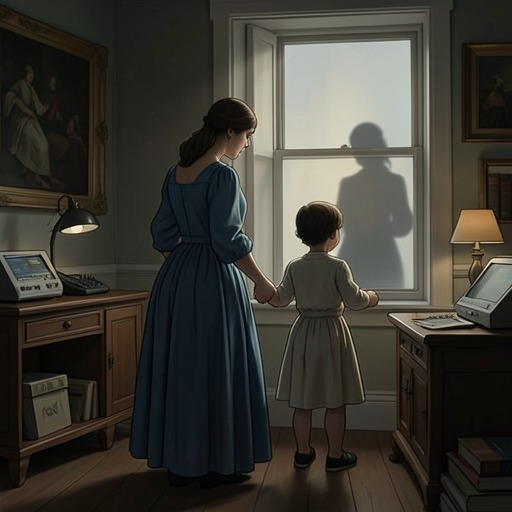
Alice Pagett’s First Vision and Cure
ShrineAlice Pagett’s First Vision and Cure marks the moment the Banfield affair moved from a local event into a public and ecclesiastical investigation. Alice Pagett regained her hearing and speech after seven years without either ability; the resulting attention brought crowds to St. Joseph’s and led Church authorities to arrange medical scrutiny while reserving the question of divine intervention for a separate judgment.
The Cure and Its Immediate Significance
At a later meeting, an older priest greeted Gerry Fenn as the man who had found Alice Pagett in the church grounds when the affair began. His cordial welcome connected Fenn directly to the first public turning point in the case. The priest offered a large hand, and Fenn accepted it cautiously; the grip proved firm but unexpectedly gentle, a small, human exchange set against the growing scale of the controversy.
The cure’s defining fact was specific: Alice Pagett could hear and speak again after seven years of being unable to do so. Its sudden public importance did not, by itself, establish what had caused the change. The distinction between the observable recovery and its possible religious meaning shaped the investigation that followed.
Public Attention and Church Involvement
The first cure created an enormous amount of public interest. Bishop Caines said that he expected crowds to descend on St. Joseph’s and that Father Hagan would need support and guidance in dealing with them. Monsignor Delgard was temporarily appointed to assist. The appointment therefore answered both a pastoral need and the practical demands created by the attention surrounding Alice Pagett’s recovery.
At a press conference, Monsignor Delgard acknowledged that he had investigated unusual phenomena for the Church, studied psychic phenomena, and performed exorcisms. He did not infer that Alice Pagett was possessed; he considered that unlikely and described her as apparently well-balanced. Bishop Caines characterized Delgard’s usual function as that of a devil’s advocate rather than a devil-seeker: he examined natural as well as unnatural explanations and helped the Church maintain a balance in cases that challenged ordinary reasoning. His history made him relevant to the inquiry, but it did not settle the interpretation of Alice Pagett’s cure.
Medical Assessment and the Question of a Miracle
The Church’s process separated medical assessment from spiritual judgment. The medical bureau and the international committee were to determine whether a cure was medically inexplicable in light of current science, not whether it constituted a miracle. The bishop and his advisers retained responsibility for considering whether divine intervention explained the recovery. The distinction left room for a medical finding to remain provisional: what seemed inexplicable in the present could later acquire a scientific explanation.
The stated medical tests were demanding. A cure had to be sudden and unexpected, occur without convalescence, be complete, and last; confirmation could require three or four years. Investigators also had to establish the seriousness and specific nature of the illness, look for objective proof such as tests, X-rays, or biopsies, and determine whether prior treatment had contributed to the recovery, even partly. An infirmity attributable to mental disorder would rule out acceptance as a miraculous cure. The criteria made Alice Pagett’s recovery the beginning of an inquiry, not its conclusion: medical evidence and a religious interpretation remained separate questions.