Our Lady’s Apparitions at Lourdes
ShrineOur Lady’s Apparitions at Lourdes serve as both a precedent and a test case for the claims surrounding Alice Pagett in Banfield. The novel presents the visions attributed to Bernadette Soubirous in 1858 as the beginning of a pilgrimage tradition whose meaning cannot be reduced to a tally of medically recognized cures: the Church’s caution about declaring miracles sits alongside its recognition of faith renewed among pilgrims.
The Visions and the Pilgrimage
The account identifies Bernadette Soubirous as a young French girl who claimed to have seen the Blessed Virgin in a series of visions in 1858. The grotto where the visions were said to have occurred lay just outside the small town of Lourdes. Its transformation into a place of worship gives the episode an enduring public consequence: the reported private visions became the focus of a shrine visited by four or five million pilgrims each year.
Those arriving at Lourdes did not all come for the same reason. Many sick or disabled visitors hoped to be cured; others sought to reaffirm their faith or simply to pay homage. The pilgrimage therefore gathered physical hope and religious devotion in one place, without making every visitor’s purpose or experience identical.
Cures and Ecclesiastical Scrutiny
The account distinguishes recorded cures from cures formally recognized as miraculous. More than five thousand cures had been recorded at Lourdes, but after stringent investigation by the Roman Catholic Church’s medical bureau, only sixty-four had been proclaimed miraculous. The disparity establishes a central feature of Lourdes as it is discussed in the novel: reports of extraordinary recovery may attract attention, but they do not by themselves settle the Church’s judgment.
That distinction informs Father Hagan’s response to Alice Pagett. After visiting her at the hospital in Brighton, he accepts that she has recovered her ability to hear and speak, while recognizing that specialists had previously understood her deafness and muteness as psychosomatic. The medical account can describe a change in her condition without resolving what caused it. For Father Hagan, the unresolved question is whether that change was self-induced or divine; the Lourdes precedent gives him a model for holding open spiritual significance without treating a claim as proven.
The novel also connects this caution to the Church’s formal procedures. Bishop Caines says that a possible miracle must be examined thoroughly before judgment, under guidelines dating to the eighteenth century and associated with Pope Benedict XIV. Such scrutiny reflects the risk of proclaiming a miracle that scientific evidence might later explain or disprove. Lourdes thus functions not as automatic confirmation of Banfield’s claims, but as an example of how religious recognition is delayed and qualified.
A Spiritual Meaning Beyond Medical Records
Father Hagan’s reflection on Lourdes gives the event a second measure of significance. Alongside cures that can be entered into medical records, he considers the renewal of faith, a calmer acceptance of illness, and an inner peace that may help pilgrims cope with their own disabilities or those of loved ones. These experiences are presented as spiritually meaningful but intangible: they cannot be captured by clinical registers or medical score sheets.
This distinction shapes the novel’s idea of what a miracle might mean. Alice’s recovery may have a medical description, and the cause of that recovery remains uncertain, but Father Hagan regards the emotional or spiritual experience behind it as significant in itself. Lourdes offers a precedent for that layered understanding, separating the question of whether a cure is medically inexplicable from the question of whether an encounter has altered a person’s faith.
The Lourdes Precedent in Banfield
The precedent also has public and institutional consequences. George Southworth sees the reported events at St. Joseph’s as a possible chance for Banfield to be reborn and for its people to recover their beliefs; he invokes the idea that an event can create faith. He and Rodney Tucker ask Gerry Fenn to write more about what will become known as the Banfield Miracle, even though Fenn recognizes that local revitalization could benefit Southworth financially and that Tucker is pursuing money.
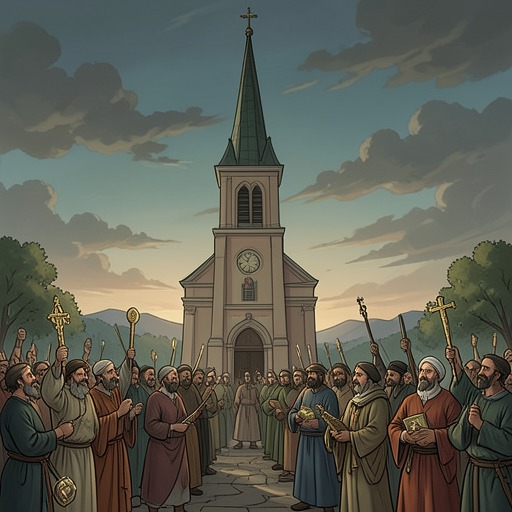
As news spreads, church leaders anticipate that people will come to the site out of belief, curiosity, or hope for healing. Bishop Caines stresses that the five reported cures, in addition to Alice Pagett’s recovery, could attract thousands whether or not St. Joseph’s is declared a shrine. He therefore argues that the Church must manage the situation from the beginning. The later crowds around the field beside St. Joseph’s echo the Lourdes pattern of sick visitors, hopeful families, believers, and the merely curious converging at a claimed holy place. Yet the comparison also sharpens the difference between a pilgrimage’s power to gather people and the evidence required to certify a miracle: Lourdes supplies Banfield with a precedent for both religious possibility and institutional restraint.