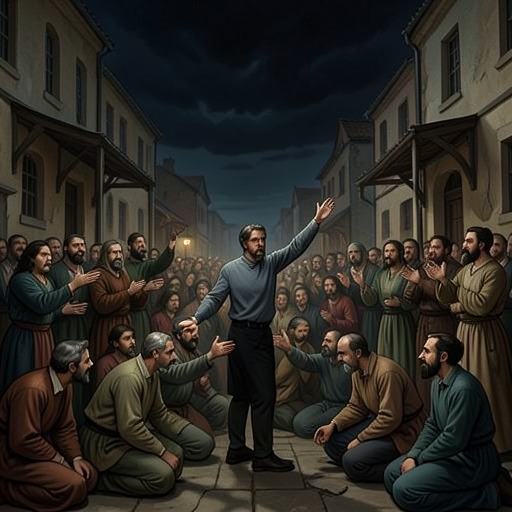
Alice Shot and Rises Again at the Banfield Pilgrimage Service
ShrineAlice Shot and Rises Again at the Banfield Pilgrimage Service is the turning point at which Banfield’s public celebration of Alice Pagett’s apparent holiness becomes a scene of violence, renewed suffering, and dread. During a vast outdoor service, Alice appears to levitate above the altar before Wilkes shoots her. The attack does not end with her death: the people she had healed lose their recoveries, while Alice herself rises again, no longer appearing to those around her as the child they had come to worship.
Gathering for the service
The event grows out of a rumor that Alice has told Father Andrew Hagan and her mother that the Lady wants to see her again on Sunday the twenty-eighth. By the time Gerry Fenn arrives with Sue and Ben, Banfield is already unusually busy: traffic thickens, people stream toward the church, and the approach is crowded with pilgrims, believers, and the curious. Fenn brings an Olympus camera and a microcassette recorder, prepared to document whatever happens, though he expects no spectacle. The crowd’s scale nevertheless offers the prospect of a follow-up story.
The gathering is not made up only of spectators. People arrive with visible disabilities and illnesses, often accompanied by family members who help them through the crowd. Fenn notices a teenage girl whose movements suggest chorea and an emaciated boy in a wheelchair whose family watches with hope. Their presence makes the stakes concrete: many have come seeking the return of abilities or health, and Fenn anticipates their disappointment if nothing occurs. For some, the pilgrimage is not an abstract expression of faith but a wager on the possibility of cure.
The service takes place amid preparations for a congregation expected to number in the thousands. Ben runs among the benches while early arrivals press toward seats near the altar, hoping either to see Alice or to be close to what they believe her holiness can offer. Invalids have difficulty moving through the churned-up field, and stewards and ushers try to manage the growing crowd. The arrangement gives the gathering the order of a religious ceremony, but the crush of people, their expectations, and the limited space also make the congregation vulnerable to sudden disorder.
Procession and apparent levitation
The approaching procession is presented as both a religious ritual and a public event. A television crew tries to frame Alice, the altar, and the distinctive oak behind it, but its picture and sound repeatedly fail. The broadcast’s technical breakdown contrasts with the crowd’s growing absorption in the ceremony. As the procession enters the field, Bishop Caines leads the clergy and religious participants, with Alice and her mother among them. Candles and singing draw the congregation into a shared mood of anticipation.
The assembled crowd includes people Alice has reportedly healed, alongside local dignitaries and clergy. George Southworth surveys the congregation with apparent satisfaction, a response distinct from the worshipful absorption around him. At the same time, the emotional intensity takes a physical toll: a nun faints, other people collapse, and Sue sways. Fenn becomes dizzy as well, but when Ben reaches toward him the reporter’s weakness abruptly passes. The episode underscores how the gathering’s atmosphere affects people differently and places Ben, without visible distress, in striking contrast to the adults around him.
During the Mass, Alice rises and walks to the center of the platform. The singing falters and falls silent as the congregation turns toward her. With the altar behind her and the illuminated oak beyond it, she raises her arms and appears to ascend into the air. The event fulfils the crowd’s expectation of a manifestation, but it also suspends ordinary ritual: attention shifts from the service to the child, and the congregation watches in concentrated silence. Fenn sees the scene as frightening rather than reassuring, while the surrounding worshippers remain transfixed.
Wilkes shoots Alice
Wilkes has entered the field carrying a German Luger concealed on his person. He waits through the service, joining the congregation’s movements without sharing its devotion, and chooses the moment when attention is fixed on Alice. As she appears to hover above the platform, he walks down the aisle, draws the gun, and fires at her. The scene’s central reversal is immediate: the figure whom the crowd regards as a source of holiness becomes a victim of a planned attack, and the congregation’s expectant silence gives way to shock.
Fenn witnesses the shooting but initially struggles to understand what he is seeing. He sees Alice fall, and the congregation remains stunned before panic and grief spread through the field. Some people weep or stand numbed; others call for revenge. Sue collapses, and Fenn supports her while keeping Ben close. The crowd’s response quickly becomes physical: people rush Wilkes and overwhelm him. In the confusion, Fenn recognizes that the assailant may not survive the attack. The service’s temporary community, formed through shared expectation and worship, breaks apart into distress, anger, and uncontrolled violence.
Failed cures and Alice’s return
The shooting is followed by a second reversal: the healings associated with Alice cease to hold. A girl who had come to honor her begins to show the same uncontrolled movements associated with her former illness. A boy who had regained the use of his legs loses his strength; a man’s restored sight fades; another girl can no longer form words. Elsewhere, people’s previous afflictions return. These changes turn the crowd’s hope into a renewed encounter with the conditions from which its members believed they had escaped. The apparent cures have not proved permanent, and the gathering’s promise of lasting relief collapses at the moment of Alice’s apparent death.
Fenn, no longer overcome by dizziness, protects Sue and Ben and then makes his way toward the platform. He finds the service’s participants in shock: altar servers are weeping or praying, the priest is silently praying, and Molly Pagett is supported by others. Bishop Caines and those around him are also overcome. As Fenn climbs, the lights and candles dim, and his nausea and weakness return. Molly alone remains standing, reaching toward Alice’s motionless body.
Then Alice begins to stir and sits up. She rises after having been shot, but her return does not restore the reassuring image that brought the pilgrims to the field. Her face no longer seems that of an ordinary child; she looks around with malevolent intent and grins. The event therefore ends not with a renewed healing or a return to the service, but with the apparent resurrection of a transformed Alice. The contrast between the congregation’s belief in a benevolent miracle and the threatening figure before them recasts the levitation, the failed cures, and the pilgrimage itself as parts of a crisis the crowd cannot control.