Sister Einor’s Execution and Curse
ShrineSister Einor’s execution, preserved in Thomas Woolgar’s chronicle, turns a village’s religious outrage into an act of collective violence and leaves behind a curse that the chronicler says reached beyond those who witnessed it. The episode is also a confession: Woolgar presents himself as a betrayer of Einor, but his account reveals his own participation in the conduct and crimes behind the accusations. Its supernatural climax is inseparable from that compromised testimony, since the chronicle’s visions are not confirmed by the more limited version of events later reported to him.
The accusations and Woolgar’s part
Woolgar’s account places the execution after a concealed relationship between him and Sister Einor, whom villagers had regarded as devout and credited with healing ailments. He admits that he was her willing accomplice and acknowledges that his own desire was part of the relationship, even while repeatedly reaching for explanations that make him seem controlled by Einor’s influence. That tension matters to the execution: the man who helps turn the village against her is not a detached witness but someone trying to describe his own guilt while shifting some responsibility onto the woman he denounces.
The chronicle attributes a series of crimes to Einor. It says that she discussed poisoning the Prioress, that three children disappeared and were killed, and that two novices were drawn into her conduct. Woolgar admits that he helped silence the children as they were punished, making his confession especially damaging to his self-presentation as a helpless victim. The Prioress, weakened by illness, learns of the misconduct through a novice’s confession and confronts Woolgar. He confesses to his relationship with Einor but withholds part of the truth, then accepts the account that her sorcery had overcome his will. The chronicle thus shows the charges emerging through a mixture of disclosure, self-protection, religious judgment, and a powerful family’s influence.
The Prioress sends for an ecclesiastical officer to arrange Einor’s confinement. Woolgar says that the prospect of Einor telling the truth at trial threatens his own position and his father’s reputation. He returns to Banfield and tells members of his congregation what he and the Prioress claim to have uncovered. The report spreads quickly; parents whose children had vanished demand vengeance, and Woolgar follows the gathering crowd while encouraging its anger. His narration does not permit him to stand outside the mob: he helps set the accusation in motion, then describes the consequences as a participant.
The mob and the execution
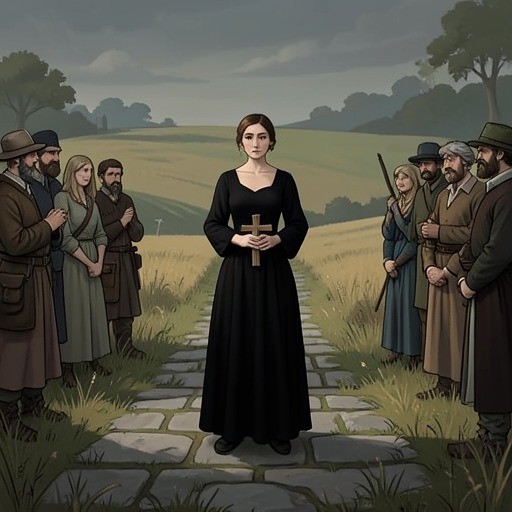
The crowd reaches St. Joseph’s Church in Banfield and finds Einor at the altar with Rosemund, a novice who had accepted her influence. Einor is dragged from the church, and Woolgar recounts that she recognizes him as the person who betrayed her. The villagers interpret his collapse at her gaze as evidence that she has bewitched him. He denies her accusation that he shared in her wrongdoing and urges the crowd to look for what it takes to be the Devil’s Mark, a bodily sign then associated in the chronicle with witchcraft. The detail exposes how the crowd turns suspicion into apparent proof: the mark does not establish the crimes, but it reinforces the identity the accusers have already assigned her.
The mob subjects Einor to escalating punishment and demands a confession. Woolgar says his pleas for the violence to stop are weak and ultimately give way to inaction. After an ordeal in water, Einor confesses to witchcraft, though the circumstances make the confession an unreliable measure of what she believes or has done. The crowd then takes her to a nearby oak, hangs her, and lights a fire beneath her. Woolgar describes her final words as curses against him and everyone present, extending the threat to their descendants and invoking the name of Mary. He cannot tell whether Einor means the Virgin Mary or Queen Mary Tudor. The ambiguity makes the curse both a personal accusation and a challenge framed in the religious language through which the villagers have condemned her.
The curse and the contested aftermath
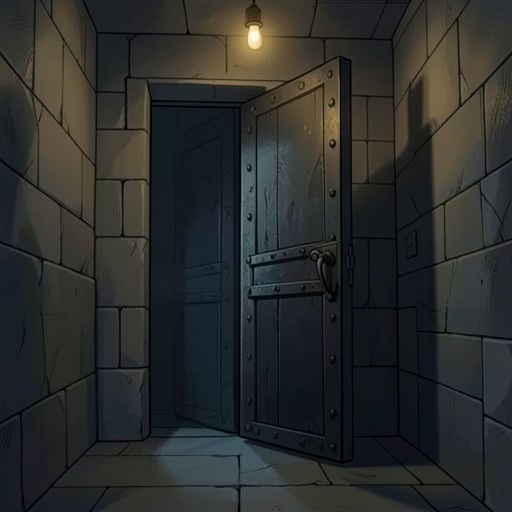
Woolgar interprets the darkness and trembling ground at Einor’s death as signs that an infernal force has been released. He says the earth opens to reveal a black pit and figures from the lower world, then retreats to the church crypt, where he hides for three days. In the chronicle, this is the most extreme turn in the event: a public execution becomes an apparent rupture in the natural order. Yet the account gives readers reason to distinguish what Woolgar experiences from what others confirm. When his father and a bishop later tell him what the villagers reported, their account includes a thunderstorm and dark clouds but not demons or an opening into hell. They believe that Einor’s drugs have poisoned Woolgar’s mind and that he has seen what was not there.
The disagreement does not resolve whether the supernatural events occurred; it establishes that the chronicle is the testimony of a man whose guilt, fear, and isolation shape what he claims to have witnessed. Found hiding in the crypt, Woolgar is taken to his father’s house and confined while his condition is treated as madness. He is later sent away from the parish and assigned to serve at St. Peter’s Church at Stapley. The move removes him from Banfield and from the place of the execution, while his father arranges repairs to St. Joseph’s Church after the damage attributed by others to lightning. Woolgar also says that the church chest and parish records are transferred, a practical relocation that carries the written history of the parish away from the site of the violence.
Narrative significance
The chronicle makes the execution both an origin story for the curse and an indictment of the people who claim to suppress evil. Woolgar records the villagers’ religious certainty, but his own admissions show how personal culpability feeds the accusation: he helps provoke vengeance against the woman with whom he shared responsibility, then denies her charge that he was her partner. His repeated appeals to sorcery and coercion cannot erase his confession that he acted and failed to stop the crowd. The narrative therefore preserves the mechanics of scapegoating as well as the alleged supernatural danger.
The event also binds the oak, the church, the crypt, and the parish records into a chain of memory. The execution takes place at a nearby oak; the church becomes the site from which the crowd seizes Einor; Woolgar’s refuge is the crypt; and the old chest is removed along with the records. These locations and objects make the aftermath more than a private haunting: the history of Banfield is displaced, hidden, and eventually carried forward in a manuscript whose writer insists that later readers should not dismiss him. The reader receives the curse through that very document, but also receives the grounds for questioning its witness.