Alice Pagett’s Conception in the Field beside St. Joseph’s Church
ShrineMolly Pagett’s account of Alice Pagett’s conception turns a private memory into a revelation about the field beside St. Joseph’s Church: the ground later associated with Alice’s holiness was where Molly and Leonard Pagett conceived her during a single encounter before their marriage. The confession connects Molly’s guilt and devotion to the church with the field’s later religious significance, while Monsignor Delgard tries to separate the remembered event from the claims gathering around the site.
Background and Setting
Molly recounts the event to Monsignor Delgard while explaining the history of her relationship with Leonard. At the time, she worked for the church and felt deeply attached to it, a devotion she recognizes in Alice’s love for the same place. Leonard would wait for her nearby. They had been seeing each other for a couple of months, but, as Molly presents their relationship before this day, nothing serious had happened between them.
The encounter took place in summer at dusk, in the Field beside St Joseph’s Church, beyond the church wall. Molly had been collecting dead flowers from the graves when Leonard called her over. The wall marks the event’s important physical boundary: the field felt to Molly like sacred ground, yet Monsignor later emphasizes that it was outside the church’s boundary and had never been consecrated. The distinction becomes central once a shrine and public service are associated with the same land.
The Encounter and Its Meaning for Molly
Molly describes the occasion as a departure from the way she and Leonard had previously related to one another. They kissed across the wall, and Leonard lifted her over it. She recalls the encounter as unusually intense and says she felt unable to resist what followed. Without presenting it as a declaration of love, she remembers it as passion and desire, and as an experience in which the two of them seemed almost like different people.
The consequence was Alice’s conception. Molly tells Monsignor Delgard that this was the only occasion on which she and Leonard were together before marriage, and that she knew she was pregnant soon afterward. She says she did not let Leonard touch her again until after they were married. Her account therefore identifies this particular encounter, rather than a later possibility, as the origin of Alice’s pregnancy.
Confession and Maternal Belief
Molly has carried shame about the encounter for years. In telling it, she asks whether it can be forgiven and struggles to reconcile what she understands as a sin with her conviction that Alice was a gift from God. She recalls having believed that she might remain unmarried, and describes the church as having become her life before the pregnancy. The child she wanted, she says, became something to cherish alongside that religious commitment.
Monsignor Delgard reassures Molly that she is forgiven and challenges the persistence of her guilt. He also points out that the encounter occurred outside the church boundary, so the field was not consecrated; with a service due there the next day, he sees no need for her to confess the event on the grounds that it took place on consecrated land. His distinction answers one part of Molly’s distress, but not the deeper question she raises: whether a child conceived in an act she regards as sinful can still be understood as a divine gift.
When Monsignor asks whether there were other occasions that could explain the pregnancy, Molly answers that there were not. This confirmation makes her disclosure more than a general admission of past sexual conduct: it establishes the field encounter as the specific circumstance of Alice’s conception. Monsignor is shaken by the implication, although he tries to resist the idea that a past sin explains what is happening in the present. The scene leaves his reaction unsettled rather than establishing that the conception caused Alice’s later experiences.
The Field’s Later Significance
Molly’s memory acquires a wider resonance because the field is now being used for a religious service and associated with a shrine to the Virgin Mary. At the time of her confession, the land remains unconsecrated, a fact Monsignor stresses even as people prepare to gather there. The narrative thus holds two interpretations of the same place beside one another: Molly’s memory of a concealed, private encounter and the public treatment of the field as a site of holiness.
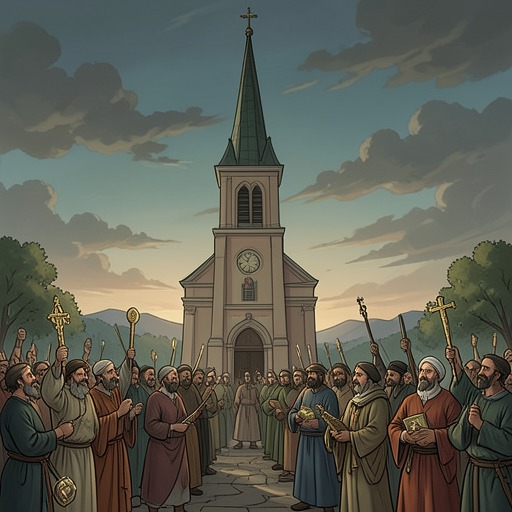
Later, the field draws thousands. It is described as an open-air temple, and many arrive hoping to see Alice or to be close to her holiness; others come as pilgrims from Banfield and farther away. Monsignor, facing the expectant congregation, worries about the sick and invalids among them and doubts that the earlier events can be repeated. The contrast does not prove a supernatural connection between Molly’s past and the crowd’s expectations. Instead, it makes the location’s layered history consequential: the ground associated with Alice’s conception becomes the focus of collective religious hope, while the private circumstances of her birth remain a source of unease and interpretation.