Banfield Field Apparition and Healings
ShrineBanfield Field Apparition and Healings is the Sunday the twenty-eighth episode in which Alice Pagett was followed from St. Joseph’s Church into the adjoining field, appeared to rise above the ground, and was associated with the healing of five people. The event’s force lies both in the reported cures and in the crowd that witnessed them: medical records later supported the illnesses and improvements, while the gathering’s shared expectation turned the field into a destination for pilgrims and the curious. The novel preserves a distinction between what was documented and what remained open to interpretation, especially Alice’s levitation.
Background and gathering
A rumor circulated that Alice had told Father Andrew Hagan and her mother that the Lady wanted to see her again on the twenty-eighth. The date fell on a cold, wet Sunday, but unusually heavy traffic and activity on the village High Street signaled that people were already converging on St. Joseph’s Church. Gerry Fenn arrived with Sue and her son Ben. He carried an Olympus camera and a microcassette recorder, prepared to report on whatever happened, while expecting little beyond a possible follow-up story.
The crowd at the church gate included the merely curious as well as people seeking help. Fenn noticed a teenage girl whose involuntary movements suggested chorea and a frail boy in a wheelchair, surrounded by family members whose hope was difficult to separate from their fear of disappointment. Their presence made the gathering more than a spectacle for a reporter: people had brought sick relatives into the damp field because they believed Alice might help them. Fenn estimated that at least three hundred people were present as the groups spread out beyond the churchyard wall.
Alice at the oak
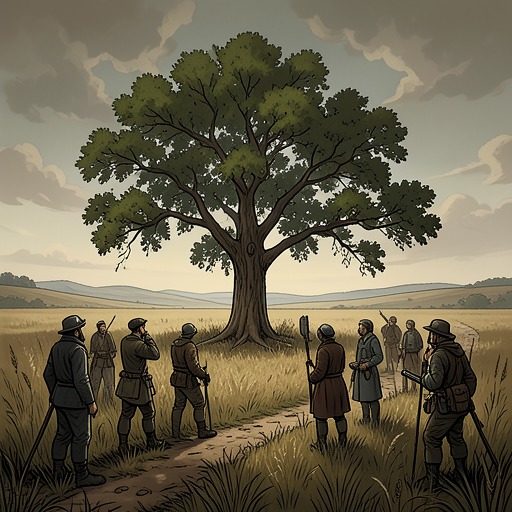
Father Andrew Hagan had instructed Alice’s mother to keep her away that day. The plan changed when a youth rushed into the sacristy to report that Alice was in the field by the tree and that the crowd was following her. Father Andrew Hagan and Monsignor Peter Delgard hurried outside; Fenn followed them through the graveyard and climbed onto the wall for a view. Alice, wearing a blue plastic raincoat, stood looking toward the twisted oak as people brought children and adults with illnesses closer to her.
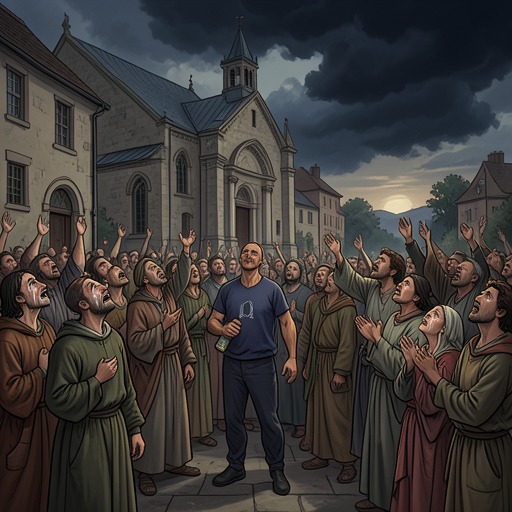
The crowd fell quiet. A strong wind rose around the tree and unsettled the onlookers; some backed away, while others stayed, and many knelt. Father Andrew Hagan tried to move toward Alice, but Monsignor Peter Delgard held him back. When the wind subsided, Alice stood with her arms outstretched, speaking and laughing. The people watching could not make out her words. They then saw her feet clear the ground by two or three inches. She remained suspended without rising further or descending, while the grass moved beneath her feet. Fenn, who had brought a camera in expectation of a story, could not bring himself to use it during the spectacle.
Alice eventually descended gently to the grass. Fenn and other people in the field experienced weakness, and he saw both priests appear confused and unsteady; the narrative does not establish whether their condition had the same cause. The focus then shifted from the apparent levitation to the people who had come seeking cures.
The reported healings
A small boy ran to Alice with gray-black growths on his hands. As he held them up, the growths began to fade; his mother broke away from her husband and embraced him. The teenage girl Fenn had noticed at the church gate approached without the twitching and loss of muscular control that had marked her movements. She examined her hands and legs, then knelt before Alice and wept.
A man with cataracts was guided through the crowd. The cloudiness in his eyes began to clear, and he could again perceive color and shapes, though his sight remained imperfect. A young girl who had not spoken in seven years asked her mother why the man was crying; her words were indistinct, but her mother understood them. The boy who had arrived in a wheelchair also rose and walked with support from adults. His movement came from his own legs, although his wasted muscles meant he was not yet walking unaided.
These were the five cases later identified as the cures associated with the gathering: the boy’s hand growths disappeared, the girl’s chorea-like symptoms ceased, the man’s cataracts cleared in part, the previously silent child spoke, and the wheelchair user regained the ability to stand and walk with assistance. The improvements did not all amount to complete recovery. That distinction matters to the episode’s aftermath, where public claims of miracles met medical records describing both dramatic change and continuing limitations.
Recognition and aftermath
At an emergency parish council meeting on Monday, George Southworth treated the cures as genuine while remaining uncertain about the levitation. He had witnessed the gathering but had not had an unobstructed view of Alice rising from the ground. The five people’s illnesses had, however, been confirmed by their doctors and hospital records. Their conditions had disappeared or improved, although the man’s sight was not yet perfect and the boy still needed support as his leg muscles strengthened.
News of the cures spread internationally, bringing press, television crews, and other media workers to Banfield. Southworth anticipated that St. Joseph’s would become a shrine even if the Catholic Church declined to recognize it as one; the publicity alone, he believed, would attract pilgrims, tourists, and thrill-seekers. The village’s residents were surprised by the attention, but many welcomed the activity and supported plans for expansion. The field’s meaning therefore changed quickly: it was the site of an extraordinary Sunday gathering and, almost at once, the center of a possible pilgrimage economy.
Later services drew crowds numbering in the thousands, placing fresh pressure on Church officials and on the claims attached to Alice. Monsignor Peter Delgard looked out over the sick and disabled at a subsequent service and hoped that the earlier event would not be repeated or become a source of renewed disappointment. In later public descriptions, the field was called the Field of the Holy Virgin, and a procession led by Bishop Caines approached it as an open-air place of worship. The first gathering thus became a precedent as well as an event: the reported healings created expectations that the same place, child, and ceremony might again produce a miracle, though the initial spectacle itself had not settled what Alice’s levitation meant.