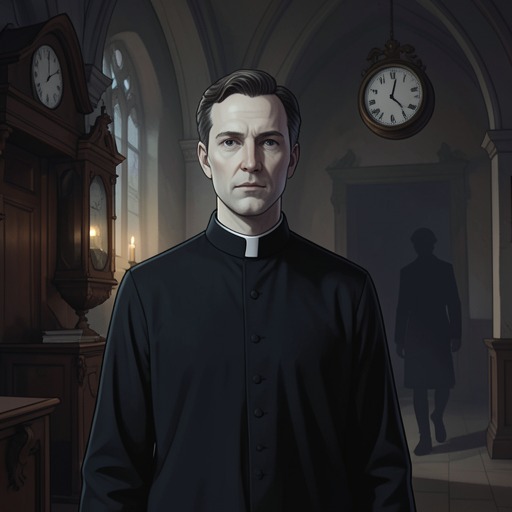
Father Hagan’s Death Attributed to an Evil Force
ShrineFather Hagan’s death becomes a point where Banfield’s public optimism and private fear meet. Southworth regards the priest’s absence as a practical opening in the campaign to establish the shrine, while Gerry Fenn later describes the same death as the work of an evil force that had weakened and then destroyed him. The account offers no settled resolution between those explanations: the death is at once politically useful, physically anticipated, and spiritually ominous.
Background and Political Consequences
Father Hagan had become a problem for Southworth as the supposed miracles drew attention to Banfield. In Southworth’s private calculations, Bishop Caines was more open to persuasion; the bishop had hinted in their discussions that Father Hagan might soon need a long rest because the controversy was too draining for a man in poor health. Southworth regrets the priest’s untimely death, yet immediately recognizes that it has removed a potential obstacle. His regret therefore sits beside calculation rather than displacing it: the death eases the way for a project whose commercial prospects he is already exploiting.
The irony is sharpened by Southworth’s confidence that the miracles can no longer be denied. He sees Father Hagan’s removal as convenient to the shrine’s advance, even as the events surrounding the shrine are beginning to generate a different kind of unease. The priest’s death is thus not treated only as a private loss; it changes the balance of influence around the Banfield claims and exposes how readily religious events can be assessed in terms of institutional and personal advantage.
Decline and Spiritual Unease
The narrative also associates Father Hagan’s death with a visible and spiritual exhaustion. His condition had been apparent before he died: the weariness of his soul showed in his lusterless eyes. This description lends weight to the bishop’s expectation that he would need rest, while leaving the depth and cause of his decline unresolved. The priest’s poor health is established, but it does not by itself account for the atmosphere of fear that gathers around the church and its house.
That fear is set against the apparent success of the miracles. Alice Pagett remains calmly convinced that she has spoken with Mary, while churchmen disagree over whether her visions are divine, whether the cures can yet be called miraculous, and whether her levitation could be explained as an illusion or mass hypnosis. The growing religious interest might seem to promise revival; instead, the priest’s death belongs to a setting in which spiritual depletion persists alongside reports of healing and renewed belief.
The Evil-Force Interpretation
Gerry Fenn gives the death its most explicitly supernatural explanation. He identifies the force around them as evil and says that it weakened Father Hagan before destroying him. Fenn connects this force to what he himself experienced in the crypt the previous Sunday, making the priest’s death part of a continuing pattern of menace rather than an isolated illness. His account is an assertion within the investigation, not a neutral medical finding.
Fenn’s interpretation is disputed. He tells Gerry Fenn’s companion that there is nothing evil about the miracles; the exchange sets the reported healings against the possibility that a hostile force is operating around them. The death consequently remains a hinge in the story’s competing readings of Banfield: to Southworth, it has cleared a political and practical obstruction; to Fenn, it demonstrates that the force surrounding the shrine can attack and destroy. Its significance lies in the unresolved coexistence of those readings, as the supposed signs of grace multiply while fear deepens around the church.