Banfield’s Marian Candlelight Procession and Open-Air Mass
ShrineBanfield’s Marian Candlelight Procession and Open-Air Mass is a mass pilgrimage and memorial service that draws thousands to St. Joseph’s Church. Requested in the name of Alice Pagett’s vision of the Lady, it brings worshippers, invalids, curious visitors, church officials, and local promoters together in a ritual whose swelling collective fervor becomes central to Gerry Fenn’s understanding of the danger surrounding the shrine.
Background and Purpose
The service follows the deaths of Father Hagan and Monsignor Delgard. Alice Pagett asks the Church authorities to hold a special service for the two priests and says the Lady of the Vision wants a candlelight procession through the village, followed by a revelation. The Church agrees, although it does not expect a revelation; the tribute is considered fitting for priests who served the Church and, in Father Hagan’s case, died in an explosion.
The procession takes place amid Banfield’s transformation into a destination. Earlier, local businessmen had described the village’s limited attractions and the small benefit it received from summer visitors who treated it as a base for trips to the Sussex countryside and Brighton. They saw a possible return in investment and development, and George Southworth privately stands to gain from the shrine’s commercial growth. By the night of the service, traffic is backed up toward Banfield and roadside sellers offer food, drinks, trinkets, and religious goods. Pilgrimage has become both a devotional gathering and a public attraction.
Arrival and Gathering
The scale of the event is evident before Fenn reaches the church. He abandons his car when traffic makes progress impractical and walks at least a mile toward the village. A searchlight above the shrine is visible apart from the wider glow of Banfield. Pilgrims travel in coaches, minibuses, cars, motorcycles, and bicycles; some pray or sing hymns, while others come for curiosity, excitement, or simply because there is little else to do. Fenn recognizes a peculiar intensity in the gathering and compares it with the atmosphere around the 1981 Royal Wedding and Pope John Paul II’s visit the following year, while sensing that the crowd at Banfield possesses a potency of its own.
The journey through the village becomes a slow passage through a crowd. More stalls line the road than before, and police appear occupied with managing the numbers rather than stopping unauthorized trading. Near the church, Fenn takes about twenty minutes to push through five hundred yards of people. The congestion and commercial activity are not separate from the religious occasion: they are part of the same gathering, in which sacred expectation attracts both pilgrims and spectators.
The field had already begun filling hours before the Mass was due to start. Benches near the altar and scaffolded centerpiece were especially desirable, while other seats were reserved for church and civic dignitaries and religious associations. Some people wanted to see the Miracle Girl; others hoped to sit close enough to Alice Pagett to feel the benefit of her holiness. Invalids and their companions negotiated the soft, churned earth in wheelchairs, and stewards recognized that future services would need a designated area for them. The crowd’s practical arrangements reveal the strain placed on the field by a pilgrimage expanding faster than its facilities.
Procession and Service
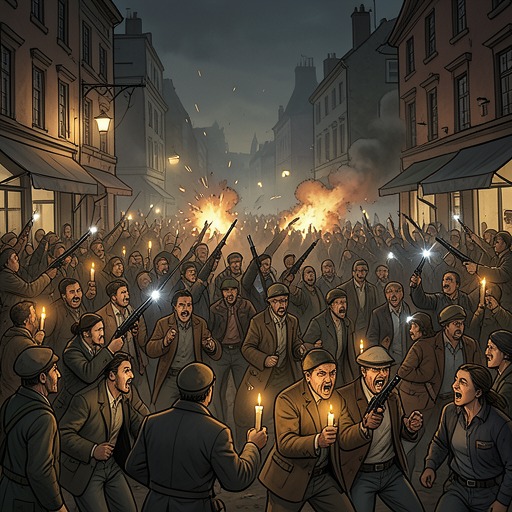
The event is also mediated as a broadcast. A production crew tries to frame Alice Pagett, the altar, and the tree, while technical problems disrupt the picture and sound. A reporter introduces the Field of the Holy Virgin as the procession approaches, describing a gathering that includes Banfield residents and visitors from farther afield, some of whom say the village has led them toward a deeper understanding. The transmission deteriorates before the ceremony can be fully presented to its remote audience. Inside the field, the procession’s impact is immediate and physical: flashlights flicker across the leaders, altar servers carry candles, and worshippers join the singing as the marchers enter.
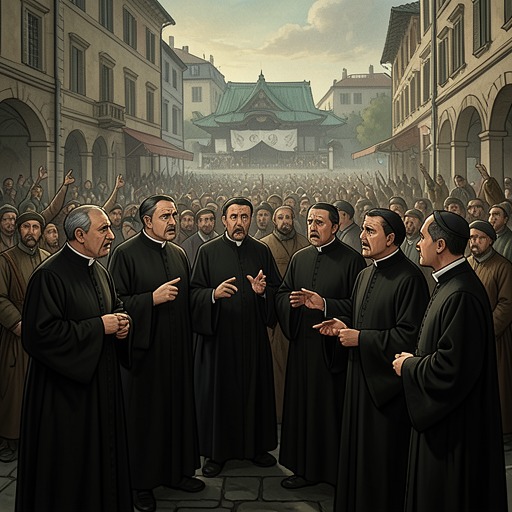
Bishop Caines leads the procession with priests and nuns, followed by Alice and her mother. The crowd rises to see the girl, though Fenn cannot get a clear view over the raised candles and banners. When the procession reaches the central platform, Bishop Caines takes his place by the altar and invites Alice and her mother to sit beside him. George Southworth surveys the congregation with an expression Fenn reads as satisfaction rather than devotional rapture. The contrast places the commercial ambitions surrounding the shrine alongside the faith of those who have come seeking comfort or healing.
The hymn grows louder as the congregation settles, then gives way to a near-total hush. Before the Mass begins, some people faint or collapse, including a nun; those nearby catch them. Sue sways, and Fenn, feeling dizzy himself, clutches at her. Ben reaches toward his mother and brushes Fenn’s cheek. The dizziness immediately leaves Fenn, although Ben shows no visible distress. This brief reversal gives the gathering an intimate counterpart to its mass spectacle: amid a crowd affected by a shared emotional atmosphere, the child’s touch appears to relieve the reporter rather than absorb his weakness.
A young priest opens the service with the Sign of the Cross and dedicates the Mass to Father Hagan and Monsignor Delgard, honoring their work for the Church. Microphones whine during the preliminaries, interrupting the solemnity, but candles across the field are then lit. Their many points of light form a bright ring around the altar as the choir begins another hymn. The memorial service thus proceeds within an atmosphere that is at once carefully organized and increasingly charged.
Fenn’s Interpretation and Significance
Fenn connects the crowd’s shared emotional intensity to the force he believes lies behind Alice’s healings. His interpretation is shaped by the historical Chronicle of Thomas Woolgar, whose account describes Sister Einor, the disappearance and deaths of three children, the villagers’ violence against her, and the curse she pronounced before her execution. The manuscript also depicts Woolgar as a compromised witness who admits his own participation while trying to explain his guilt through supernatural influence. Its account is not independent proof of Fenn’s conclusions, but it gives him a historical pattern through which to read the present gathering.
As Fenn approaches the shrine, he becomes convinced that collective psychic energy is the source of Alice’s power, as it had been Einor’s. The procession makes that theory visible as a social event: thousands converge, their expectations and emotions gathering around Alice and the altar. Yet the same convergence can be read in more than one way. The sick and their families arrive with hope; the Church provides a formal service; local interests benefit from the crowds; and curious visitors join without necessarily sharing the pilgrims’ beliefs. The ceremony therefore holds devotion and spectacle, care and commerce, in uneasy proximity.
The Mass does not resolve those tensions in the episode covered here. It intensifies them. The crowd’s reverence, the reporter’s suspicion, the Church’s public tribute, and the commercial life around the field all occupy the same ritual space, while Fenn watches for evidence that his explanation is true. The gathering’s significance lies in that convergence: Banfield’s shrine has become not only a place where people seek healing, but also a stage on which belief, skepticism, institutional authority, and collective expectation meet.